Andrew Ng's Agentic AI Course: Core Methodology for Building Intelligent Agent Systems
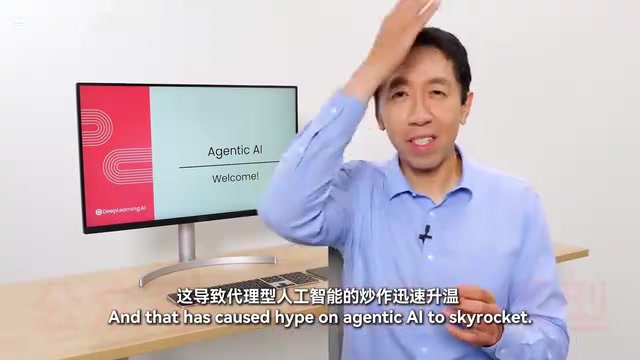
Andrew Ng cuts through agentic AI hype to focus on evals and error analysis as the core engineering methodology.
This article covers the core ideas from Andrew Ng's Agentic AI course. He acknowledges that "agentic" has been heavily over-marketed, but genuinely valuable agent applications — spanning customer support, deep research, legal processing, and medical assistance — are growing substantially. The course's central argument: what separates expert developers from average ones isn't prompt-writing ability, but whether they can build a disciplined engineering process around evals and error analysis. Only this methodology can move an agent from "seems to work" to stable, reliable, and scalable.
Starting with an Overused Buzzword
At the beginning of this Agentic AI course, Andrew Ng candidly admits that when he coined the term "agentic" to describe an important and rapidly growing trend in how people build LLM applications, he never anticipated that marketers would turn it into a sticker slapped on nearly every product in sight. The result: hype around agentic AI skyrocketed.
This hype is palpable everywhere. Any product labeled "Agent" seems to command extra attention, yet the gap between genuinely valuable applications and marketing buzzwords keeps widening. Ng reminds learners: set aside the hype — the number of truly useful applications built with agentic AI is also growing fast, just not as dramatically as the hype suggests. That statement alone sets the tone for this course — pragmatic and no-nonsense.
What Agentic Workflows Can Actually Do
Ng outlines several real-world use cases where agentic workflows are already being deployed — not theoretical ideas, but directions he and his team are actively pursuing:
- Customer support agents: Handling user inquiries and automatically completing multi-step service processes
- Deep research: Assisting in writing insightful research reports
- Legal document processing: Parsing complex legal documents with dense clauses
- Medical diagnostic assistance: Analyzing patient-provided information and suggesting possible diagnoses
He emphasizes that across many of the teams he works with, numerous projects simply could not exist without agentic workflows. The weight of that statement is significant — agents aren't a nice-to-have feature, but the critical technical path that transforms certain applications from "impossible" to "achievable."

Why This Is One of the Most Valuable AI Skills Right Now
Ng calls "knowing how to build applications with agentic workflows" one of the most important and valuable skills in AI today. The logic behind this judgment is clear: as foundation model capabilities improve, the barrier to simply calling a model keeps dropping. The real competitive differentiation has shifted to how you orchestrate models, tools, and processes.
Mastering this skill brings not just job opportunities, but also the ability to independently build outstanding software. For developers, this means upgrading from "knowing how to use an API" to "knowing how to design a system."

The Core Methodology: Evaluation-Driven Development and Error Analysis
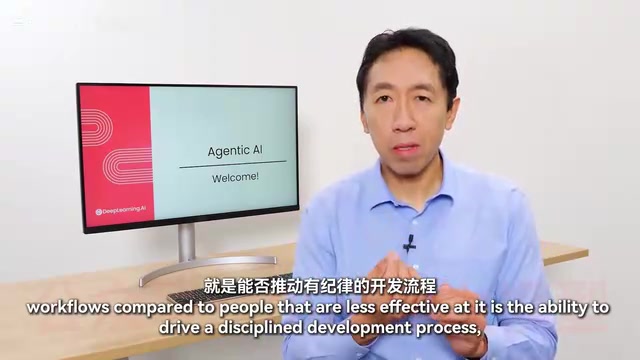
The most valuable insight in this course is Ng's observation about what separates experts from average developers. He points out that the biggest difference between people who are truly skilled at building agentic workflows and those who are less effective comes down to whether they can drive a disciplined development process — specifically, one built around evals (evaluations) and error analysis.
Evaluations (Evals)
Agentic systems often involve multiple steps and multiple model calls — a problem at any single stage can cause the final result to fail. Without systematic evaluation, developers are left debugging by intuition, unable to tell whether a change actually made things better or worse. Building a quantifiable evaluation framework is the dividing line between an agent that "seems to work" and one that is genuinely stable and reliable.
In traditional software development, evals correspond to unit tests and integration tests — but in agentic systems, the complexity is significantly higher. Because LLM outputs are probabilistic, the same input can produce different results across runs. Evaluation therefore can't just check "right or wrong" — it requires designing test sets that cover diverse inputs, defining quantitative scoring criteria (e.g., accuracy, task completion rate, hallucination frequency), and tracking performance changes across version iterations. Common evaluation approaches include: comparison against human-annotated golden datasets, using another LLM as a judge (LLM-as-judge), and end-to-end task success rate tracking. Without this framework, every time a developer tweaks a prompt or swaps a model, they can only subjectively feel that "things seem better" — they can't make repeatable, trustworthy engineering judgments.
Error Analysis
When an agent fails, the key isn't to blindly adjust prompts — it's to identify exactly which step and which type of input caused the failure. Disciplined error analysis makes the direction of optimization clear and prevents wasted effort on irrelevant areas.
Ng views this methodology as the core dividing line that separates developer skill levels. This is also what distinguishes this course from the many "learn to write prompts" beginner tutorials — it focuses on an engineering-first, sustainable development paradigm.
An agentic workflow combines large language models with external tools, memory modules, and multi-step planning capabilities. The model autonomously decides which tools to call and in what order to execute tasks, rather than having developers hardcode each step of the logic. Unlike a single "question-and-answer" call, models in a workflow must repeatedly perceive their environment, form plans, and take action — a loop commonly referred to as the ReAct (Reasoning + Acting) or Plan-and-Execute paradigm. A typical architecture contains four core components: a Planner, an Executor, a Tools set (e.g., search, code interpreter, database queries), and a Memory module (short-term context and long-term vector storage). Because so many components are involved, a failure in any single link gets amplified across the chain — which is precisely why systematic evaluation and error analysis are far more critical in agentic workflow scenarios than in single-model calls.
Who This Course Is For
In terms of positioning, this course targets learners who want to systematically master agentic development. It covers both foundational LLM knowledge and advanced engineering practices. The course includes slides and code, emphasizing hands-on learning — making it ideal for developers with some programming background who want to actually ship agent-powered products.
For those who have been bombarded with agentic AI concepts but don't know where to start, Ng's no-hype, methodology-first approach may offer more long-term value than chasing flashy demos. Real capability isn't about how many buzzwords you can drop — it's about whether you can use a rigorous evaluation and analysis process to polish an agent application into something usable, reliable, and scalable.
Related articles

LynnReal-Omni: 32B Unified Video Diffusion Model Goes Open Source with Multi-Task Coverage in Four Steps
LynnReal-Omni is a 32B unified video diffusion model on MiniMax H3, covering text-to-video, pose guidance, style transfer, restoration in 4 steps. Flash version generates 540p video in 377ms on one H100.

Anthropic Co-Founder: AI 'Kill Switch' May Need to Be Mandatory by Law
Anthropic's co-founder tells the BBC that AI 'kill switches' may need to be legally mandated. We analyze the industry logic, technical challenges, and the tension between regulation and innovation.

The AI Data Center Boom Is Colliding With Cities Scarred by Heavy Industry
The AI data center boom is clashing with post-industrial communities. Philadelphia's case reveals structural conflicts between AI growth, energy use, water, and environmental justice.