Andrew Ng's "AI for Everyone" Explained: The Essential Course for AI Beginners

Andrew Ng's "AI for Everyone" explains ANI vs. AGI and teaches non-technical people to build AI judgment.
The article introduces Andrew Ng's non-technical AI literacy course "AI for Everyone," noting that its core value lies in building judgment rather than teaching parameter tuning. The course first corrects misconceptions by splitting AI into Artificial Narrow Intelligence (ANI) and Artificial General Intelligence (AGI), emphasizing that almost all current progress comes from ANI while AGI remains distant, and fears of "evil robots" lack basis. It then unfolds over four weeks: technical understanding, project screening and implementation, organizational transformation (AI Transformation Playbook), and social impact (algorithmic bias, employment, developing economies). The article particularly stresses the value of failure cases—looking only at success stories leads to misjudging machine learning's capability boundaries; deep learning, though the main driver of the recent wave, is mainly good at narrow pattern recognition tasks. McKinsey estimates AI will create about $13 trillion in additional value, with the majority outside software in traditional industries. The article concludes with audience guidance: those with modeling skills can skip it, while product managers, business leaders, and ordinary users should watch it in full.
Why This Course Is Worth Watching for Everyone
After being reposted on Bilibili, Andrew Ng's "AI for Everyone" quickly went viral, marketed with the tagline "more fun than binge-watching TV shows"—but its value goes far beyond entertainment. This is a non-technical AI literacy course aimed at people who don't want to write code but need to understand how AI affects their work and life. The course opens by laying out three core questions: what actually lies behind the AI buzzword, how ordinary people can use AI to solve their own problems, and how society should respond to AI's impact.
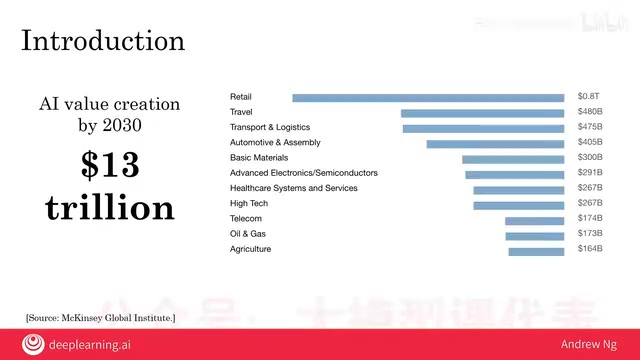
In the course, Andrew Ng cites McKinsey Global Institute's estimate that AI will create approximately $13 trillion in additional value in the future. He particularly emphasizes that while the software industry is already reaping AI's benefits, the larger value increment lies in traditional sectors such as retail, travel, transportation, automotive, materials, and manufacturing. He even joked that the only industry he couldn't imagine AI disrupting was haircutting—until a robotics professor friend told him: "A robot can cut your hair." Behind this anecdote is a serious judgment: there is virtually no industry where AI cannot have a massive impact.
ANI vs. AGI: Unpacking the Two Meanings of "AI"
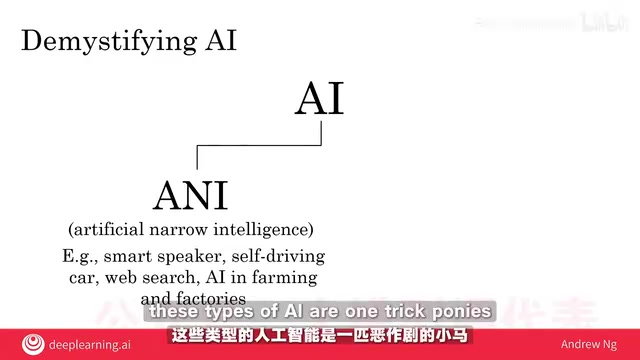
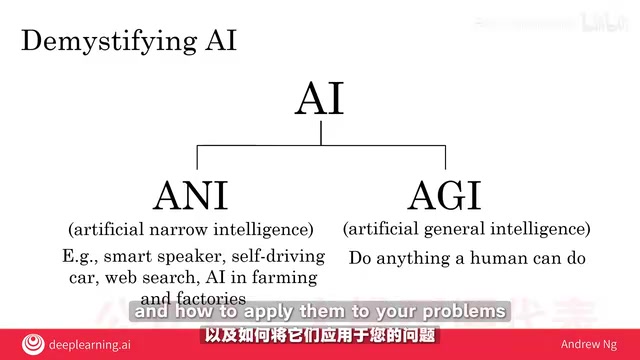
The most critical cognitive correction in the first week of the course is splitting "AI" into two completely different concepts. Andrew Ng points out that almost all visible progress today belongs to Artificial Narrow Intelligence (ANI)—smart speakers, autonomous driving, search ranking, specialized AI in agriculture or factories are essentially all "one-trick pony" tools. But public discussion often mistakenly grafts ANI's progress onto Artificial General Intelligence (AGI), generating irrational fears of "evil robots about to take over humanity."
His judgment is direct: ANI is advancing rapidly, while AGI has seen virtually no substantive progress. AGI requires multiple technological breakthroughs and may take decades, centuries, or even longer. Therefore, excessive worry about AGI is unnecessary; what we should really do is learn to apply ANI to our own problems.
This distinction is especially important for non-technical decision-makers. When you hear "AI can do anything," first ask: is this ANI or AGI? If it's ANI, what is its "one trick"? Where are its boundaries?
Artificial Narrow Intelligence (ANI) refers to systems that can only exhibit intelligence within a specific, limited task scope. Its core characteristic is "closed task boundaries": smart speakers only handle voice commands and Q&A, autonomous driving only handles road driving, search ranking only handles relevance matching—once outside the designed scenario, capability drops sharply. ANI's "narrowness" doesn't mean weak capability, but rather a narrow scope of application. All current commercial AI, including large language models, still strictly belongs to the ANI category: they perform amazingly within their training distribution but lack cross-domain autonomous transfer and goal-setting capabilities.
Artificial General Intelligence (AGI) refers to systems that can reach or exceed human level on any cognitive task and possess autonomous learning and transfer capabilities. There is no consensus in academia on the definition and implementation path of AGI, which is an important backdrop for Andrew Ng's judgment that "AGI has seen virtually no substantive progress": without recognized evaluation standards, progress is difficult to measure. For non-technical decision-makers, the key is not to debate when AGI will arrive, but to identify which type is being discussed—mistaking ANI's capability ceiling for AGI's starting point is the root of most current AI anxiety and investment misjudgment.
The Four-Week Course Map: From Understanding to Implementation
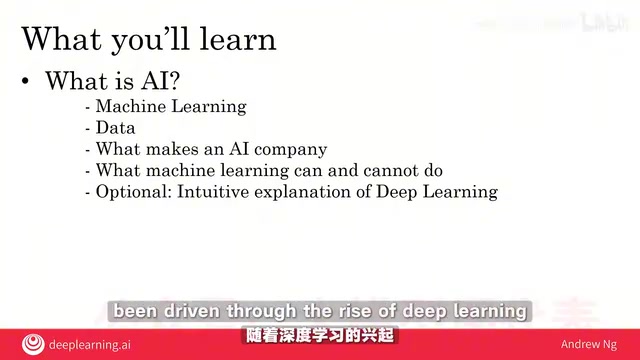
The course structure is very clear, with each week addressing a different level of questions. Week 1 builds technical intuition: what machine learning is, what data is valuable, what makes a company an AI company, and what machine learning can and cannot do. Andrew Ng specifically emphasizes that media and papers only report success stories; failure cases are almost never discussed, yet it is precisely failure cases that help people make more accurate feasibility judgments.
Week 2 moves to the project level: what an AI project actually feels like to execute, and how to screen projects that are technically feasible and commercially valuable. Week 3 enters the organizational level, covering the AI Transformation Playbook, how to build AI teams, and how to build complex AI products. Week 4 discusses social impact: algorithmic bias and its mitigation, how AI affects developing economies, and how it affects employment.
Andrew Ng makes a rather bold promise in the course: after four weeks, your understanding of AI technology and AI transformation will exceed that of most CEOs at large companies. The confidence behind this claim is that he isn't teaching parameter tuning, but judgment—knowing what should be done, what shouldn't, and how to organize resources to do it.
AI Transformation Playbook is a corporate AI transformation methodology that Andrew Ng summarized based on his practical experience at Google Brain, Baidu, and Landing AI. Its core steps include: first executing several persuasive pilot projects to build internal confidence, then forming a centralized AI team, then providing extensive AI training, followed by formulating a coherent AI strategy, and finally developing internal and external communication mechanisms. It matters because most corporate transformation failures are not due to technology but to wrong sequencing—scaling up broadly without early success stories, or letting departments fight separately without a unified team. Week 3 of the course covers exactly this organizational rhythm of "prove first, replicate second, scale last," and for those who need to secure resources from management, it provides an action checklist that can be cited directly.
Why Deep Learning Deserves Its Own Section
The last two optional videos in Week 1 are dedicated to an intuitive explanation of deep learning (neural networks). Andrew Ng views the rise of deep learning as the main driver of the recent machine learning wave, but he doesn't package it as a master key; instead, he emphasizes that deep learning is particularly good at a set of narrow tasks. For non-technical readers, understanding "what pattern recognition neural networks are good at and what reasoning they are not good at" is far more useful than memorizing the number of network layers.
This is also the consistent style of the entire course: no formula dumping, no myth-making, putting technology back where it belongs. For those who want to promote AI implementation in their companies but don't know where to start, this course provides a language system they can take to meetings.
Neural networks consist of multiple layers of interconnected computational units, where each layer performs a weighted transformation of the input and passes it to the next layer; many layers means "deep." Its power lies in automatically abstracting features layer by layer from raw data: in image recognition, shallow layers learn edges and textures, while deep layers learn object parts and overall shapes, without manual feature design. This explains why deep learning far outperforms traditional methods on perceptual tasks (images, speech, natural language), but also explains its limitations: it is essentially a powerful pattern matcher, good at finding statistical regularities in large amounts of labeled data, but not good at tasks requiring strict logical deduction, common-sense reasoning, or few-shot generalization. For non-technical readers, remembering that "the boundaries of deep learning are determined by data and task type" has more decision-making value than understanding the mathematical details of backpropagation.
Who Should Watch and Who Can Skip
If you can already independently train models and tune and deploy parameters, this course's technical depth is insufficient. But if you are a product manager who needs to judge AI project priorities, a business leader who wants to introduce AI tools, or simply an ordinary user who doesn't want to be led around by news headlines, it is worth watching from start to finish. The Bilibili version with Chinese and English subtitles lowers the language barrier, but the real barrier is after class: only by taking the judgment frameworks from the course and applying them to your own work can you say you didn't watch in vain.
Related articles

Deleted Reddit Post Sparks Debate Over AI Content Moderation
A Reddit post removed with only a 'Removed by Reddit' notice highlights AI content moderation's transparency gaps, misjudgment risks, and appeal challenges for platforms and creators.

DSH + Ollama Local LLM Deployment in Practice: Free Chat with Da Fei Yu
Bilibili creator tests DSH + Ollama local LLM deployment end to end: Ollama install, Xunlei-accelerated downloads, ModelScope GGUF model import, DSH custom API address setup, and a comparison of Qwen 3.5 4B, 8B, Gemma, and other models on 8GB VRAM, with advice on choosing local deployment vs. API calls.

Tested: A $899 Mac Mini vs. a $200/Month AI Subscription
Real-world test of whether an M4 Mac mini can replace a $200 AI subscription: 16GB can't fit large models, and both speed and quality fall short—but privacy, no caps, and near-zero running costs make it an ideal host for an always-on agent. Includes buying advice per configuration and money-saving strategies.