Andrew Ng's AI for Everyone: Understanding the Truth and Limits of Artificial Intelligence

Andrew Ng's AI for Everyone demystifies AI by separating hype from reality for non-technical audiences.
Andrew Ng's AI for Everyone course helps non-technical learners build a rational AI worldview. It clarifies the critical difference between narrow AI (ANI) and general AI (AGI), explains why AGI fears are premature, and shows how deep learning is driving real-world transformation across industries — from software to manufacturing and beyond.
Article Content
Artificial intelligence has become the hottest — and most misunderstood — topic of our time. Amid an endless flood of news, hype, and fear, it's hard for ordinary people to distinguish real progress from pure imagination. AI for Everyone, a course by leading AI scholar Andrew Ng, is designed specifically for non-technical audiences. Its goal: cut through the noise and help everyone build a rational understanding of AI. This article distills the key insights from the course's first week.
AI Is Creating Enormous Value — And Not Just in Software
Ng opens the course by citing research from the McKinsey Global Institute (MGI): by 2030, AI is projected to generate an additional $13 trillion in value annually. This figure makes the commercial potential of AI unmistakably clear.
MGI is McKinsey & Company's business and economics research arm, known for publishing influential forecasts on technology and the economy. Its 2018 report, Notes from the AI Frontier: Modeling the Impact of AI on the World Economy, systematically assessed AI's potential value across 16 industries — including agriculture, manufacturing, finance, and healthcare. The $13 trillion figure represents cumulative GDP growth, roughly equivalent to China's total GDP at the time, underscoring that AI's economic impact has already surpassed the contribution of any single technology in previous industrial revolutions.
What you might have missed: Ng specifically emphasizes that while AI has already created enormous value in the software industry, much of its future value will come from outside software. He points to retail, travel, transportation, automotive, materials, and manufacturing — arguing that nearly every industry will be profoundly transformed by AI in the coming years.
He also shares an entertaining story: he and his friends challenged each other to name an industry AI wouldn't significantly impact. His best answer was "haircutting" — because robots can't easily automate a haircut. But a robotics professor immediately pushed back: "Most people's hairstyles would be hard for a robot to handle — but yours, Andrew, a robot could manage just fine." The joke perfectly illustrates just how far-reaching and unpredictable AI's influence can be.

Cutting Through the Hype: ANI and AGI Are Fundamentally Different
One of the most illuminating ideas in the course is Ng's sharp distinction between two very different AI concepts. He argues that much of the hype surrounding AI stems from people conflating the two.
The distinction between ANI (Artificial Narrow Intelligence) and AGI (Artificial General Intelligence) was first systematically articulated by AI research pioneer Nick Bostrom and later popularized by Ben Goertzel, among others. The gap between them isn't a matter of degree — it's a difference in kind. No matter how large today's deep learning models become, they are fundamentally performing pattern matching on training data distributions, not genuine reasoning or understanding. That is the unbridgeable divide between ANI and AGI.
Narrow AI (ANI): Remarkable Value in a Single Domain
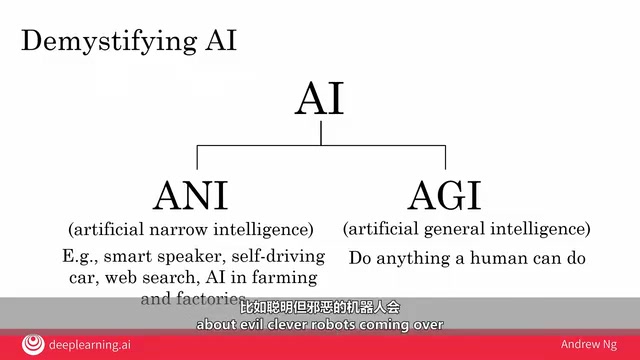
Ng points out that virtually all AI progress we see today falls under Artificial Narrow Intelligence (ANI) — systems that are very good at doing one specific thing. Think smart speakers, self-driving cars, web search, or targeted applications in agriculture and manufacturing. ANI refers to systems optimized for a single task; every commercial AI product today fits this description, with capabilities strictly bounded by training data and task definitions.
He colorfully calls these systems "one-trick ponies." Narrow in scope, yes — but when applied to the right use case, the value they create can be extraordinary. The ongoing breakthroughs in ANI are the true engine powering the current AI wave.
General AI (AGI): A Distant Horizon
The other concept is Artificial General Intelligence (AGI) — building systems that can perform any intellectual task a human can, or even surpass human intelligence across the board. AGI implies cross-domain reasoning, autonomous learning, generalization to unknown tasks, and true adaptability — capabilities that are fundamentally different from how any existing AI system works. Ng is candid: while ANI has seen enormous progress, there has been virtually no meaningful advancement toward AGI.
The danger is that ANI's rapid progress makes people think AGI is also rapidly approaching — fueling irrational fears about "evil killer robots taking over humanity." Ng considers AGI a worthy long-term research goal, but believes it may still be decades, centuries, or even millennia away, and is not something to lose sleep over.
A Grounded View: What AI Can and Can't Do
Ng emphasizes a point that often gets overlooked: media outlets and research papers tend to highlight AI's successes because failure stories don't make for compelling headlines. But to develop an accurate picture of AI, we need to see both its wins and its limitations.
Only by understanding what machine learning can and cannot do can everyday people and business leaders make smarter decisions — including whether and where to bring this technology into their own work. This pragmatic "neither blindly follow nor panic" mindset is the core value the entire course aims to instill.
Deep Learning: The Technical Foundation of Today's AI Wave
Ng goes on to explain that much of the recent AI progress is largely thanks to the rise of deep learning — sometimes called neural networks.
Deep learning is a subfield of machine learning built on multi-layer artificial neural networks. The idea dates back to the 1940s, but the real explosion came in 2012, when Geoffrey Hinton's team and their AlexNet model won the ImageNet image recognition competition by a stunning margin, marking the dawn of the deep learning era. Hinton, Yann LeCun, and Yoshua Bengio were awarded the 2018 Turing Award for their foundational contributions. Deep learning's rise depended on three factors maturing simultaneously: the availability of massive labeled datasets, exponential growth in GPU parallel computing power, and engineering-ready training algorithms like backpropagation. It's worth noting that Ng himself was a key figure in popularizing deep learning — most notably through the "cat face recognition" project he led at Google Brain, and later through the Deep Learning Specialization he created on Coursera.
The rest of the first week digs into a clear explanation of deep learning, helping learners understand why it can handle such a wide range of intelligent tasks. Ng also corrects a common terminology mistake: the most impactful technology today is specifically deep learning, not just "machine learning" as a general term. Understanding this distinction helps us more accurately trace the real sources of AI progress.
Course Overview: From Understanding to Implementation to Societal Impact
AI for Everyone unfolds over four weeks, each building on the last to form a complete framework:
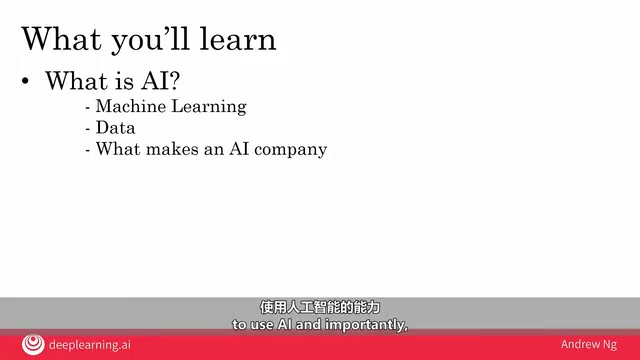
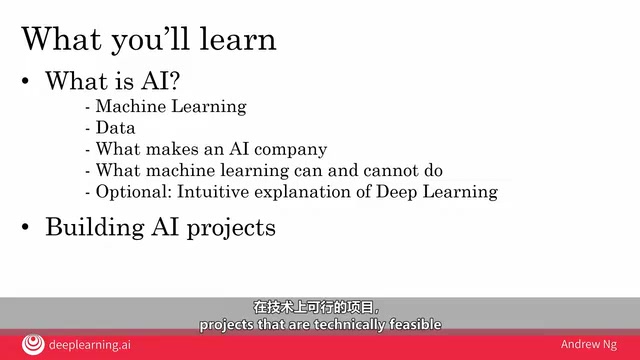
- Week 1: What is AI, machine learning, and data — understanding what kinds of data are valuable, what aren't, and what makes a company truly "AI-first."
- Week 2: How to build valuable AI projects, and how to evaluate both technical feasibility and business value.
- Week 3: How to lead an AI transformation within an organization, with a practical walkthrough of the "AI Transformation Playbook."
- Week 4: AI's broader impact on society — including how to identify and reduce bias in AI systems, and AI's effects on economic development and employment.
Bias in AI systems is one of the most pressing issues in AI ethics today. It typically originates at three levels: historical discrimination embedded in training data (e.g., hiring data that systematically underrepresents women), model architectures that underfit the characteristics of certain groups, and inequitable evaluation metric design. Notable cases include Amazon's recruiting AI, which downgraded female candidates because its training data was predominantly male, and facial recognition systems that perform significantly worse on darker-skinned individuals compared to lighter-skinned ones — a phenomenon documented by MIT Media Lab researcher Joy Buolamwini. This is precisely why AI for Everyone dedicates a section to it: understanding AI bias isn't just a technical problem — it's a systemic issue of algorithmic fairness and social equity.
Ng's hope is that after completing these four weeks, learners will understand AI better than many senior executives at large companies — and will be equipped to help themselves, their organizations, or others navigate the AI transformation ahead.
Conclusion
The greatest value of AI for Everyone isn't teaching you to write code — it's helping you develop a clear-eyed worldview about AI. In an era where AGI panic and AI-can-do-everything hype coexist, Ng's crisp distinction between ANI and AGI, combined with an honest look at both AI's successes and failures, gives ordinary people a key to understanding artificial intelligence on their own terms. For anyone who wants to make rational decisions in the age of AI — rather than being swept along by the current — this kind of foundational education is genuinely valuable.
Key Takeaways
Related articles
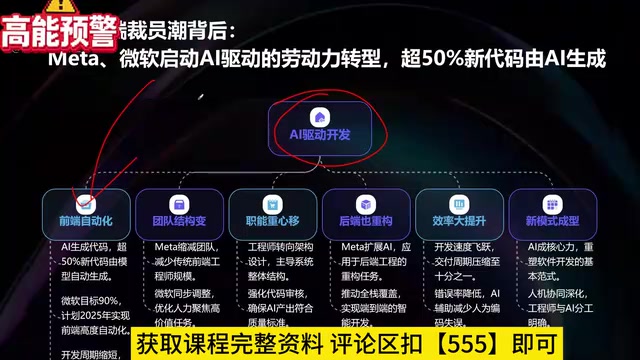
What Is Vibe Coding? The AI Programming Skill Every Developer Needs
What is Vibe Coding? Learn how AI programming is reshaping dev teams, why traditional programmers face displacement, and why Cursor & Claude Code matter.
Making Rocks Think: A Philosophical Exploration of Generative AI and Information Compression
From a viral Reddit post to deep AI theory: why compression equals understanding, the Library of Babel thought experiment, semantic compression, and the Hutter Prize.
Irregular Warns: Four AI Lab Security Breaches Traced to the Same Root Cause
Irregular reveals four AI lab security breaches share a single root cause, exposing systemic risks from technology stack homogeneity across the AI industry.