Andrew Ng × Anthropic: A Practical Guide to Claude Code and Its Core Methodology
Andrew Ng and Anthropic's hands-on Claude Code course covers RAG, data analysis, and Figma-to-frontend with key agent best practices.
Andrew Ng and Anthropic have launched a comprehensive Claude Code course tracing AI programming's evolution from chatbots to autonomous agents. It covers context management, MCP tool integration, and CLAUDE.md architecture through three real projects: a RAG chatbot, Jupyter-based e-commerce analysis, and Figma-to-frontend conversion.
From Code Completion to Autonomous Agents: A Paradigm Shift in AI Programming
The Claude Code course jointly produced by Andrew Ng and the Anthropic team offers a deep dive into how to harness this AI programming tool in real engineering scenarios. From the very first lesson, the course highlights a critical trend: AI-assisted programming is undergoing a profound paradigm shift.
The evolution of AI programming tools has gone through three distinct phases. The first was conversational Q&A, typified by ChatGPT — developers would occasionally query a large model for code snippets, essentially using it as an enhanced search engine. The second phase was marked by GitHub Copilot (launched in 2021), which used OpenAI's Codex model to deliver real-time autocomplete inside the IDE, embedding AI into developers' everyday editing workflow. The third phase is the era of autonomous coding agents — Claude Code, Devin, and Cursor Agent — which don't just generate code but can independently invoke tools, read and write to the file system, execute terminal commands, handle Git operations, and complete end-to-end engineering tasks. The core drivers of this leap are the dramatic expansion of LLM context windows (from the early 4K tokens to today's 200K tokens) and the maturation of tool-calling (Function Calling / Tool Use) capabilities, enabling models to decompose, plan, and incrementally execute complex tasks much like a human engineer.
From sporadically querying a model in the early days, to GitHub Copilot-style autocomplete, to AI coding agents that can now autonomously execute complete tasks — the autonomy of these tools keeps rising. The course considers Claude Code's release "an absolute leap forward" in this progression, significantly expanding the scope and scale of tasks a programming assistant can complete independently.
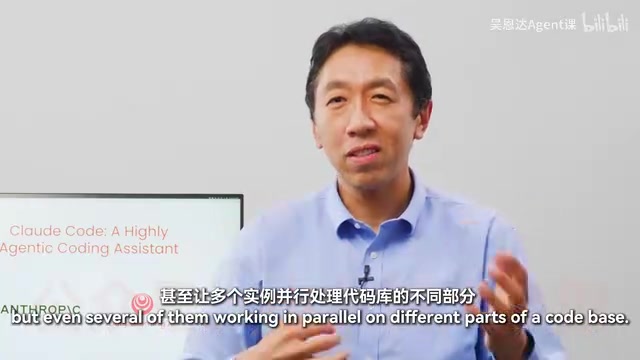
Many developers are surprised to find that after assigning a task, Claude Code can complete it autonomously within minutes. Going further, some engineers are already running multiple Claude Code instances in parallel, advancing different workflows simultaneously. This multi-instance collaboration model is redefining the productivity ceiling for individual developers.
Core Methodology: Context Is Everything
The most consistently emphasized best practice throughout the Claude Code course is: provide Claude Code with clear, explicit context. This is the fundamental prerequisite for getting high-quality results from the tool.
This methodology operates on three levels:
- Point to relevant files: Explicitly tell Claude Code which files are relevant to the current task, avoiding aimless exploration across a large codebase.
- Describe requirements clearly: Use precise language to articulate the target functionality and expected behavior, minimizing ambiguity as much as possible.
- Extend tool capabilities correctly: Connect MCP (Model Context Protocol) servers and external tools to give Claude Code execution capabilities that go beyond basic conversation.
MCP is a standardized protocol that Anthropic open-sourced in late 2024, designed to solve the interoperability problem between AI models and external tools and data sources. Before MCP, every AI application had to write its own integration code for different tools (databases, APIs, file systems, etc.), and the lack of a unified standard led to massive duplicated effort. MCP draws on the design philosophy of LSP (Language Server Protocol) — the same standard that enabled intelligent code suggestions across different IDEs for various programming languages — and formalizes the connection between AI models and external capabilities into a Client-Server architecture. An MCP Server can expose three types of capabilities: Tools, Resources, and Prompt templates. Claude Code, acting as an MCP Client, can dynamically discover and invoke these capabilities, greatly expanding the agent's range of action.
The value of this methodology lies in the fact that even seasoned users who are already using Claude Code have significant room to improve if they haven't systematically mastered these practices. The course instructor Eli presents these techniques in a "complex and systematic" way specifically to help power users uncover use cases they haven't explored before.
Three Hands-On Projects: From RAG to Data Analysis to Frontend
The Claude Code course doesn't stop at theory — it grounds best practices in three progressively challenging real-world projects.
Project 1: Full-Stack RAG Chatbot Development
RAG (Retrieval-Augmented Generation) is an architectural paradigm introduced by the Meta AI research team in 2020 to address two core weaknesses of large language models: the knowledge cutoff date and hallucinations. The basic idea is: before the model generates an answer, it first retrieves the most relevant document chunks from an external knowledge base and includes them as context in the model's input, allowing the model to reason and respond based on accurate, up-to-date information. A RAG system typically consists of three core components: document embedding and vector storage (converting a knowledge base into semantically searchable vectors, using tools like FAISS, Pinecone, or Chroma), a retrieval module (finding the most relevant chunks using cosine similarity or similar algorithms), and a generation module (combining retrieved results with the original question and feeding them to the LLM). In enterprise applications, RAG has become the mainstream approach for building private knowledge Q&A systems, customer service bots, and document assistants, since it is cheaper than fine-tuning and allows more flexible knowledge updates.
The first project centers on building a RAG chatbot, covering the complete development workflow from frontend to backend. Students will practice using Claude Code to modify files, write tests, and use GitHub integration to handle issues and fix bugs.
This process makes deep use of several key Claude Code capabilities:
- Plan Mode: Have the model plan before executing.
- Thinking Mode: Enable deeper reasoning on complex problems.
- Custom Commands: Encapsulate repetitive operations to boost efficiency.
- Memory Management: Maintain context continuity for Claude Code across sessions.
Project 2: Jupyter Notebook and E-Commerce Data Analysis
The second project moves into the data science domain, having Claude Code work alongside Jupyter Notebook to explore an e-commerce dataset. The focus is on using planning capabilities to navigate complex data and ultimately produce interactive web applications and dashboards.
This project demonstrates that Claude Code is not limited to traditional software engineering — it can equally handle data cleaning, analysis, and the construction of visualization applications, covering the full core workflow for data practitioners.
Project 3: Figma Design Directly to Frontend Implementation
The third project is the most imaginative: using Claude Code alongside a Figma MCP Server and other MCP tools to import designs directly from Figma mockups, iterate through testing, and build a fully functional frontend application. The Figma MCP Server exposes Figma's design data to Claude Code in a structured format, allowing the model to directly read component hierarchies, style properties, and layout information — enabling it to generate high-fidelity frontend code without relying on screenshots or manual annotation.
This means the gap between design and development is being further bridged by AI — mockups can be more directly converted into runnable code, dramatically compressing the delivery cycle from prototype to product.
Under the Hood: Why Claude Code's Architecture Is So Simple Yet Effective
One of the most noteworthy sections of the course is the deep-dive into Claude Code's underlying architecture — a design that is "simple enough to genuinely surprise you."
The core insight is that Claude Code does not rely on converting the codebase into a searchable vector index. Instead, it primarily uses a set of basic tools to search for patterns in code files, including:
- Listing directories
- Viewing files
- Regex matching
This "lightweight exploration" design reflects a deep engineering trade-off. Traditional codebase understanding solutions (such as early versions of tools like Sourcegraph Cody) typically pre-embed the codebase, converting code blocks into high-dimensional vectors stored in a database, then retrieve relevant code via semantic similarity at query time. This approach is fast, but has notable drawbacks: indexes go stale as code changes, and semantic retrieval may miss critical connections based on exact symbol names. Claude Code's alternative only became truly viable once large context windows (200K tokens) matured — when a model can read dozens of files in a single pass, a strategy of "consulting files on demand, like a human" turns out to be more precise and current than pre-computed indexes, while eliminating the engineering overhead of maintaining an index.
Another key mechanism for improving efficiency is recording the codebase's core information in a CLAUDE.md file — covering the overall structure of the codebase, areas for improvement, and so on. This design draws on the "convention over configuration" philosophy from software engineering, similar to a project's README or Architecture Decision Records (ADRs). It provides the model with persistent, project-level meta-knowledge, avoiding the cold-start overhead of "re-learning" the codebase at the beginning of every session. With this "navigation map" in place, Claude Code doesn't need to do a full scan of the codebase each time it works, dramatically improving operational efficiency while maintaining deep understanding. The course also previews a discussion of several important security safeguards built around this mechanism.
Conclusion: Systematically Mastering the New Generation of AI Coding Agents
For developers who haven't yet used Claude Code, Andrew Ng believes this course delivers "a meaningful speed boost" and genuinely equips developers with the ability to drive autonomous programming systems. For those who already have some experience, systematically revisiting these best practices can equally unlock a wealth of possibilities that haven't yet been explored.
From the macro evolution of AI-assisted programming, to specific context management techniques, to a surprisingly minimalist architectural design — this Claude Code course, jointly created by Andrew Ng and Anthropic, provides a rare, systematic reference for understanding and effectively using the new generation of AI coding agents.
Key Takeaways
Related articles
Osprey: General-Purpose Pretraining Makes Speculative Decoding Draft Models More Efficient
Osprey treats pretraining as a reusable, target-agnostic asset. Through pruning and lightweight adaptation, a single draft model transfers across multiple LLMs, boosting mean acceptance length by 16%-22%.
PGP-Clinical-TimeKAN: A Detailed Guide to the Multivariate Physiological Indicator Joint Prediction Framework
An in-depth analysis of the PGP-Clinical-TimeKAN framework for joint probabilistic prediction of multivariate physiological indicators, covering trajectory-first paradigm, KAN message passing, MIMIC-IV validation, and ablation studies.
CriticGen: A New Framework That Transforms AI Evaluation into Actionable Improvement Feedback
CriticGen proposes a generation-aware evaluation framework that transforms AI assessment from passive scoring to an active optimization loop, achieving 73.17% answer improvement and 93.28% non-degradation rate.