Android Password Manager One-Click Migration: Seamless Transfer of Passwords and Passkeys

Google introduces one-click Android password manager migration with full Passkey portability support.
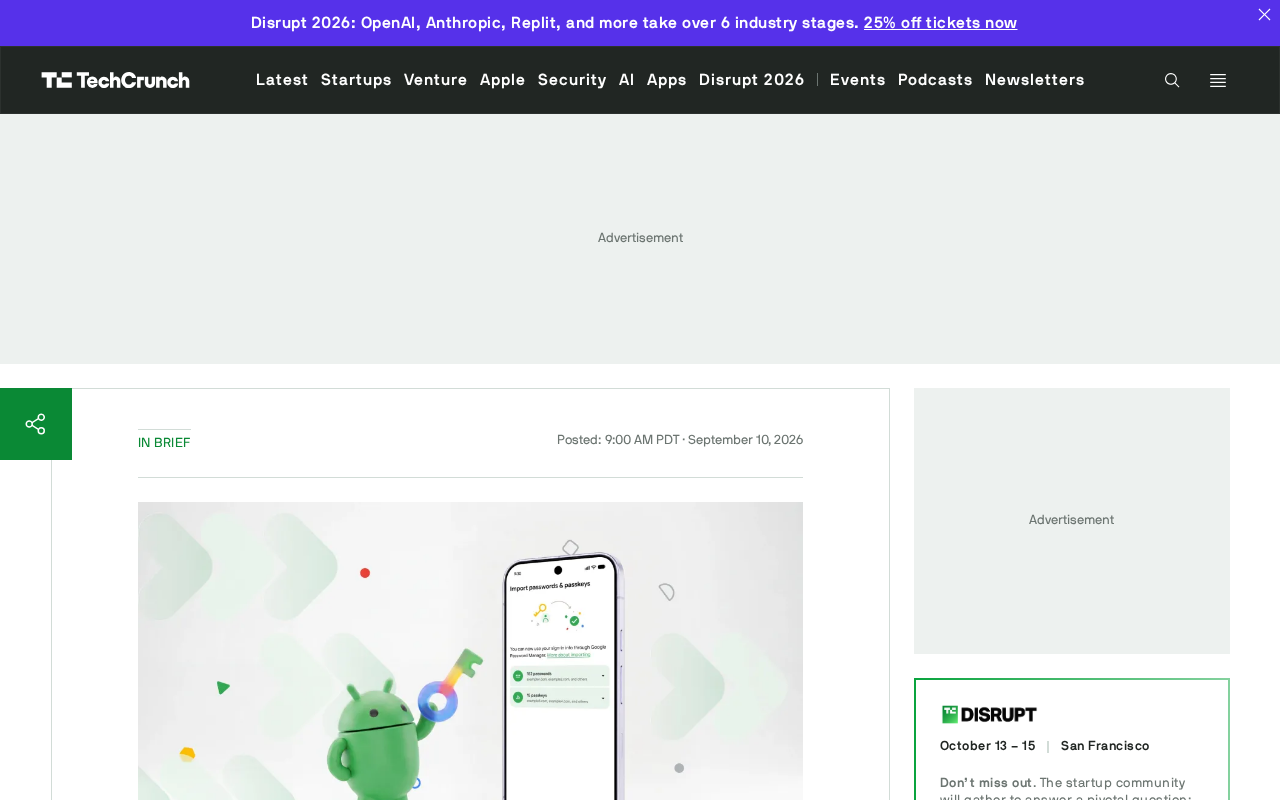
Google is rolling out a one-click password manager migration feature for Android, with its biggest highlight being support for migrating not just traditional passwords but also Passkeys. Passkeys use public-key cryptography to replace passwords with biometrics, but have long been locked to specific ecosystems. The feature is backed by the FIDO Alliance's Credential Exchange Protocol (CXP), ensuring secure encrypted transfers. For users, switching devices or services will no longer require manual exports, and Passkey portability removes a key barrier to passwordless authentication adoption.
The Long-Standing Pain of Password Manager Migration Is Finally Being Addressed
For a long time, Android users switching between password managers have faced an awkward reality: the migration process is tedious, often requiring manual export and import steps, and sometimes running into format incompatibility issues. Even more frustrating, as Passkeys — a new form of passwordless authentication — have grown in popularity, smoothly transferring these credentials between different password management services has remained an unsolved problem.
Now, Google is stepping in to fix this. According to newly disclosed information, Google is bringing a brand-new one-click migration feature to Android, making it easier than ever to switch between password managers.
Not Just Passwords — Passkeys Can Be Migrated Too
The most noteworthy highlight of this new feature is that it doesn't just transfer traditional account passwords — it also migrates your Passkeys.
For those less familiar: Passkeys are a new login method championed by the FIDO Alliance and backed by major tech companies including Google, Apple, and Microsoft. Built on public-key cryptography, Passkeys replace traditional passwords with biometrics (fingerprint or face recognition) or a device PIN, fundamentally protecting against phishing attacks and password breaches.
However, one major real-world obstacle for Passkeys has always been portability. Due to their technical nature, Passkeys tend to be locked to a specific ecosystem or password management service. If a user wants to switch providers, these hard-earned credentials can quickly become "digital baggage." By including Passkey migration in this feature's scope, Google is directly tackling a pain point that has long troubled the industry.
From a technical standpoint, the core of a Passkey is an asymmetric key pair: the private key is stored on the user's device (or in the encrypted storage of a password manager), while the public key is registered on the website's server. During login, the device uses the private key to sign a challenge issued by the server, which then verifies it with the public key — no shared secrets are ever transmitted over the network, which is why Passkeys are inherently phishing-resistant. Because the private key is typically bound tightly to the device's secure hardware (such as Android's StrongBox or TEE — Trusted Execution Environment), migrating across devices or services requires additional cryptographic wrapping mechanisms to complete the transfer without ever exposing the private key in plaintext. This is precisely the core technical challenge that the FIDO Credential Exchange Protocol was designed to solve.
Why This Feature Matters
Breaking Ecosystem Lock-In and Giving Users Back Their Freedom of Choice
The password manager market is highly competitive, with third-party services like 1Password, Bitwarden, and Dashlane going head-to-head with Google's own password manager. In the past, the high barrier to data migration created an invisible "ecosystem lock-in" — even if users were unhappy with their current service, the cost of switching was high enough that many simply stayed put.
By making migration simple, Google is dramatically lowering switching costs and genuinely returning the power of choice to users. This reflects both a respect for open standards and an alignment with growing global regulatory expectations around platform "interoperability."
Accelerating the Arrival of a Passwordless Era
From a broader perspective, Passkey portability is a critical factor in determining whether passwordless authentication can achieve mainstream adoption. If users worry that choosing a Passkey means being locked in forever, they'll hesitate to adopt it. But when migration becomes as straightforward as transferring traditional passwords, those concerns largely disappear — helping the entire industry move toward a safer, passwordless future.
The Technical Foundation: FIDO Credential Exchange Protocol
It's worth noting that this kind of cross-service credential migration capability relies on industry standards. The FIDO Alliance has been advancing the Credential Exchange Protocol (CXP), which aims to establish a unified specification for secure data transfer between different password managers.
Google's implementation of this feature on Android can be seen as an important step in taking this industry standard from blueprint to real-world application. Through a standardized, encrypted transfer channel, users' passwords and Passkeys can be migrated securely without any risk of data leakage at intermediate stages.
The FIDO Credential Exchange Protocol (CXP) and its companion Credential Exchange Format (CXF) were formally published as drafts by the FIDO Alliance in 2024. The core idea is to define a standardized encrypted container format, so that when a password manager exports credentials, the data is end-to-end encrypted using the destination service's public key — making it unreadable even if it passes through intermediate storage such as a temporary file. CXP/CXF covers not only traditional username/password pairs, but also explicitly includes specifications for exporting Passkey private keys. Major password managers including 1Password, Bitwarden, and Dashlane have all participated in developing this standard, which strongly suggests that Google's one-click migration feature on Android is likely built on this industry-consensus protocol — rather than a proprietary Google-only solution.
What This Means for Everyday Users
For the vast majority of Android users, the practical impact of this feature is straightforward:
- Switching devices or services is stress-free: When changing phones or password management services, there's no need to re-enter account information one by one.
- Lower barriers to action: The migration process is handled by a system-level feature, eliminating the need to manually deal with exporting and importing files.
- No more hesitation about adopting Passkeys: Users can feel more comfortable using Passkeys to log in to various services, knowing that even if they switch password managers later, their credentials can come with them.
Conclusion
Google's move to simplify password manager switching on Android may look like a simple UX improvement on the surface, but it actually touches on core issues of "user freedom" and "industry openness" within the password security ecosystem. When both passwords and Passkeys can flow freely between different services, users gain not just convenience — they gain genuine control over their own digital identities.
As the passwordless authentication era draws closer, improvements at this infrastructure level will become key variables shaping the overall user experience. It's reasonable to expect that more platforms will follow with similar interoperability features, collectively driving a more secure and open identity authentication ecosystem.
Related articles
Open-Source Python SDK: Measuring AI Agent Reliability with SRE Principles
Agent Reliability is an open-source Python SDK that applies SRE's SLO and error budget concepts to AI Agent evaluation, with PASS/FAIL/UNKNOWN states, CI assertions, and zero forced dependencies.
MiniMax RefMod: A Complete Guide to Training-Free Reusable Identity Workflows
MiniMax RefMod offers training-free reusable identity workflows for image, video, and audio generation. Includes Runpod template and tutorial for quick setup.

Invalid Source Material Notice
The source material provided lacks substantive information and is unrelated to AI/tech topics, making it impossible to produce a complete professional article.