Annual Agent Engineering Survey Launches: How to Build AI Agents Becomes the Focus

Annual agent engineering survey launches, focusing on reliability and engineering implementation challenges.
The article introduces the launch of the annual "State of Agent Engineering" survey, which collects real experiences and pain points from developers, researchers, and product teams building AI agents. The focus is shifting from capability demos to engineering implementation, with core topics including reliability, tool integration, evaluation and debugging, and cost and latency. The organizers stress that the industry is still in a collective exploration phase with no standard answers, and the article also notes limitations such as sample bias in community surveys.
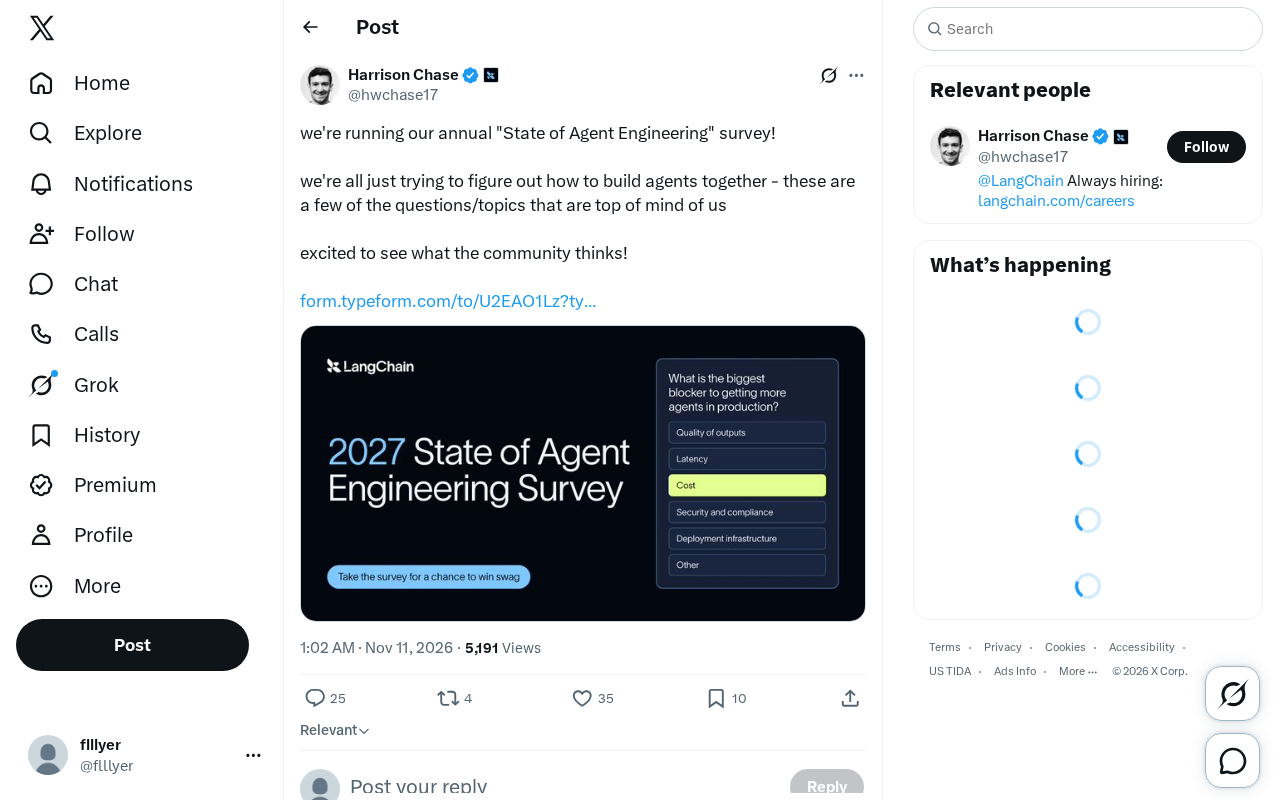
AI agents are moving from concept to engineering practice. Recently, an annual survey called "State of Agent Engineering" was officially launched, drawing attention from the developer community. The survey aims to collect real experiences and pain points from frontline developers, researchers, and product teams as they build agents, attempting to answer a shared question: how exactly should we build reliable AI agents?
Survey Background: From "Can It Be Done" to "How to Do It Well"
For a while now, discussions about AI agents have mostly centered on capability demos and scenario imagination. The launch of this survey signals that the focus is shifting toward engineering implementation. According to the organizers' posts on social media, the survey covers several topics developers "care about most," emphasizing that "we're all trying to figure out together how to build agents."
This framing itself sends a signal: there is no standard answer yet for agent development, and the industry is still in a collective exploration phase. Whether it's prompt orchestration, tool calling, or multi-agent collaboration, every link in the chain lacks recognized best practices. The value of the survey lies in aggregating the experiences and pain points scattered across teams into a referenceable industry picture.
Core Topics: The Real Challenges of Engineering
Although the organizers haven't listed every question, their "top of mind" phrasing suggests the topics likely revolve around key difficulties in agent development. Based on common discussions in the technical community, these difficulties typically include:
- Reliability and controllability: Agents tend to drift from their goals when executing multi-step tasks. How do you design effective constraints and validation mechanisms?
- Tool integration and orchestration: With external APIs, databases, and various tools, how do you select and combine them to ensure stability?
- Evaluation and debugging: Unlike traditional software, agent behavior is non-deterministic. How do you build a reproducible evaluation system?
- Cost and latency: In real business scenarios, inference cost and response speed often become hard constraints on deployment.
The organizers encourage community participation, saying they "look forward to seeing the community's ideas." This open attitude helps gather first-hand feedback from teams of different sizes, rather than only the experience of top-tier companies.
Multi-agent collaboration is listed in the article as one direction of exploration. It refers to multiple agents with independent roles and tools working together on complex tasks through message passing or shared state. Compared with a single agent, it can divide responsibilities and process in parallel, but it also introduces new problems such as communication overhead, task allocation, and conflict resolution. Common patterns today include orchestrator-executor, debate-style, and pipeline-style, but reliability and cost remain bottlenecks for deployment.
On evaluation and debugging, traditional unit tests struggle to cover non-deterministic agent behavior. The community often uses a combination of "golden datasets + environment simulation + trajectory scoring," along with human evaluation and LLM-as-a-Judge. Reproducibility depends on fixed random seeds, versioned prompts, and tool interfaces, while debugging requires complete execution traces and intermediate state records.
The Value and Limits of Community Participation
The significance of such annual surveys lies in establishing longitudinal comparisons. If conducted year after year, they can reveal how agent engineering practices shift as technology evolves. For example, early surveys might focus more on framework selection, while later ones might shift toward operations and governance in production environments.
However, the limitations of the survey should also be viewed objectively. Samples from social media tend to skew toward active developers and may not fully represent the real situation of enterprise users. In addition, how survey questions are designed directly influences the direction of conclusions. Therefore, when referencing survey results, one should consider the specific context and avoid equating community consensus with engineering standards.
Sample bias is a common issue with this kind of community survey: social media recruitment often attracts developers with high technical activity who use specific frameworks, while enterprise teams and industry participants bound by compliance may be underrepresented. In addition, self-reported data is susceptible to social desirability bias, and disclosure of failure cases may be scarce. All these factors affect the external validity of the conclusions.
Implications for Developers
For teams building agents, the launch of this survey is itself a reminder: agent engineering is not an isolated technical problem but a comprehensive engineering challenge involving product design, system architecture, and operations management. Participating in the survey or following its results can help teams benchmark their own practices and identify blind spots.
More importantly, at a stage when standards have not yet been established, staying open to absorbing community experience while insisting on validation based on one's own scenarios may be the more pragmatic path. There is no silver bullet for building agents, but the accumulation of collective experience is accelerating the maturation of this field.
The survey is still ongoing, and the organizers invite community members to participate via the provided link. Developers interested in agent engineering may want to keep an eye out for the release of the results.
One-line Summary
Annual agent engineering survey launches, focusing on reliability and engineering implementation challenges.
Paragraph Summary
The article introduces the official launch of an annual survey called "State of Agent Engineering," which aims to collect real experiences and pain points from frontline developers, researchers, and product teams building AI agents. The survey's focus is shifting from capability demos to engineering implementation, with core topics including reliability and controllability, tool integration and orchestration, evaluation and debugging, and cost and latency. The organizers stress that the industry is still in a collective exploration phase with no standard answers yet. The article also notes limitations such as sample bias in community surveys and suggests developers participate in or follow the results to benchmark their own practices, identify blind spots, and insist on validation based on their own scenarios.
Related articles

ChatGPT Plus Subscription Pitfall Guide: Go/Plus/Pro Tier Comparison and Quick Activation
A complete ChatGPT Plus subscription guide based on a Bilibili tutorial: from registering an account, comparing Go/Plus/Pro tiers, to the practical steps for quickly completing your subscription.

GPT-6.2 Sol/Astra Released! A Step-by-Step ChatGPT Plus Subscription Guide and Tier Comparison
GPT-6.2 Sol/Astra is out—here's a ChatGPT Plus subscription guide: register an account, compare Go/Plus/Pro tiers, and subscribe in a minute.

Comparing Three Channels for Subscribing to GPT Plus in China: Is Website Top-Up the Easiest?
How to subscribe to GPT Plus in China? This article compares website top-up, credit card, and mobile top-up channels—process, cost, and risk—with steps and tips to help you choose wisely.