Anomalo Analyst: The AI Analytics Assistant That Lets Your Data Speak First

Anomalo Analyst proactively monitors cloud data warehouses and pushes AI-driven anomaly insights with natural language follow-up support.
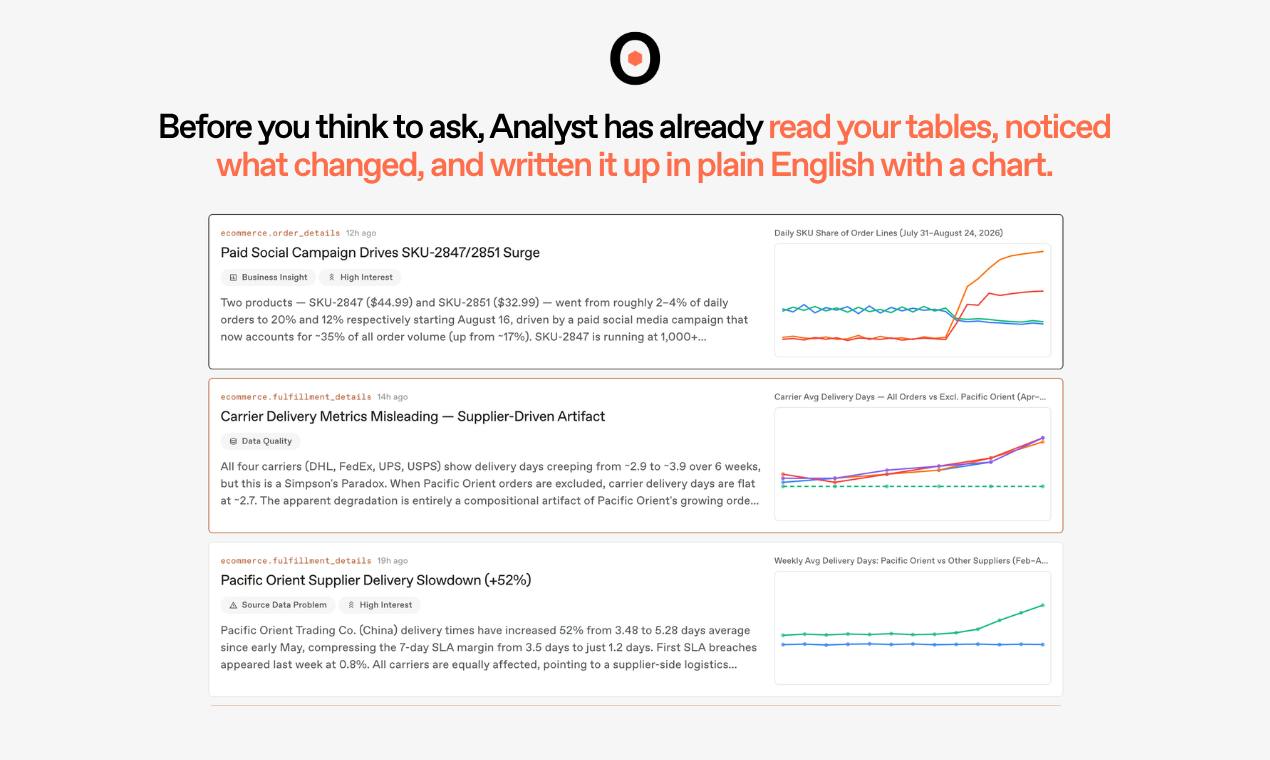
Anomalo Analyst is a proactive AI analytics assistant that flips the traditional BI model from "humans hunting for problems" to "data reporting problems." It natively integrates with Snowflake, Databricks, and BigQuery to continuously monitor data and surface important trends and anomalies before users think to ask. Users can then investigate signals further using plain natural language — no SQL required. The product also emphasizes false positive management, validating every insight against actual data to distinguish real business changes from pipeline failures — a capability rooted in Anomalo's background in data quality monitoring. Its #2 ranking on Product Hunt reflects growing market interest in proactive analytics, though its ultimate value depends on detection accuracy and business relevance of insights.
Anomalo Analyst: The AI Analytics Assistant That Lets Your Data Speak First
In an era where data-driven decision-making has become the norm, there's an uncomfortable reality: companies generate massive amounts of data every day, yet they often only discover problems after something has already gone wrong. Anomalo Analyst, which recently climbed to #2 on Product Hunt's AI rankings, is designed to address exactly this pain point — letting your data proactively tell you what it's seeing, rather than waiting for you to think of the right question to ask.
From Reactive Queries to Proactive Insights
Anomalo's core philosophy is captured in its tagline: "Your data is always talking. Don't miss what it's saying." Traditional business intelligence (BI) tools are inherently reactive — analysts must first formulate a question, write a query, and build a dashboard before they can get an answer. Anomalo Analyst flips this model on its head by proactively monitoring data sources and surfacing important trends, anomalies, and changes before you even realize you need to ask.
This shift from a "pull" to a "push" model is especially valuable for organizations dealing with large, fast-moving datasets. When a key metric starts to drift, waiting for someone to manually catch it often means missing the optimal window to respond.
Native Integration with the Top Cloud Data Warehouses
Anomalo Analyst connects directly to the three most widely used cloud data warehouses in the enterprise stack: Snowflake, Databricks, and BigQuery. This means it fits naturally into the existing architecture of most modern data teams, requiring no additional data migration or complex setup to get started.
For organizations that have already built their core business data assets on these platforms, this native integration lowers the barrier to adoption and ensures monitoring covers the data that actually drives business value.
Each of the three platforms has its own strengths in the enterprise data landscape: Snowflake is known for its cloud-native elasticity and data sharing capabilities, making it a popular choice in finance and retail; Databricks, built on Apache Spark, dominates in machine learning and large-scale data engineering; BigQuery serves as the core analytics engine within the Google Cloud ecosystem, recognized for its pay-per-query pricing and massive parallel query execution. Together, these three platforms account for the majority of the modern enterprise data stack. By prioritizing integrations with all three, Anomalo is effectively maximizing its market reach. It's also worth noting that "native integration" typically means reading metadata and query logs directly through official connectors — not copying data into third-party storage — which carries meaningful advantages for data governance and privacy compliance.
Natural Language Follow-Up: Putting Analysis Back in Human Hands
Another standout feature is support for natural language follow-up investigations. Once Anomalo surfaces a noteworthy anomaly or trend, users can continue digging using everyday language — asking about root causes, related dimensions, or scope of impact — without writing SQL or learning complex query syntax.
This interaction model leverages large language models to lower the barrier to data analysis down to "if you can talk, you can query data," allowing business stakeholders to participate directly in the insight discovery process without relying on data engineers for every question.
Distinguishing Real Business Changes from Data Failures
One of the greatest challenges in data monitoring is false positives: when a key metric suddenly drops, is it a genuine business shift, or a broken data pipeline and missing fields creating a "phantom anomaly"? If a tool fires off meaningless alerts too often, users will quickly lose trust in it.
Anomalo specifically emphasizes that every insight is validated against actual data, helping users distinguish between "real business changes" and "broken data." This aligns directly with Anomalo's roots as a data quality monitoring platform — identifying data reliability issues has always been its core competency. Combined with AI-powered analysis, this forms a differentiated product position.
Data Quality Monitoring is Anomalo's technical foundation. Core methods typically include statistical anomaly detection models (such as Z-score and time series decomposition) alongside rule-based checks for data freshness, completeness, and consistency. When a pipeline fails due to an upstream system outage — causing no new data to be written to a table within a given time window — this manifests as a sudden "drop" in metrics, nearly indistinguishable in shape from a genuine business decline. The key to telling them apart often lies in cross-validation: checking whether metadata indicators like row count, null rates, and timestamp distribution are also behaving abnormally. If a business metric falls but data volume looks normal, it likely reflects a real change; if both are off, the problem is probably in the pipeline. This reasoning is the technical basis behind Anomalo's claimed ability to keep false positive rates low.
Positioning and Takeaways
Anomalo Analyst sits at the intersection of artificial intelligence, data and analytics, and business intelligence. Its #2 ranking on Product Hunt with 146 upvotes signals genuine market interest in the "proactive AI analytics" category.
From a broader perspective, it represents an emerging trend in BI tool evolution: AI is shifting data analysis from "humans hunting for problems" to "data reporting problems to humans." That said, the real-world value of a product like this hinges heavily on two factors — the accuracy of its anomaly detection, and whether its insight prioritization actually aligns with business priorities. If the "important changes" it pushes lack business relevance, the proactive model can quickly become information noise. For teams evaluating adoption, testing the signal-to-noise ratio in their own data environment will be the critical evaluation step.
Related articles

Huberman's Rational Supplement Guide: A Five-Layer Health Framework and Scientific Decision-Making
Stanford neurobiology professor Huberman proposes a rational supplement framework: behavior and nutrition are the foundation, basic combination supplements serve as insurance, and sleep/hormonal/cognitive directions should stick to single-ingredient experiments. Omega-3 is the top single-ingredient choice, and melatonin is not recommended.

The Unsung Painter Behind Gilded Age Manhattan Interior Design
HN discussion highlights the painter behind Gilded Age Manhattan interiors: he created murals and decorative paintings but was long overlooked as his work was seen as architectural appendage.

Can AI Agents Be Socially Engineered? Understanding Prompt Injection and Tool Permission Risks
Through Invariant Lab's GitHub Issue injection and Brave's AI browser attack, this article analyzes how Prompt Injection induces AI Agents to perform unauthorized actions, and offers protection advice across three layers: least privilege, tool validation, and operation auditing.