Ant Group's AntLing Open-Sources Ming-Image-0.1-Design: 6B Design Image Model Tops UI/UX Leaderboard

Ant Group's AntLing open-sources two 6B design image models, topping the open-weight UI/UX leaderboard with editable PPT Agent Skills.
Ant Group's inclusionAI team has open-sourced the Ming-Image-0.1-Design series, comprising two 6B-parameter image models (a base version and a layer-supporting variant) plus two Agent Skills: Ling UI Design Skill and Image-to-Editable-PPT. Ming-Image-0.1-Design ranks first among open-weight models on Artificial Analysis's UI/UX Design leaderboard, achieving strong professional precision within a moderate parameter count through design-specific training. The 6B scale lowers local deployment barriers, while skills like Image-to-Editable-PPT bring AI outputs into real design collaboration workflows — addressing the long-standing issue of AI-generated content being visually impressive but difficult to edit. Models are available for free download on Hugging Face.
Ant Group's AntLing (inclusionAI) team recently open-sourced the Ming-Image-0.1-Design series of image models on Hugging Face. This design-focused model family drew immediate attention upon release — Ming-Image-0.1-Design has claimed the top spot among open-weight models on Artificial Analysis's UI/UX Design leaderboard.
Model Family Overview: Two Models and Two Agent Skills
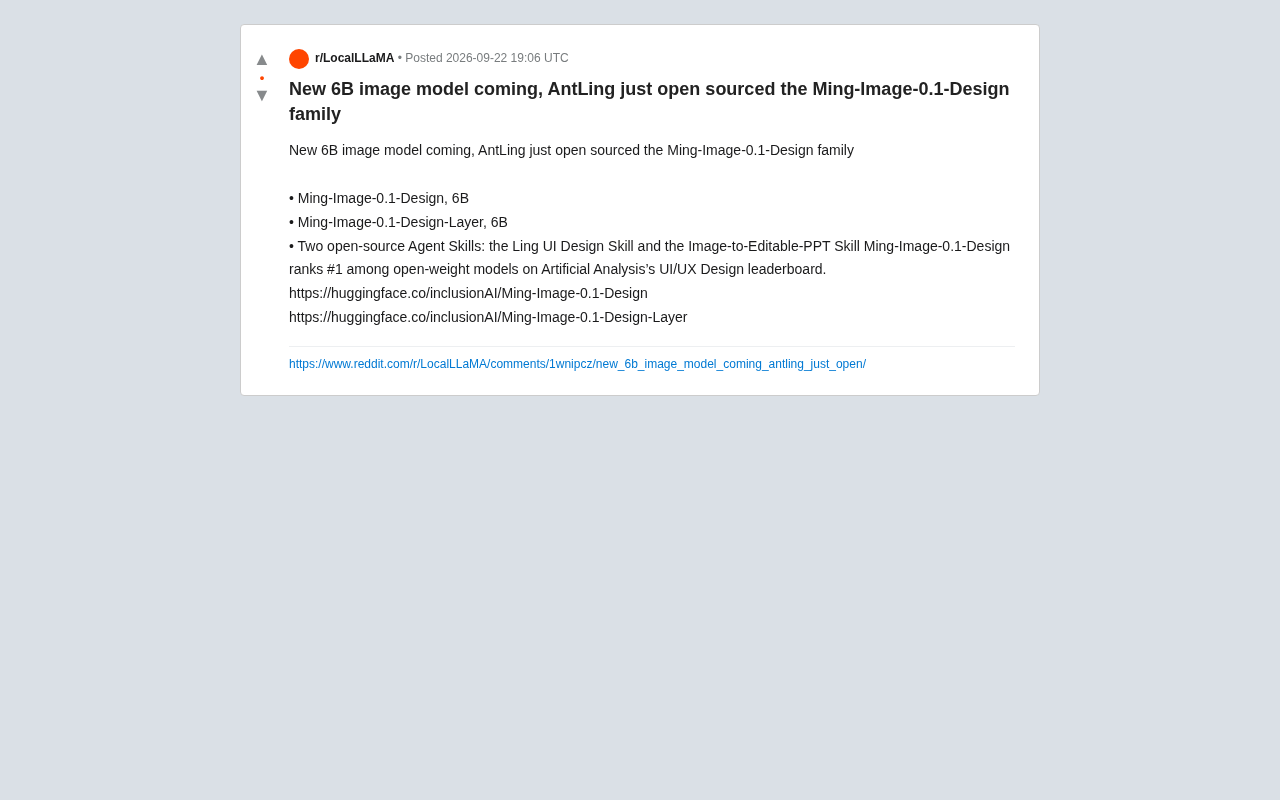
This release isn't a single model — it's a complete suite designed for design workflows. At its core are two models with 6B parameters each:
- Ming-Image-0.1-Design (6B): The primary image generation model, focused on UI/UX design scenarios.
- Ming-Image-0.1-Design-Layer (6B): A layered-output variant that, based on its name, supports layer-structured design output — critical for downstream editable design workflows.
Alongside the models, the team also open-sourced two Agent Skills:
- Ling UI Design Skill: A skill module for UI interface design.
- Image-to-Editable-PPT Skill: Converts images into editable PowerPoint presentations.
The logic behind this combination is clear — rather than just releasing a model that generates images, the team has packaged the entire pipeline from design generation to editable deliverables. In real-world design and productivity contexts, an editable output is almost always more valuable than a static image.
Why 6B Parameters Matter
In image generation, bigger isn't always better — especially for vertical use cases. Ming-Image-0.1-Design's choice of 6B parameters, a relatively moderate scale, means lower deployment barriers and inference costs. For developers and small-to-medium teams, a 6B model is far more likely to run on consumer-grade or single professional GPUs, which directly determines whether it gets used in practice.
More importantly, it's the model's positioning that matters — specialized for design rather than general-purpose image generation. General-purpose large models, in their pursuit of "drawing anything," often struggle to deliver precision in specific domains like UI/UX, typography, and interface elements. A 6B model trained and optimized specifically for design scenarios can achieve deep professional quality within constrained parameters — which explains how it managed to lead in a specialized leaderboard.
Topping the Open-Weight UI/UX Design Leaderboard
According to the release, Ming-Image-0.1-Design ranks first among open-weight models on Artificial Analysis's UI/UX Design leaderboard. Artificial Analysis is an active independent third-party model evaluation organization in the industry, and its leaderboards carry meaningful reference value.
It's worth distinguishing between "first among open-weight models" and "first overall." This result means it performs best in the UI/UX design dimension among freely downloadable and deployable models — but it doesn't imply it surpasses all closed-source commercial models. Even so, for teams looking to deploy design capabilities locally or in private environments, an open-source model that tops the open-weight category is inherently very attractive.
Artificial Analysis was founded in 2024 and focuses on independent third-party benchmarking of large language models and multimodal models, evaluating dimensions including output quality, inference speed, and cost efficiency. Its UI/UX Design leaderboard compares image generation models across metrics such as design output quality, pixel fidelity, and typographic coherence. Evaluated models include closed-source commercial models like GPT-4o Image and Gemini, as well as open-weight models like Stable Diffusion and FLUX. "Open-weight" specifically refers to models whose parameters are publicly downloadable and allow local deployment — slightly different from fully open-source (which includes training code and datasets), but practically sufficient for deployment purposes. The evaluator's independence and cross-model comparative methodology are what give its leaderboard results high credibility in the developer community.
From Generation to Editable: Completing the Design Workflow
What truly sets this release apart from ordinary image models is its consideration of the complete workflow. The Image-to-Editable-PPT Skill is particularly noteworthy — automatically converting images into editable PowerPoint files means the model's output is no longer the endpoint of design, but rather something that can directly enter the human collaboration and revision cycle.
Combined with the layered output capability of Design-Layer, it's reasonable to infer that this toolchain aims to address a long-standing pain point in AI design adoption: AI-generated images are often "beautiful but impossible to modify." When outputs carry layer structure and can be exported as editable documents, designers can truly integrate AI into their daily production workflows — rather than starting from scratch every time.
Agent Skills are a modular capability packaging format that has emerged in the large model ecosystem in recent years. They typically refer to bundling the invocation logic, prompting strategy, and tool integrations for a specific task into a reusable skill unit, available for direct use by agent frameworks (such as AutoGPT, Dify, etc.). The two skills open-sourced with the Ming-Image series follow this approach: Ling UI Design Skill standardizes the UI interface generation process, while Image-to-Editable-PPT Skill builds on image recognition and layout parsing to map static visual content back into structured presentation elements (titles, charts, text boxes, etc.), generating file formats that can be re-edited by tools like PowerPoint or WPS. This "generate and immediately edit" capability bridges the last mile between AI-generated content and human collaboration — and is one of the key bottlenecks in deploying design automation today.
How to Access and Use
Both core models are now live on Hugging Face and can be accessed at the following addresses:
- Ming-Image-0.1-Design: huggingface.co/inclusionAI/Ming-Image-0.1-Design
- Ming-Image-0.1-Design-Layer: huggingface.co/inclusionAI/Ming-Image-0.1-Design-Layer
For developers focused on open-source image generation — especially in UI/UX and design automation — this combination of models and skills offers a compelling starting point worth exploring hands-on. As more developers put it to work, real-world design performance will be the ultimate test of what its leaderboard rankings are truly worth.
Related articles

"Black October": Did AI Uncover 3% of All Critical Vulnerabilities Ever?
A Reddit post claims 3% of all critical software vulnerabilities ever were found in the past month, dubbed 'Black October.' We break down the statistical issues, how AI-assisted code auditing accelerates discovery, and how developers should respond.

Microsoft Project Gecko: Using AI to Bridge Language Gaps for African Farmers
Microsoft's Project Gecko launches PharmaChat, letting African farmers ask questions in their native language and get precise video clips and farming book chapters via AI. The project also releases three interactive manuals to advance inclusive AI.

Musk's Space Dominance: How Starlink Throttling Undermines Ukraine's Defense
SpaceX's Starshield throttling disabled Ukraine's high-speed interceptor drones, exposing how Musk's private control over low Earth orbit communications affects battlefield dynamics and national security, and highlighting the risks of commercial space militarization and space governance dilemmas.