Ante: A Deep Dive into the Single-Binary Offline Programming AI Assistant

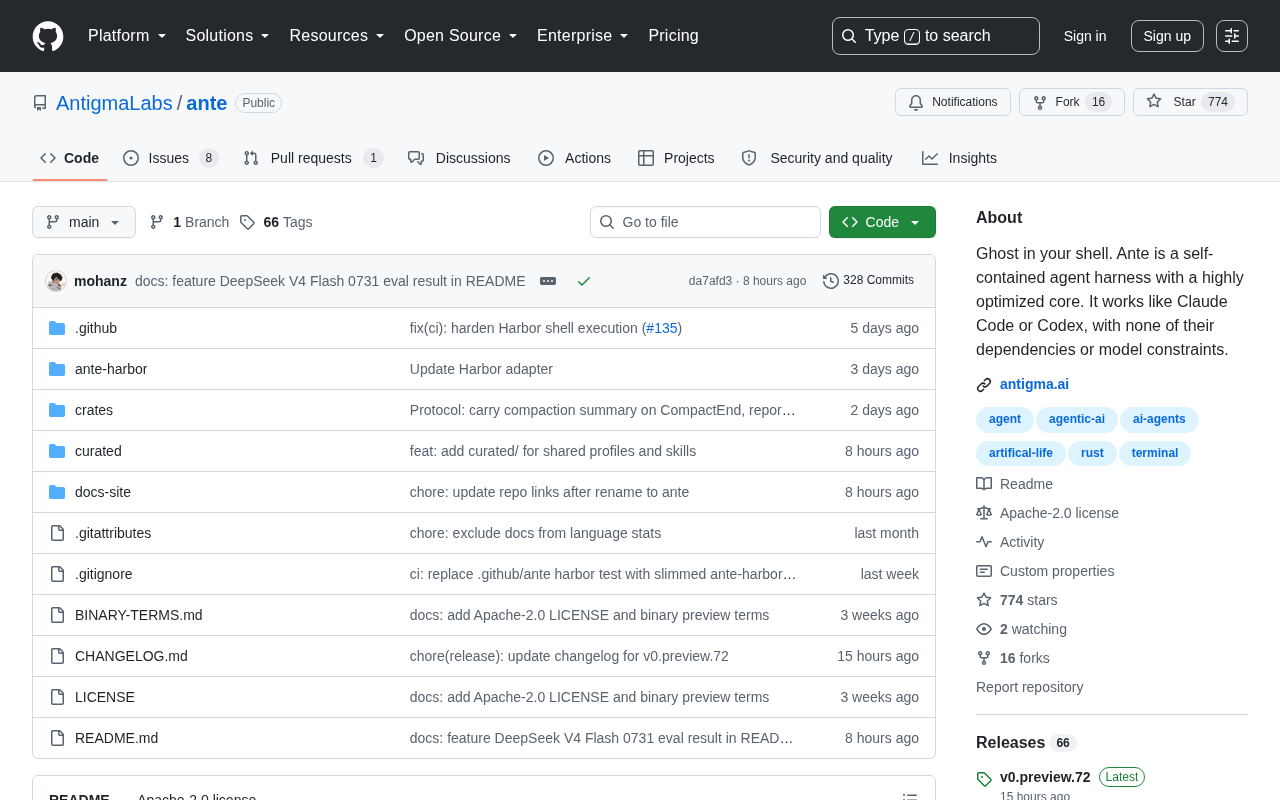
Ante is a single-binary, fully offline programming AI agent that runs locally without internet or API keys.
Ante is an emerging open-source programming AI agent that runs entirely offline as a single executable file. It leverages local LLM inference via frameworks like llama.cpp and quantized open-source models to provide coding assistance without cloud dependencies. This approach addresses key developer concerns around privacy, cost control, and availability, though with trade-offs in model capability compared to cloud solutions like GPT-4 or Claude.
A New Form Factor for Programming AI Assistants: Lightweight and Offline
Most programming AI assistants today rely on cloud-based large models, requiring constant network connectivity, API keys, and substantial subscription fees. However, Ante, a project that recently sparked discussion on Hacker News, takes a fundamentally different approach—it's a fully offline, single-binary programming agent.
This positioning stands out in the developer community. For developers who prioritize privacy, work in restricted network environments, or simply don't want to be constrained by cloud API costs and latency, a locally-running programming assistant holds considerable appeal. The project garnered 26 upvotes and 9 comments on Show HN—modest in scale, but it sparked valuable discussion about the trend toward localized AI tools.
What Is a "Single-Binary" Programming Agent?
Single binary means the entire tool is packaged into one executable file, requiring no complex installation process, dependency management, or runtime environment configuration. Users can run it immediately after downloading. This distribution method is increasingly common in modern command-line tools built with languages like Go and Rust.
The rise of this pattern is closely tied to the design philosophy of modern systems programming languages. Go has made static linking the default behavior since its inception—compiled artifacts don't depend on external dynamic libraries. Rust likewise supports static compilation, and its zero-cost abstraction features produce binaries that are both high-performance and compact. The opposite of this pattern is the "dependency hell" common in interpreted language ecosystems like Python and Node.js—a simple tool might require installing dozens of packages, with version conflicts occurring frequently. While Docker partially solves environment consistency issues, it introduces the additional complexity of a container runtime. The single-binary approach bypasses all these problems entirely, which is why modern CLI tools like kubectl, terraform, and ripgrep choose this distribution method.
For a programming agent, the single-binary form factor means:
- Zero-dependency deployment: No need for Python environments, Node.js, or piles of pip/npm packages
- High portability: Can be directly copied to any machine for use
- Lower barrier to entry: Eliminates environment configuration—the first hurdle that discourages newcomers
This stands in stark contrast to the traditionally complex toolchains required for AI Agents.
The Core Value and Technical Foundation of Offline Operation
Ante's most compelling selling point is its offline operation capability. This typically relies on locally deployed large language models (such as open-source models loaded via llama.cpp, Ollama, etc.) rather than calling cloud APIs from OpenAI, Anthropic, and others.
The Technical Stack for Local LLM Inference
The technical foundation for offline programming agents is the maturation of local LLM inference frameworks. llama.cpp is the most representative project among them, developed by Georgi Gerganov using pure C/C++ to implement LLM inference with CPU and GPU acceleration support, capable of running on machines without a CUDA environment. Ollama builds on llama.cpp to provide a more user-friendly model management and API interface.
Quantization is the key technology enabling large models to run on consumer hardware—by compressing model weights from FP16 (16-bit floating point) to 4-bit or even 2-bit integer representations, model size and memory requirements can be reduced by 4-8x. While there is some precision loss, performance remains acceptable for many tasks. The GGUF format has become the de facto standard file format for local models, supporting flexible quantization level selection.
Real Pain Points Solved by Offline Programming Assistants
Offline operation solves several problems that developers genuinely care about in specific scenarios:
Privacy and data security. Sending code to cloud AI for processing is unacceptable for many enterprises and developers working on sensitive projects. The 2023 incident where Samsung employees pasted internal code into ChatGPT, leading to data leakage, prompted numerous companies to ban external AI coding services or establish strict usage policies. Compliance frameworks in the US and EU (such as GDPR, SOC 2) place explicit restrictions on the external transmission of sensitive information that code may contain (API keys, business logic, user data processing logic). Local execution ensures code never leaves the machine, fundamentally eliminating data leakage risk—this is not just a technical preference but a compliance requirement.
Cost control. Cloud programming assistants charge per token or via subscription, representing an ongoing expense with long-term use. Local models require one-time deployment, with subsequent inference costs limited to electricity and hardware depreciation.
Low latency and availability. Independence from the network means the tool works on airplanes, in network-restricted environments, or during outages, while avoiding API rate limiting and service interruptions.
Limitations of the Offline Approach
Of course, the offline approach isn't without trade-offs. Open-source models running locally typically can't match the capabilities of top cloud models like GPT-4 and Claude. Code understanding, complex reasoning, and multi-step task completion quality are often limited by the model size that local hardware can actually run. This was one of the focal points in the Hacker News comments: On consumer hardware, how practical can such a programming agent actually be?
However, it's worth noting that open-source LLM coding capabilities underwent a quantum leap between 2024-2025. Meta's Llama 3.1 and subsequent versions approached early GPT-4 performance levels in code generation benchmarks; Alibaba's Qwen2.5-Coder series was specifically optimized for programming tasks, with its 32B parameter version showing impressive results on benchmarks like HumanEval; DeepSeekAd-Coder-V2 similarly demonstrated open-source model potential in complex code understanding and generation. More critically, models in the 7B-14B parameter range can run smoothly on laptops with 16GB of RAM after quantization, and specialized code models at this scale can already handle a wide range of everyday programming assistance tasks. This "small but specialized" model approach is precisely what makes offline programming agents viable.
Technical Evolution: From Code Completion to Programming Agents
Ante's emergence reflects an important direction in the evolution of programming AI tools.
From Completion to Autonomous Planning Agents
Early AI programming tools focused on code completion (like the original form of GitHub Copilot), essentially being "smarter autocomplete." Today's coding agents go much further—they can understand task objectives, autonomously plan steps, read and modify multiple files, execute commands, and even self-correct. Representative tools in this category include Cursor, Aider, and various open-source projects built on Agent frameworks.
From a technical architecture perspective, programming agents are fundamentally different from simple code completion. Code completion is essentially a "fill-in-the-blank" task where the model receives context before and after the cursor and predicts the most likely next code snippet. Programming agents instead employ ReAct (Reasoning + Acting) or similar Agent frameworks: they maintain a task loop where, at each step, the model first reasons about the current state and next action (such as reading files, searching code, editing specific lines, running tests), then executes that action, observes the result, and decides the next step. This architecture requires the model to have strong instruction-following ability, tool-calling capability, and long-context understanding. Typical programming agents also implement sandboxed execution environments, filesystem access controls, and human-in-the-loop confirmation mechanisms to ensure safety.
Ante belongs to this generation of agents, but through its "single-binary + offline" combination, it places its focus on being lightweight and self-contained rather than pursuing maximum model capability.
The Rising Trend of Local AI Programming Tools
As open-source models (such as Llama, Qwen, DeepSeek, etc.) continue to improve in performance, and quantization technology enables large models to run on ordinary laptops, local AI applications are experiencing a wave of growth. Ante is a product of this trend—it seeks to prove that programming agents don't have to be the exclusive domain of the cloud.
Developer Community Response and Use Cases
Judging from the Hacker News discussion, projects like this resonate with a segment of developers who care about data sovereignty and tool autonomy. The concept of Data Sovereignty originally applied to national-level data governance discussions, but in the AI era it's gradually extending to enterprise and individual developer contexts. In today's landscape of increasingly centralized, subscription-based cloud AI services, an open-source, offline, single-binary alternative is itself an expression of values. Developer tool "autonomy" also carries another layer of meaning: avoiding vendor lock-in—when cloud services adjust pricing, modify terms of service, or discontinue service, users won't be left in a passive position.
That said, we should be objective: as an emerging independent open-source project, it still needs time to mature in terms of stability, model capabilities, and ecosystem maturity. It's better suited as a supplementary tool for technical exploration and privacy-sensitive scenarios rather than an immediate replacement for mature cloud solutions.
Directions Worth Watching
For developers following AI programming tools, projects like Ante offer at least three insights:
- Lightweight distribution is becoming an important competitive advantage for developer tools
- Offline-first design philosophy is increasingly valuable in the age of privacy
- Progress in open-source local models is redefining the deployment boundaries of AI tools
As local model capabilities continue to close the gap, the practicality of offline programming agents is poised to improve further. Ante may be just a starting point, but the direction it points toward—bringing powerful AI programming capabilities truly back into developers' own hands—is undoubtedly worth continued attention.
Related articles

Amphibious Transforming Drone: Beyond 100x Power Savings, What Are the Real Needs?
Is the amphibious transforming drone just a gimmick? Starting from the 100x power difference of the M4 Morphobot, explore real application scenarios and thesis topic ideas, analyzing boundary conditions where pure drones and pure ground robots both fail.

Warhound Raises $200 Million: Genetically Engineered "War Dogs" Paired with Anduril Gear
Warhound raises $200M, backed by Ben Lamm and Palmer Luckey, to genetically engineer dogs for military and law enforcement use and equip them with Anduril gear. This article analyzes its technology direction, funding logic, and ethical controversy.

Claude API Comes to Google Cloud: IAM Integration and SDK Access Guide
Anthropic hosts the full Claude API on Google Cloud with IAM-controlled permissions and unified billing. This guide covers the Vertex AI and Anthropic-hosted entry points, IAM role configuration, and SDK access.