Anthropic: A Single Agent Isn't Enough — Lessons from Running Thousand-Scale Multi-Agent Topologies

Anthropic borrows OS evolution lessons to break single-agent bottlenecks with multi-agent topologies and dynamic workflows.
Anthropic's CJ Avilla and Harrison Stall argue that single-agent capability is hitting its ceiling, and the solution is to borrow system design lessons from Unix, Linux, and OS/360. They distinguish Flows (structured, predictable workflows) from UltraCode (thousand-scale parallel agent collaboration), and highlight Dynamic Workflows in Managed Agents for runtime adaptation. The real bottleneck at scale is scheduling, isolation, and observability — not prompt tuning.
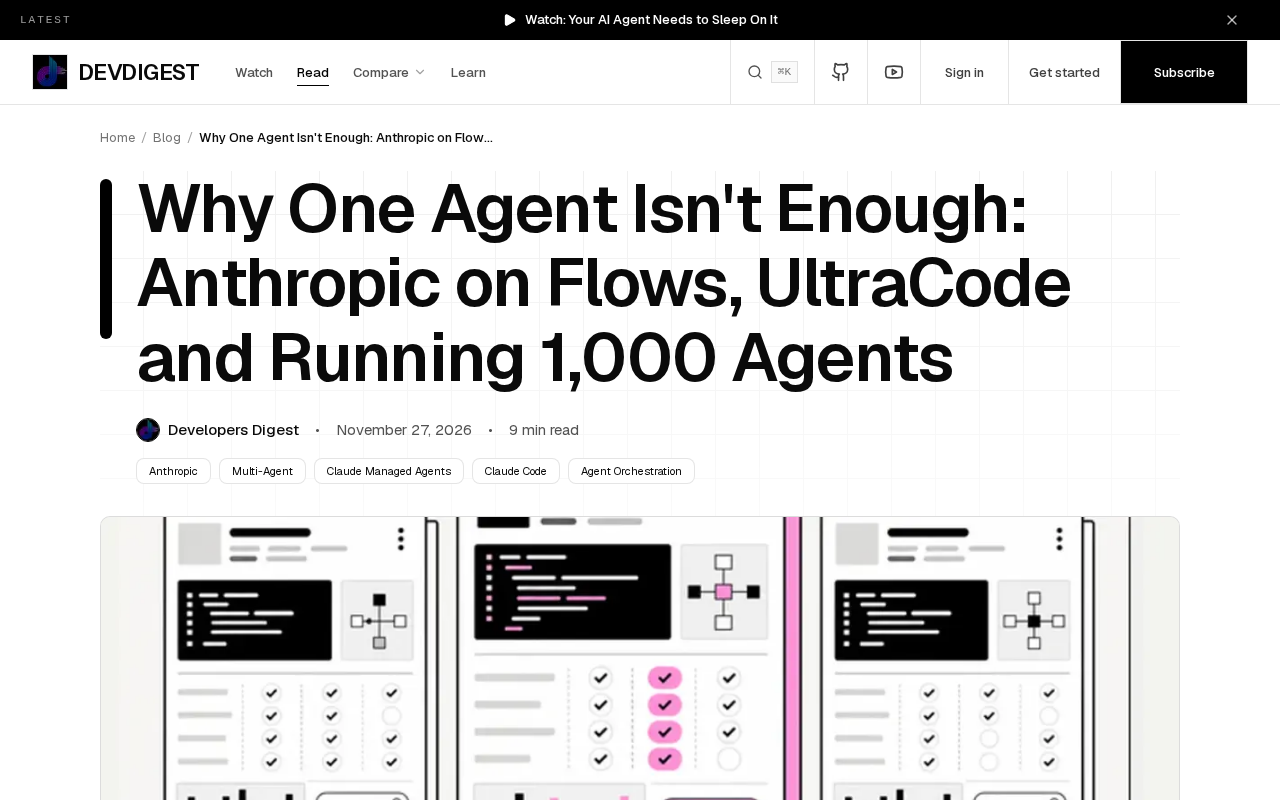
What a single agent can do is hitting its ceiling. In a presentation, Anthropic's CJ Avilla and Harrison Stall stated this outright and offered their solution: borrow lessons from operating system history, and break through the bottleneck with multi-agent topologies, Dynamic Workflows, and thousand-scale agent parallelism. This isn't a concept demo — it's engineering practice already running internally.
Why Learn Multi-Agent Design from Unix and Linux
Avilla and Stall's core analogy is straightforward: today's multi-agent systems are at the early stage of what operating systems went through. Unix replaced monolithic giant programs with "compositions of small tools," Linux made large-scale collaboration possible through process scheduling and permission isolation, and OS/360 offered lessons and paradigms from early multitasking time-sharing systems. These historical lessons map directly onto agent architectures at Anthropic.
Specifically, the Unix philosophy of "each program does one thing and does it well" translates to agent design as giving each agent clear responsibility boundaries, rather than having one omnipotent agent handle everything. Linux's process management and scheduling ideas correspond to task distribution, state synchronization, and failure recovery in multi-agent systems. Lessons from the OS/360 era about resource contention and batch scheduling inform thinking about concurrency control among agents.
The value of this historical perspective is that it pulls multi-agent systems away from the intuition of "stack more models" and back to the level of system design. Once the number of agents goes up, the real challenge isn't single-point intelligence — it's coordination cost, context passing, and error propagation.
OS/360 is a milestone operating system IBM launched in 1964, the first to introduce multiprogramming, batch scheduling, and job control language at scale in a commercial system. It made it possible for multiple jobs to share a single mainframe, but also exposed classic concurrency problems like resource contention, deadlock, and priority inversion. Anthropic cites OS/360 to emphasize that multi-agent systems likewise face the scheduling challenge of "multiple execution entities competing for limited resources" — the problems operating systems solved with job queues, time slices, and resource allocation tables reappear in multi-agent architectures as task queues, context budgets, and agent quotas.
Flows vs. UltraCode: Two Multi-Agent Orchestration Paths
In the presentation, Anthropic clearly distinguishes two orchestration mechanisms: Flows and UltraCode. They are not substitutes for each other but two topology choices for different scenarios.
Flows emphasizes structured workflow orchestration. Tasks are decomposed into explicit steps and dependencies, and agents execute according to a predefined process — suited to scenarios with clear boundaries and high predictability requirements. In this mode, controllability and debuggability take priority over flexibility.
UltraCode heads in a different direction, targeting more open and dynamic task environments, allowing agents to collaborate with greater freedom. According to the presentation, this mechanism supports Anthropic's internal practice of running thousands of agents. The benefit of massive parallelism is throughput, but the cost is rising coordination complexity and resource consumption.
Which to choose depends on how decomposable the task is and the requirement for determinism. For fixed, auditable processes, use Flows; for exploratory scenarios that need horizontal scaling, use UltraCode.
Orchestration in the multi-agent context refers to a scheduling layer deciding "which agent executes what task, at what time, with what input." It differs from a simple model call: the orchestration layer is responsible for splitting tasks, maintaining a dependency graph, passing context, and handling failure retries. The difference between Flows and UltraCode is essentially how control authority is allocated in the orchestration layer — the former concentrates control in a predefined process, the latter delegates part of the control to the runtime or the agents themselves. Understanding this distinction helps determine whether a multi-agent framework is building a "workflow engine" or a "distributed collaboration runtime."
Dynamic Workflows: Making the Workflow Itself Move
Dynamic Workflows in Managed Agents are another piece of the multi-agent puzzle. Traditional workflows are static, with steps determined before execution; Dynamic Workflows allow the workflow to dynamically adjust its structure based on intermediate results during execution.
This capability is especially critical in multi-agent scenarios. When one agent's output becomes the next agent's input, a fixed process easily gets stuck under unexpected circumstances. Dynamic adjustment means the system can add or remove steps, switch agents, or replan paths based on actual progress. Avilla and Stall see this as a key mechanism for multi-agent systems to move from "able to run" to "runs stably."
Dynamic Workflows don't conflict with Flows; the former is more like an adaptive layer added on top of orchestration: the underlying layer can still be a structured process, but the shape of the process is determined by runtime state.
The Engineering Reality of Thousand-Scale Agent Parallelism
The phrase "Running 1,000 Agents" highlights the scale threshold of multi-agent systems. When the number of agents grows from single digits to thousands, the nature of the problem changes: prompt optimization for a single agent no longer matters — what matters is scheduling, isolation, and observability.
Anthropic's practice shows that large-scale agent parallelism isn't simply distributing tasks to more instances. Task decomposition granularity, inter-agent communication overhead, and failure retry strategies all become bottlenecks as scale amplifies. The Unix and Linux process model again serves as a reference here: process isolation ensures a single process crash doesn't affect everything, and multi-agent systems likewise need similar isolation boundaries.
For engineering teams, the signal from this scale-level practice is: multi-agent architectures need to be designed in advance, not cobbled together when a single agent is no longer enough.
Observability in distributed systems refers to the ability to infer internal system state through logs, metrics, and trace tracking. When the number of agents reaches thousands, checking conversation records one by one is no longer feasible; structured execution tracing is essential: each agent's inputs and outputs, duration, failure reasons, and call relationships with other agents all need to be recorded and correlated. Without observability, faults in multi-agent systems manifest as hard-to-reproduce overall behavioral anomalies rather than a clear error point — precisely the root cause of sharply rising debugging costs at scale.
When to Use Multi-Agent
There's an implicit but clear criterion in the presentation: when a single agent suffices, don't introduce multi-agent. The coordination costs and debugging difficulty of multi-agent are real; only when tasks can be naturally decomposed and sub-tasks are loosely coupled is a multi-agent topology worthwhile.
Flows suits decomposition tasks requiring determinism, UltraCode suits open tasks requiring horizontal scaling, and Dynamic Workflows provides runtime adaptivity for both. The essence of this combination is to design agent systems as distributed systems, not to use them as a smarter model.
From Unix to Linux to thousand-scale agent parallelism, Anthropic's presentation points to the same conclusion: the decisive factor for multi-agent is system design, not the model itself.
One-line Summary
Anthropic borrows lessons from operating system evolution to break through single-agent bottlenecks with multi-agent topologies and dynamic workflows.
Paragraph Summary
Anthropic's CJ Avilla and Harrison Stall argue that single-agent capability is hitting its ceiling, and the solution is to borrow system design lessons from the history of Unix, Linux, and OS/360. They distinguish two orchestration paths — Flows and UltraCode: the former targets structured, predictable workflows, while the latter supports large-scale parallel collaboration of thousands of internal agents. Dynamic Workflows in Managed Agents let workflows adjust dynamically based on intermediate results at runtime, compensating for the fragility of static processes. The article emphasizes that the real bottleneck of thousand-scale agent parallelism is scheduling, isolation, and observability, not prompt optimization for a single agent; multi-agent isn't a default option and is only worth introducing when tasks can be naturally decomposed and are loosely coupled.
Related articles

A 19-Year-Old's Rental Horror Story: Ceiling Collapse, Bug Infestation, and the Lessons It Taught Me
At 19, my first off-campus rental brought bug infestations, no heat, a collapsed ceiling, and a ruined laptop with no renter's insurance. Here are the hard-won lessons for first-time student renters.

Veda Nurse's Cranial Nerve Exam: Why ASMR Role-Play Is Going Viral
Bilibili creator Veda's cranial nerve exam ASMR video goes viral, blending humor and sensory triggers through nurse role-play. This article analyzes its unique appeal and the audience psychology behind ASMR role-play.

LG Cinebeam AI Review: 120-Inch Giant Screen + 3000 Lumens, a New Choice for the Living Room Theater
LG Cinebeam AI projector review: 3000 ANSI lumens, 4K, 100 inches from about 8 cm and 120 inches from about 18 cm. Built-in webOS, AI Concierge voice recommendations, AI Sound Pro 11.1.2 virtual surround, and Game Optimizer—positioned for fixed living room installation, complementing the portable Cinebeam S.