Anthropic Adjusts Policy: Claude Refuses to Help Users Clone Games Amid AI Slop Flood

Anthropic steers Claude to refuse helping clone games in response to the flood of low-quality AI games on Steam.
Anthropic recently updated Claude's code of conduct to explicitly steer the model away from helping users clone existing games. This comes as Steam has been flooded over the past few weeks with large quantities of low-quality AI-generated games, which the community calls "AI slop" and accuses of crowding out indie developers. The root cause is that large language models lower the barrier to cloning games, enabling mass production of low-quality works. Anthropic chose preventive intervention at the model level rather than after-the-fact removal, but the specific implementation and effectiveness have not been disclosed. The article notes that this adjustment reflects AI companies taking proactive action on copyright and ethics, and also mirrors the boundary debate over AI-generated content. In the long run, solving AI slop requires coordination among model self-regulation, platform review, and community oversight; Anthropic's attempt is an important step but not a fundamental solution.
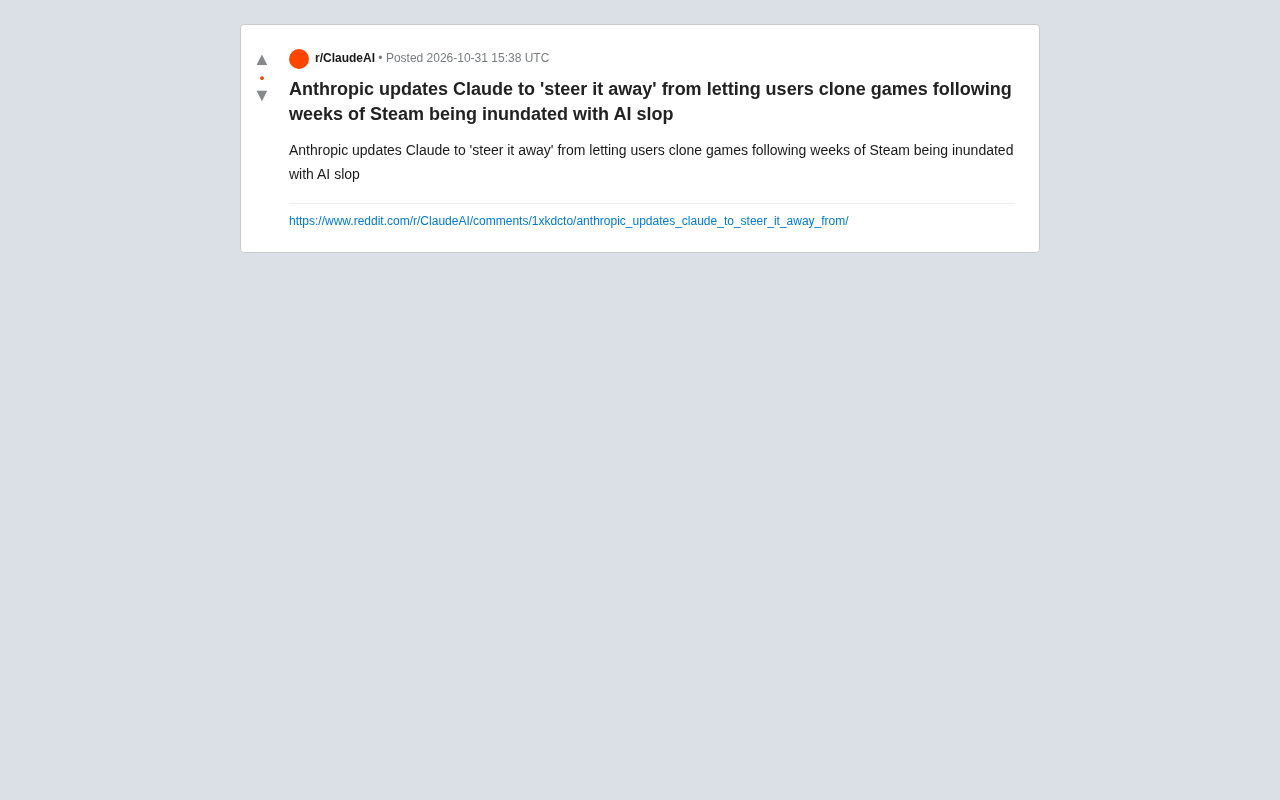
According to the Reddit community, Anthropic recently updated Claude's policy to explicitly steer the model away from helping users clone existing games. This adjustment comes in response to Steam being flooded over the past few weeks with large quantities of low-quality AI-generated games (AI slop), which has sparked widespread frustration among players and developers.
Background: Steam Hit by a Flood of AI Games
Over the past few weeks, a large number of low-quality, obviously AI-generated games have appeared on Steam. These works often lack originality, have crude gameplay, and sometimes even directly copy assets and mechanics from existing games. The player community calls this kind of content "AI slop," accusing it of polluting the platform ecosystem and crowding out exposure for indie developers.
The core of the problem is that large language models (such as Claude) can generate game code or design documents from simple instructions, lowering the barrier to cloning games. Some people use this capability to quickly crank out low-quality games and upload them to Steam, resulting in uneven content quality across the platform.
AI slop is a derogatory term that has become popular in content communities since 2024, referring to content mass-produced by generative AI that is low in quality and lacks creative intent. It is distinct from "AI-assisted creation"—the latter still involves human oversight and original design. In the Steam context, AI slop games typically have the following characteristics: store pages use AI-generated cover art and screenshots, gameplay directly applies existing templates, and code or assets are heavily reused. Because Steam's Direct distribution mechanism allows developers to self-publish after paying $100 and review is primarily automated, this kind of content can flood in quickly. Valve updated its policy in 2024 to require developers to disclose their use of AI-generated content, but disclosure itself does not constitute a quality threshold, which is one reason community dissatisfaction persists.
Anthropic's Response: Steering Claude Away from Game Cloning
Faced with this situation, Anthropic chose to intervene at the model level. According to the Reddit post, the company updated Claude's code of conduct to explicitly "steer it away" from helping users clone games. This means that when a user asks Claude to help replicate an existing game, the model may refuse or pivot to suggesting original designs.
This move reflects AI companies taking proactive action on copyright and ethical issues. Compared with removing infringing content after the fact, restricting it at the generation end is more preventive. However, the specific implementation method (such as through system prompts, filters, or fine-tuning) has not been disclosed, and its actual effectiveness remains to be seen.
Model-level restrictions refer to behavior constraints built into the model during inference or training by the AI provider, rather than relying solely on post-hoc review at the user or platform end. Common implementation approaches include: behavioral guidelines in system prompts (lowest cost, easiest to adjust), output filters (intercepting specific request patterns), and fine-tuning based on human feedback (RLHF/Constitutional AI, incorporating "do not assist in cloning copyrighted works" into preference data). The three increase in constraining power but decrease in transparency and interpretability. The inherent limitation of model-level restrictions is that they can be bypassed—users can switch to open-source models, adjust prompts, or use locally deployed tools. Therefore, it is better suited as a first gate to "reduce the scale of abuse" rather than an ultimate solution for copyright protection.
Industry Impact: The Boundary Debate Over AI-Generated Content
Anthropic's adjustment is not an isolated event. As generative AI becomes increasingly common in game development, how to balance innovation efficiency with intellectual property protection has become an industry focus. The game cloning issue is just the tip of the iceberg; similar controversies also appear in areas such as art assets, music, and narrative text.
From the platform perspective, Valve (Steam's parent company) is also facing regulatory pressure. Relying solely on manual review makes it difficult to cope with the massive volume of AI-generated content, while completely banning AI-assisted development could stifle innovation. Anthropic's model-level restrictions offer a new approach: making AI itself the gatekeeper.
The intellectual property boundary of game cloning is not clear under current law. Gameplay mechanics (rules and mechanics) are generally not protected by copyright; what is protected is the specific expression—code, art, music, characters, and level design. This means that "making gameplay similar to a certain game" may be legal, while copying its assets or code constitutes infringement. AI generation makes this line harder to enforce: the model may output code that is highly similar to training data but not copied verbatim, making evidence-gathering difficult. This is also why Anthropic chose to guide at the generation end rather than wait for legal clarification. Similar tensions also appear in art and music; copyright offices in multiple countries have required disclosure of AI-generated components, but enforcement still relies on case-by-case judgment.
Future Outlook: Coordination Between Model Self-Regulation and Platform Governance
Claude's policy update sends a signal: leading AI companies are beginning to proactively constrain model applications in sensitive areas. This may encourage other model providers to follow suit and establish an industry norm. However, model-level restrictions are not a panacea; users can still achieve similar goals through other tools or open-source models.
In the long run, solving the AI slop problem requires collaboration among model self-regulation, platform review, and community oversight. Anthropic's attempt is an important step, but there is still a long way to go before a fundamental solution is reached.
One-line Summary
Anthropic steers Claude to refuse helping clone games in response to the flood of low-quality AI games on Steam.
Paragraph Summary
Anthropic recently updated Claude's code of conduct to explicitly steer the model away from helping users clone existing games. This comes as Steam has been flooded over the past few weeks with large quantities of low-quality AI-generated games, which the community calls "AI slop" and accuses of crowding out indie developers. The root of the problem is that large language models lower the barrier to cloning games, making it possible to mass-produce low-quality works. Anthropic chose preventive intervention at the model level rather than after-the-fact removal, but the specific implementation and effectiveness have not been disclosed. The article notes that this adjustment reflects AI companies taking proactive action on copyright and ethics, and also mirrors the boundary debate over AI-generated content. In the long run, solving AI slop requires coordination among model self-regulation, platform review, and community oversight; Anthropic's attempt is an important step but not a fundamental solution.
Related articles

AI Can Read Neural Network Weights Directly: Do Models Already Exceed Expectations?
A Reddit developer experiment shows language models can directly read neural network weights and infer their function. Astra, Opus 5.5, and Muse Spark 1.3 all passed the test, sparking discussion on model generalization and training sources.

India's Microdrama Market Explodes: EloElo Secures $80M Investment from NBCUniversal
EloElo secures $80M from NBCUniversal to boost StoryTV, its microdrama platform with over 33M monthly active users, as India's microdrama market draws global capital.

Acoustic Detection of Multi-Rotor UAVs: Fusing Handcrafted Features with Pre-Trained Embeddings
Study reveals data leakage from random splits in UAV acoustic detection, proposes source-disjoint protocol with stacked ensemble of handcrafted features and YAMNet embeddings, achieving 95.29% accuracy for low-cost drone detection.