Anthropic at $2 Trillion vs. 35 SaaS Companies at $948 Billion: Is the AI Bubble Back?
Anthropic's $2T valuation is over twice the combined market cap of 35 SaaS giants, yet its revenue is only one-fifth, reflecting the market's divergent pricing of AI narratives versus mature cash flow.
A Reddit comparison chart has sparked heated discussion: Anthropic's $2T valuation is more than twice the combined market cap of 35 mature SaaS companies including Salesforce, Adobe, and SAP ($948B), yet its quarterly revenue of $11.5B is only one-fifth of the latter's $53.4B. By P/S ratio, Anthropic trades at ~43x quarterly revenue versus ~4.4x for the SaaS camp—a near 10x gap. Bulls cite AI's superior growth, agents potentially restructuring the software value chain, and frontier model scarcity; bears point to the extreme revenue-valuation divergence, resilient SaaS fundamentals, and parallels to the dot-com bubble. The article argues the market is applying different discount rates to mature cash flow versus future options, and participants should know whether they're betting on cash flow or narrative.
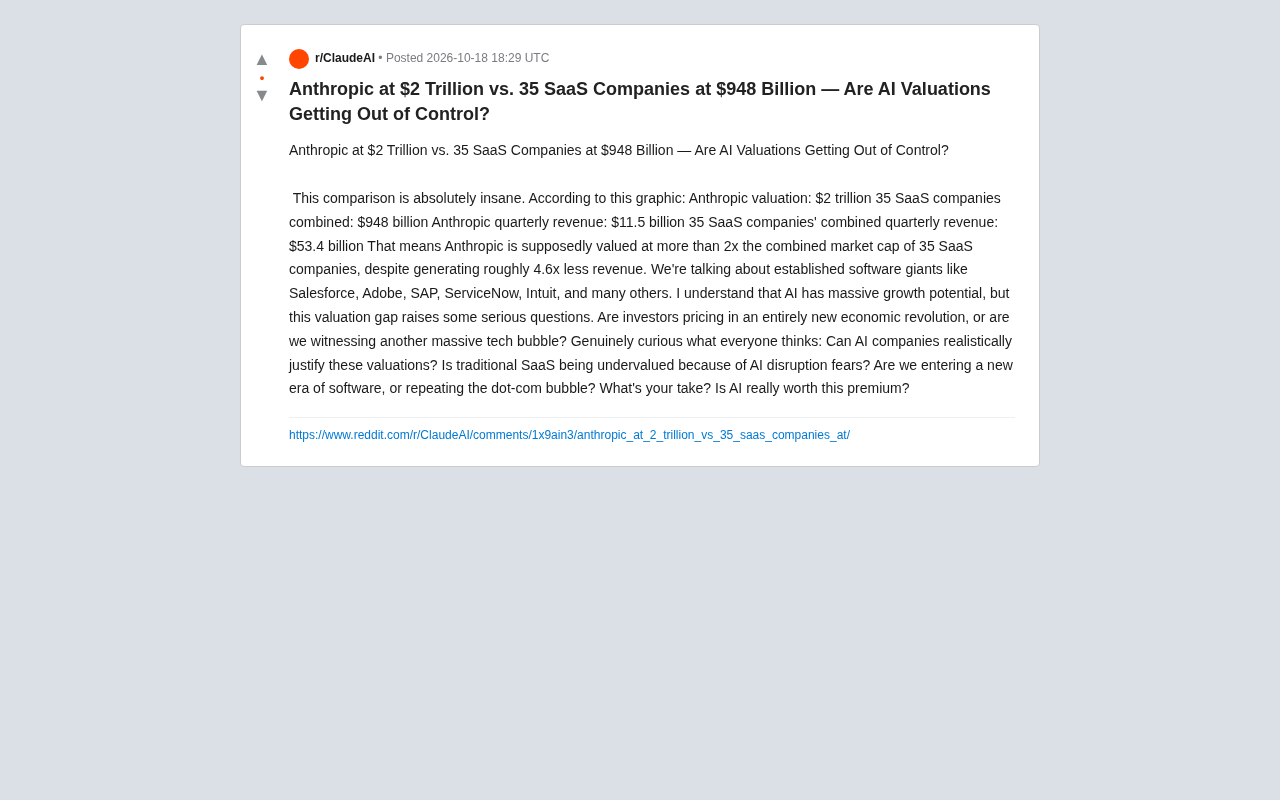
A comparison chart has sparked heated discussion on Reddit: Anthropic's valuation is as high as $2 trillion, while the combined market cap of 35 mature SaaS companies—including Salesforce, Adobe, SAP, ServiceNow, and Intuit—is only $948 billion. Even more striking are the revenue figures—Anthropic's quarterly revenue is $11.5 billion, while the 35 SaaS companies combined total $53.4 billion. In other words, Anthropic's valuation is more than twice the combined total of these 35 giants, but its revenue is only about one-fifth of theirs. Are investors pricing in a new economic revolution, or yet another tech bubble?
The Extreme Inversion of Valuation and Revenue
Let's break down these numbers first. Anthropic's valuation is $2 trillion, while the 35 SaaS companies combined are worth $948 billion; on the revenue side, Anthropic's quarterly revenue is $11.5 billion versus the SaaS camp's $53.4 billion. Roughly calculating by price-to-sales ratio (P/S), Anthropic is about 43 times quarterly revenue, while the SaaS camp is about 4.4 times. The former is nearly 10 times the latter.
These 35 companies are no marginal players—Salesforce defined CRM, Adobe dominates creative software, SAP carries the ERP systems of large global enterprises, and ServiceNow is the benchmark for IT service management. They have stable subscription revenue, deep customer stickiness, and years of profit records. Anthropic, meanwhile, is still in a period of heavy investment, with its valuation built on expectations of future growth.
This inversion is not an isolated case. It reflects a fundamental divergence in today's capital markets: traditional software's cash flow is seen as "the past," while AI's imagination is seen as "the future."
Price-to-sales ratio (P/S) is one of the most commonly used relative valuation metrics, calculated as total market cap divided by trailing 12-month (or annualized) revenue. It is particularly applicable to companies that are not yet profitable but have rapidly growing revenue, because the price-to-earnings ratio (P/E) often fails or turns negative for such companies. The limitation of P/S is that it ignores cost structure and profit margins: two companies with the same revenue—one with an 80% gross margin and the other with 20%—can have justified P/S ratios differing by several times. Therefore, cross-industry P/S comparisons must be made with caution—traditional SaaS companies typically have 70%-80% gross margins and stable free cash flow, while AI model companies may have lower gross margins (high inference costs) and larger capital expenditures. Using "quarterly revenue" to calculate P/S in this article is a simplification; strictly speaking, annualized or trailing 12-month revenue should be used, but this does not change the massive gap in order of magnitude.
The Threefold Logic Behind the Premium
Those supporting high valuations are not without basis.
Different growth slopes. SaaS companies generally grow at 10%-20% annually, while leading AI companies' revenue grows several times over. Anthropic's quarterly revenue has reached $11.5 billion—a scale that is itself no longer at the level of an early-stage startup, showing that enterprise AI demand is genuinely materializing. Investors are buying the growth curve, not current profits.
AI may restructure the software value chain. Traditional SaaS charges per seat, while AI may charge per task or per outcome. If AI agents can replace some software functions, value will shift from the application layer upstream to the model layer. Under this narrative, model companies being valued higher than application companies is logically consistent.
Scarcity premium. Only a handful of companies worldwide truly possess frontier model capabilities, and capital competing for limited targets naturally drives up pricing.
AI agent refers to an AI system capable of autonomously perceiving its environment, formulating plans, and invoking tools to execute multi-step tasks, as distinct from chatbots that can only passively answer single-turn questions. In the context of enterprise software, typical agent use cases include automatically handling customer service tickets, entering data across systems, and generating and executing procurement processes. Its business implication lies in the shift in pricing models: traditional SaaS charges per "seat" (i.e., number of users), while agents charge per "task completed" or per "outcome," meaning the value anchor of software shifts from "humans using tools" to "machines directly producing results." If agents can replace human operations across multiple software applications, the entry-point value of the application layer may be weakened, and value may concentrate in companies providing underlying model capabilities—this is precisely the core narrative logic behind model companies' higher valuations than application companies.
Three Counter-Questions from Bubble Theorists
But the opposing voices are equally forceful.
First, the revenue gap is 4.6x, while the valuation gap is 2x in the opposite direction, meaning Anthropic needs to maintain super-high growth for years to justify its current valuation. Once growth slows, there is enormous room for valuation correction.
Second, have SaaS companies really been disrupted by AI? Looking at this data, the 35 companies' combined quarterly revenue of $53.4 billion is still growing, and customers have not churned on a large scale. The so-called "AI disrupting SaaS" is currently more expectation than established fact. The market may be underestimating the migration costs and customer inertia of traditional software.
Third, history rhymes. During the dot-com bubble, there was likewise a narrative of "the new economy replacing the old economy," and likewise extreme divergence between valuation and revenue. The definition of a bubble is not high valuation, but valuation so high that no reasonable assumption can support it.
The dot-com bubble refers to the irrational exuberance of Nasdaq tech stocks between 1995 and 2000 and the subsequent crash. At the time, a large number of internet companies were valued on non-financial metrics such as "eyeballs" and "page views," and many had no revenue or even no clear business model. Ultimately, the Nasdaq index fell from its March 2000 peak of 5,048 points to 1,114 points in 2002, a decline of about 78%. The similarities with the current AI boom lie in the narrative of "new technology replacing the old economy" and the extreme divergence between valuation and revenue; the key difference is that today's leading AI companies already have real revenue in the tens of billions of dollars and clear willingness of enterprises to pay, rather than pure concept hype. The value of historical analogy is not in predicting the timing of a crash, but in reminding us: when valuation depends on the assumption of perpetual growth, once growth is disproven, the magnitude of the correction will far exceed expectations.
This Is Not a Black-and-White Issue
Reducing this debate to "bubble" or "revolution" is too crude. A more accurate description is: the market is applying different discount rates to two different business models. SaaS is being discounted according to the cash flow of mature enterprises, while AI companies are being priced as options—buying possibility, not certainty.
The problem is that options can go to zero. If AI model capabilities become homogenized, price wars intensify, and enterprise procurement returns to rationality, the premium at the model layer will be compressed. Conversely, if AI agents truly reshape how enterprise software is used, today's SaaS giants may indeed face the risk of being "pipeline-ized."
For ordinary observers and practitioners, the value of this comparison is not in judging who is right or wrong, but in reminding us: when valuation diverges so far from revenue, anyone participating should be clear about what exactly they are betting on—cash flow, or narrative.
Frequently Asked Questions
Is Anthropic's $2 trillion valuation justified? The valuation is mainly based on revenue growth, frontier model capabilities, and market scarcity, but a 43x quarterly P/S ratio is far above traditional software companies, constituting high-expectation pricing.
Are the 35 SaaS companies undervalued? Judging by revenue and customer retention, these companies' fundamentals remain solid, and market concerns about AI disruption may have suppressed their valuation multiples.
Will this be another dot-com bubble? There are similarities, but current AI companies already have considerable revenue, unlike the concept stocks with no revenue back then. The risk lies in valuation correction after growth slows.
One-line Summary
Anthropic's $2 trillion valuation is more than twice the combined total of 35 SaaS giants, yet its revenue is only one-fifth of theirs, reflecting the market's divergent pricing of AI narratives versus mature cash flow.
Paragraph Summary
A Reddit comparison chart has sparked heated discussion: Anthropic's $2 trillion valuation is more than twice the combined market cap of 35 mature SaaS companies including Salesforce, Adobe, and SAP ($948 billion), yet its quarterly revenue of $11.5 billion is only one-fifth of the latter's $53.4 billion. By price-to-sales ratio, Anthropic is about 43 times quarterly revenue, while the SaaS camp is about 4.4 times—a gap of nearly 10x. Those supporting the high valuation argue that AI growth far exceeds traditional software, agents may restructure the software value chain, and frontier models are scarce; bubble theorists point to the extreme divergence between revenue and valuation, the still-solid fundamentals of SaaS, and historical similarities to the dot-com bubble. The article argues that the essence is the market applying different discount rates to mature cash flow versus future options, and participants should be clear about whether they are betting on cash flow or narrative.
Related articles

Claude Pro Doesn't Include API Access? Max and Team Plans Now Add API Credits Explained
Claude Pro has no API access; API is billed separately. But Max and Team plans now include monthly API credits: Max 5x $100, Max 20x $200, Team up to $500 per seat. This article details each tier's credits, how to claim them, and the impact on developers.

Testing the 350K-Star REA in an Isolated Environment: 4-Second Install, but Watch Out for Two Pitfalls
Isolated lab test of the 350K-star open-source reverse-engineering tool REA: 4-second install, 15 seconds to list a screenshot tool's outbound addresses, 565 communication channels mapped, while exposing two pitfalls—user-level settings writes and 31 high-risk tool permissions—plus three safety rules.
Reverse Engineering + AI Agents: The T…
Reverse Engineering + AI Agents: The Technical Truth Behind Cloning Adobe Apps in Weeks
A developer used AI Coding Agents for reverse engineering to build 7 open-source Adobe alternatives in weeks. We explore how it works, the MCP Server that hit 100K stars in 6 days, and the real technical and legal limits.