Claude Pro Doesn't Include API Access? Max and Team Plans Now Add API Credits Explained

Claude Pro is chat-only; Max and Team add monthly API credits, so developers must recalculate costs.
The article clarifies that the Claude Pro subscription and API access are separate: the monthly Pro fee covers only the chat interface, and apps calling the API still need separate keys and payment. The change: Anthropic added monthly API credits to Max and Team plans—Max 5x $100, Max 20x $200, Team billed per seat up to $500 total. Credits must be manually claimed in billing settings and don't roll over. Free, Pro, and Enterprise plans don't include credits, and credits don't cover Claude Code. This shifts subscriptions from pure chat tools to chat-plus-dev-resource bundles, so developers and teams must re-evaluate plans and costs.
Many developers have wondered: I've paid for a Claude Pro subscription, so why can't my app call Claude's API directly? According to a recent breakdown on a YouTube channel, the answer is clear—the Claude Pro subscription is only for the chat interface, and API access is billed separately. However, Anthropic recently adjusted its Max and Team plans, adding monthly API credits to these two higher-tier subscriptions. What does this change mean for teams building applications with Claude? How many credits does each tier actually get? This article breaks it down one by one based on the video content.
The Fundamental Difference Between Claude Pro and the API
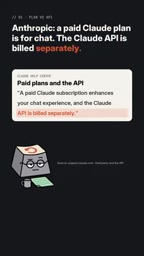
According to the video's author, Anthropic's paid Claude plans are essentially designed for chat scenarios. After subscribing to Pro, users can converse on Claude's web or client interface, but this benefit does not extend to the API level. API access has always been a separate billing channel, and application developers need to create their own API keys and pay separately.
This means that if you've developed an application under a Pro subscription that needs to call Claude's capabilities, you still need to configure a separate API key for that application and pay the corresponding fees. The monthly Pro fee does not offset any API usage—the two are completely separate in the billing system. This is the foundation for understanding all the plan differences that follow.
API keys are the credentials for calling the Claude API, created by developers in the Anthropic console, with each key bound to a billing account. Token-based billing is the basis of API pricing: both input and output text are priced by token count, and different models (such as Claude Haiku, Sonnet, Opus) have significantly different unit prices. This is completely different from the "flat monthly fee with unlimited usage" model of chat subscriptions—under the subscription model, users don't perceive the cost of individual conversations, while under the API model, every request incurs a measurable cost. Understanding this difference helps developers estimate the actual operating costs of their applications and make trade-offs in model selection.
Max and Team Plans Add API Credits
The video points out that things are changing: Max and Team plans now include monthly Claude API credits. This is the first time Anthropic has linked subscription fees with API usage to some extent. For users who have already subscribed to these two plans, it's essentially an extra "subsidy" they can use for application development.
It's important to emphasize that these credits come with the subscription and users don't need to apply separately. However, the specific amount varies by tier and there are usage restrictions, which will be detailed below.
API Credit Details by Tier
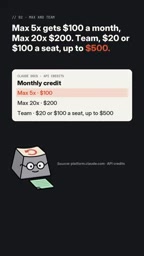
The video provides a clear credit comparison. The Max plan is divided into two tiers: Max 5x gets $100 in API credits per month, and Max 20x gets $200 per month. The Team plan is billed per seat, at $20 or $100 per seat, with the entire team getting up to $500 in total credits—the video also mentions the $200 tier when listing them.

These credits need to be actively claimed by users in Claude's billing settings and don't take effect automatically. The video specifically reminds that unused credits do not roll over to the next month, so using them up monthly is the sensible strategy. For teams with heavy API consumption, these credits can substantially reduce development costs; for light users, it's necessary to assess whether the subscription fee matches the value of the credits.
The API credits here are essentially prepaid balances denominated in US dollars that can directly offset costs incurred by API calls. They are two separate concepts from "rate limits": credits determine how much you can spend, while rate limits determine how many requests you can send per minute or per day. After claiming credits, fees are deducted from the credits first, and once the credits are exhausted, it switches to regular billing. Since credits reset monthly and don't roll over, teams should estimate their monthly consumption based on historical usage to avoid wasting credits or overspending due to concentrated calls at the end of the month.
Which Plans Don't Include API Credits
Not all paid plans enjoy this benefit. The video clearly lists that the Free, Pro, and Enterprise plans do not include API credits. Additionally, these credits do not cover Claude Code usage.
This limitation is worth noting: Enterprise, as a plan aimed at large organizations, is ironically not included in the API credit system, possibly due to its pricing and contract model. And Claude Code being excluded suggests that the credits are mainly for standard API call scenarios rather than the coding assistant tool. For developers building applications under the Pro plan, the video's conclusion is straightforward—your application still needs its own API key and separate payment.
Claude Code is a command-line coding assistant tool launched by Anthropic. It is authorized through subscription plans rather than going through the standard API billing channel. That's why the API credits included with Max and Team cannot be used for Claude Code—the latter has its own usage quota system. For developers who want to use both Claude Code and call the API, two resource lines need to be managed separately: Claude Code relies on subscription quotas, while application development relies on API credits or independent payment. This distinction is key when planning toolchain costs.
Practical Impact on Developers
From a product strategy perspective, Anthropic's move further differentiates subscription tiers: Max and Team are not just higher chat usage quotas but also come with API resources that can be used in production environments. This may push some Pro users to migrate to Max, especially individual developers who have both chat needs and light API needs.
For team users, the combination of per-seat billing plus up to $500 in credits makes the Team plan more attractive in multi-person collaboration scenarios. But the no-rollover rule requires teams to plan their monthly usage well to avoid waste. Overall, this adjustment evolves Claude's subscription system from a "pure chat tool" toward a "chat plus development resources" bundle, and developers need to recalculate costs when choosing a plan.
Frequently Asked Questions
Can Pro users use subscription credits to call the API? No. The Pro subscription does not include API credits, and applications need to create separate API keys and pay.
How do I claim API credits? Manually claim them in Claude's billing settings; unused portions do not roll over.
Can Claude Code use these credits? No, the credits do not cover Claude Code.
Why doesn't Enterprise have them? The video doesn't explain the reason, only confirming that Enterprise does not include the credits.
One-line Summary
Claude Pro is chat-only; Max and Team now add monthly API credits, and developers need to recalculate costs.
Paragraph Summary
The article clarifies the separation between the Claude Pro subscription and API access: the monthly Pro fee only covers the chat interface, and applications calling the API still need separate keys and payment. The change is that Anthropic has added monthly API credits to the Max and Team plans—Max 5x gets $100, Max 20x gets $200, and Team is billed per seat with up to $500 in total. Credits must be manually claimed in billing settings and unused credits don't roll over. Free, Pro, and Enterprise plans do not include credits, and the credits don't cover Claude Code. This adjustment evolves the subscription system from a pure chat tool toward a chat-plus-development-resources bundle, and developers and teams need to re-evaluate plan choices and costs based on their own usage.
Related articles

Frontend to AI Agent Development: A Frontline Architect Explains Career Paths and Opportunities
A frontline AI architect explains the industry changes and practical paths for frontend developers transitioning to AI Agent development: why pure frontend jobs are disappearing, why Agent + full-stack has become mainstream in hiring, and three transformation routes—Agent development engineer, FDE, and remote contracting—along with corresponding learning strategies.

How to Choose an AI Agent Development Course: Five Pitfall-Avoidance Guidelines
A mechanical-engineering career changer's two-year pitfall-tested checklist for screening AI Agent development courses: complete delivery pipeline, resume-worthy projects, real development perspective, update frequency, and coaching feedback—with concrete judgment methods and pitfall-avoidance tips.

Coze AI Agent Building for Beginners: A Zero-Code AI Agent Development Guide
Coze, ByteDance's one-stop AI application development platform, supports zero-code drag-and-drop AI agent building. This article outlines Coze's core concepts, three advantages, differences between the domestic and international versions, and the distinction between agents and apps, helping beginners quickly get started with AI Agent development.