Anthropic Completes Largest IPO in History: $1.5 Trillion Valuation, Stock Swings on Day One
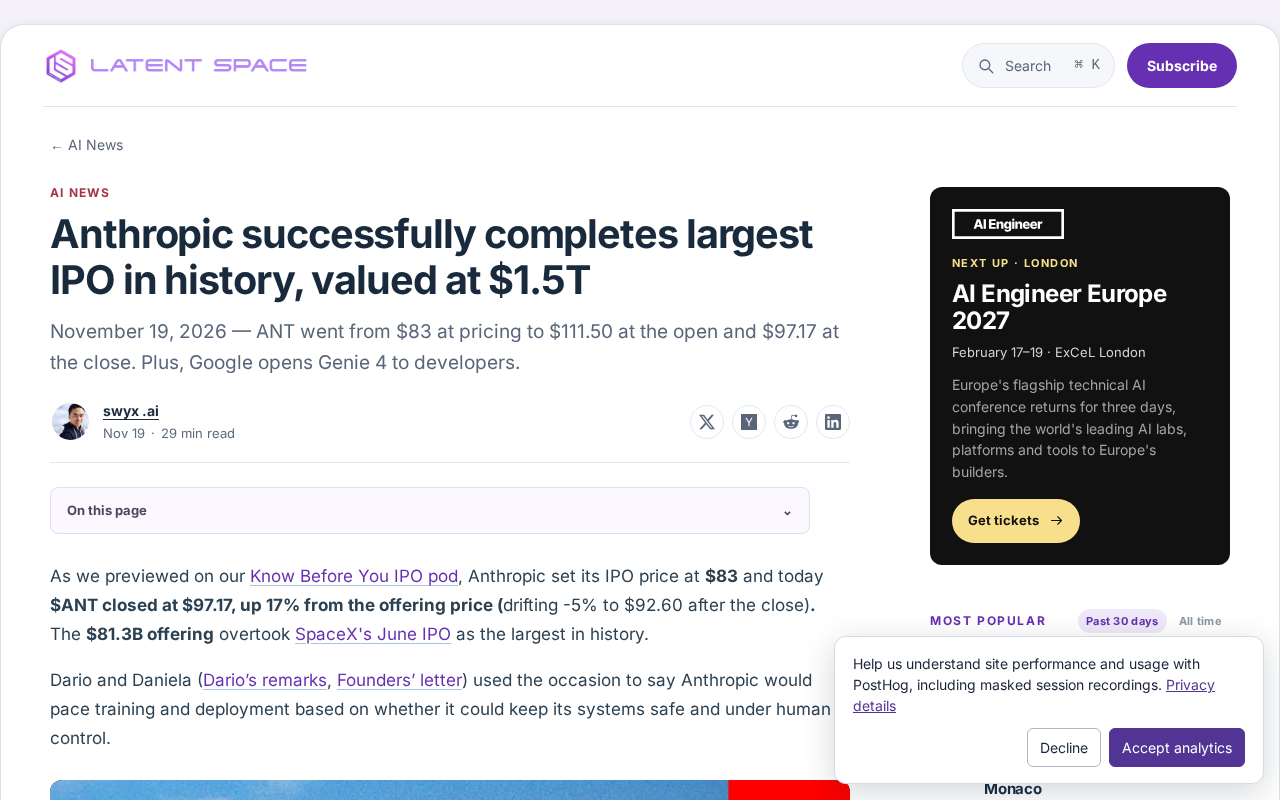
Anthropic completes the largest IPO ever at a $1.5T valuation, opening high and closing lower; Google opens Genie 4 the same day.
Anthropic completed the largest IPO in history at a $1.5 trillion valuation under ticker ANT. The stock gapped up from $83 to $111.50 on day one before closing at $97.17, a classic high-open, low-close pattern showing lingering market disagreement over leading AI valuations. The article argues this valuation signals that capital markets now treat top foundation model companies as long-term infrastructure assets, and that Anthropic's listing will serve as a key reference for future AI IPOs. On the same day, Google opened Genie 4 to developers, marking a shift in AI competition from model capability alone to a two-front battle of capital and developer ecosystems.
According to RSS reports, Anthropic (ticker: ANT) has completed the largest IPO in history, reaching a valuation of $1.5 trillion. On its first day of trading, ANT opened at $111.50—up from its $83 IPO price—and ultimately closed at $97.17, showing a classic pattern of opening high and drifting lower. Meanwhile, Google announced that Genie 4 is now open to developers.
An IPO That Rewrites the History Books
A $1.5 trillion valuation makes Anthropic a landmark event in the capitalization of the AI industry. From the $83 IPO price to the $111.50 opening price, the market priced in a premium far above the offering price right at the open; but the close falling back to $97.17 shows that the momentum buying after the open didn't translate into sustained support. The wide range on day one reflects significant disagreement in the market over how to value this AI company.
At this scale, the capital markets are treating leading foundation model companies as assets with long-term infrastructure characteristics rather than as pure tech startups. For the AI industry as a whole, Anthropic's listing path and first-day performance will serve as an important reference for future AI company IPOs.
What the First-Day Price Action Reveals
The opening price gapping well above the IPO price typically means that IPO subscribers and institutional allocation holders are cashing in profits on day one. Although the close fell back from the open, it remained above the IPO price, indicating that the market's recognition of Anthropic's fundamentals hasn't collapsed—it simply returned to rationality after the opening-day euphoria was released.
This "gap up—pullback—stabilize" pattern is not uncommon in large tech IPOs. What really matters is the price action over the following few trading days: if the stock can establish a stable range above the IPO price, it would indicate that the $1.5 trillion valuation has support from medium- and long-term capital; if it keeps drifting toward the IPO price, it could trigger a broader reassessment of valuations across the AI sector.
The "IPO price" and "opening price" that appear repeatedly in this article are two key stages in the IPO pricing mechanism. The IPO price is set by the underwriters in consultation with the company after the roadshow bookbuilding process, reflecting the pricing consensus of institutional investors before listing; the opening price is generated by the opening auction on the first trading day, reflecting the immediate bids of a broader set of buyers in a real trading environment. The spread between the two (the "first-day premium") is often seen as a thermometer of market sentiment: an excessively high premium suggests conservative pricing and rich IPO returns, but it may also front-load future upside. In addition, institutional allocations typically come with a lock-up period, usually 180 days; lock-up expirations often bring selling pressure, which is a variable that cannot be ignored when assessing the medium-term price trajectory of large IPOs.
Google Genie 4 Opens Simultaneously
Another piece of news that broke on the same day as Anthropic's IPO is that Google is opening Genie 4 to developers. The Genie series is Google's flagship product in the generative interactive environment space, and opening it to developers means this capability is moving from internal demo to external ecosystem building.
These two stories appearing in the same time window reflect a shared trend: AI competition is shifting from a contest of model capabilities to a two-front battle of capital operations and developer ecosystems. Anthropic is accessing public market capital through its IPO, while Google is competing for developer mindshare through an open platform—different paths, same goal: securing an advantageous position in the next phase of AI infrastructure competition.
The Genie series belongs to the "generative interactive environment" category, whose core idea is to let models generate interactive virtual worlds in real time based on text, images, or action commands, rather than merely outputting static content. This type of capability differs from traditional video generation models in that it emphasizes an environment that continuously evolves with user actions, placing extremely high demands on inference latency and world consistency. Opening APIs or SDKs to developers means third parties can embed this capability into game prototypes, robot simulation training, educational simulations, and other scenarios. Historically, Google's experience building ecosystems through open platforms like Android and TensorFlow shows that the scale of a developer ecosystem often determines whether a technology becomes an industry standard—which is why Genie 4's opening is seen as a strategic move.
What This Signals for the AI Industry
Anthropic's IPO at a $1.5 trillion valuation sets a capital pricing anchor for the AI industry. For AI companies still raising funds in private markets, this case provides a public-market valuation reference for leading AI assets; for investors, the first-day price swings are a reminder that even amid the AI boom, public markets will still test valuations in real time.
The IPO era for AI companies has begun, and Anthropic's first-day performance is only the first act of this long-term game.
A "public market pricing anchor" refers to the valuation formed by secondary market trading, which becomes a benchmark for primary market (private financing) negotiations. Previously, leading AI companies mostly relied on venture capital and strategic investment, with valuations lacking a continuous, verifiable market price; once a comparable company goes public, its P/E, P/S, and other metrics will be used by investment institutions to revalue unlisted peers. It's worth noting, however, that public market valuations are highly volatile and influenced by liquidity, index inclusion, macroeconomic interest rates, and other factors, and may not fully reflect a company's fundamentals. Therefore, the reference value of this anchor needs to be judged in combination with trading activity and post-lock-up price performance.
One-line Summary
Anthropic completes the largest IPO in history at a $1.5 trillion valuation, opening high and closing lower on day one; Google opens Genie 4 the same day.
Paragraph Summary
Anthropic completed the largest IPO in history at a $1.5 trillion valuation under the ticker ANT. On its first trading day, the stock gapped up from its $83 IPO price to $111.50 before closing at $97.17—a classic high-open, low-close pattern reflecting lingering disagreement over how to value leading AI companies. The article notes that this valuation means capital markets now treat top foundation model companies as assets with long-term infrastructure characteristics, and that Anthropic's listing path will serve as an important reference for future AI IPOs. On the same day, Google announced it was opening Genie 4 to developers, marking a shift in AI competition from pure model capability contests to a two-front battle of capital operations and developer ecosystems. Overall, the IPO era for AI companies has begun, and Anthropic's first-day performance is only the opening act of a long-term game.
Related articles

Multi-Agent Collaborative Development: Task Card-Driven Practices for Medium-to-Large AI Projects
A Bilibili creator shares a task card-driven, PM-orchestrated multi-Agent collaboration model with local-first repository state, so any Agent tool can take over a project anytime.
Cursor vs Copilot vs Claude Code: How Laravel Developers Should Choose
Compare Cursor, GitHub Copilot, and Claude Code for Laravel development: an AI-first editor, a plugin for existing editors, and a terminal agent for multi-file tasks and testing — plus workflow-based recommendations.
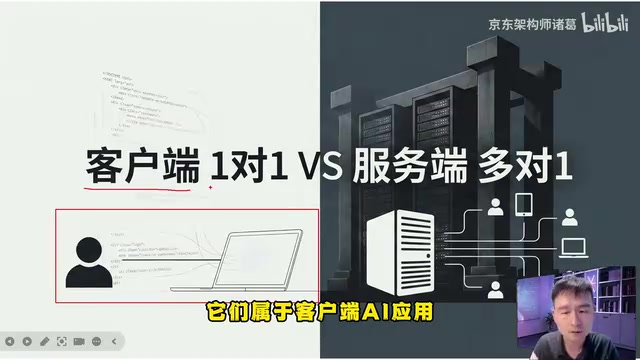
AgentScope Java Edition: A Practical Guide to Enterprise-Level Agent Frameworks
An in-depth analysis of Alibaba's AgentScope Java enterprise agent framework: contrasting client-side AI and server-side AI, explaining Java's natural advantages in high concurrency and distributed state management, and outlining a complete learning path from core principles to multi-agent collaboration.