Anthropic Confidentially Files S-1, Formally Kicks Off IPO Process
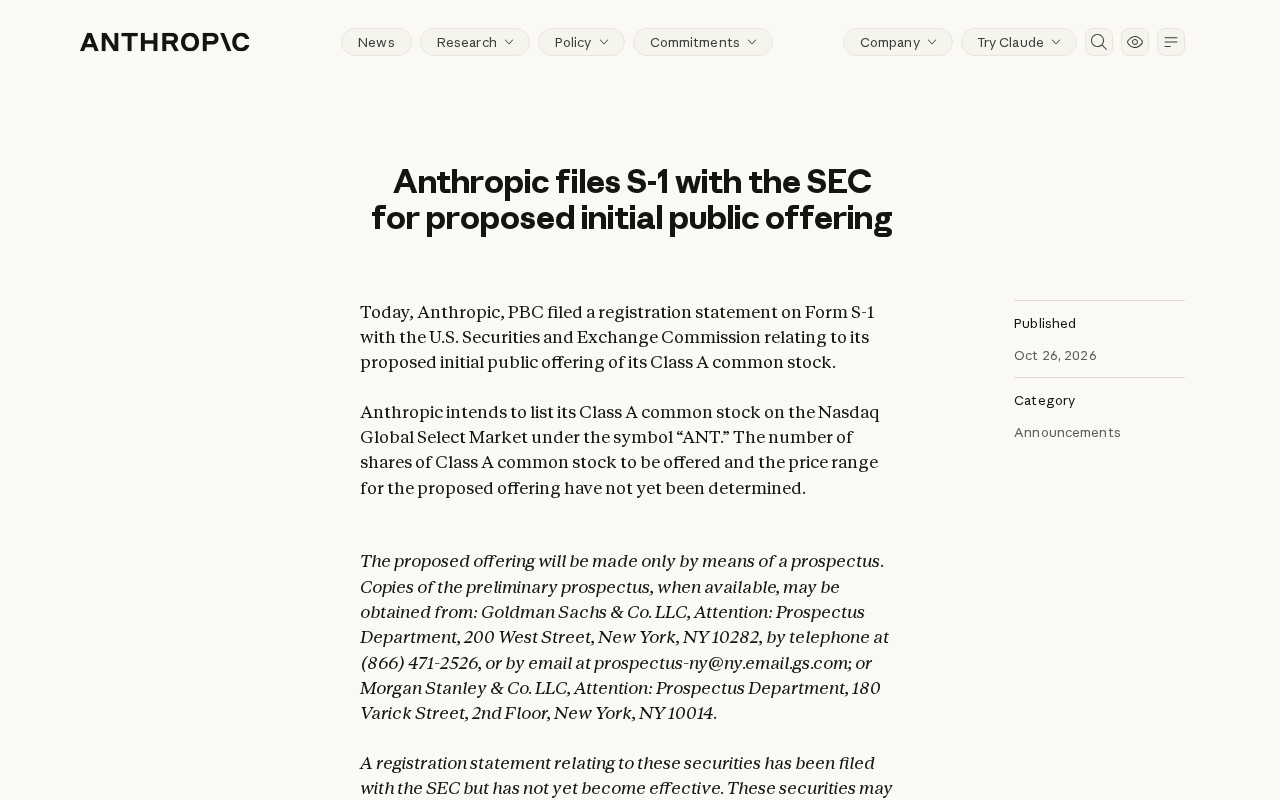
Anthropic files S-1 to launch IPO, marking the first public-market test of AI company valuations.
Anthropic has filed an S-1 with the SEC, formally launching its IPO process and marking the "safety-first" AI company known for its Claude models' shift from private to public capital markets. The S-1 requires systematic disclosure of business model, risk factors, financials, and equity structure, offering a rare business sample for the large-model industry. The listing comes as AI fundraising heats up and private capital tightens; its pricing will be the public market's first large-scale vote on AI company value.
According to Hacker News, AI company Anthropic has filed an S-1 with the U.S. Securities and Exchange Commission (SEC), formally initiating its initial public offering (IPO) process. This move means the artificial intelligence firm, best known for its Claude series of models, is beginning its transition from private markets to public capital markets.
From Research Lab to Public Company: Anthropic's Path
Anthropic was founded by former OpenAI members and has long positioned itself as a "safety-first" AI research company. Filing the S-1 marks an important turning point in its governance structure and capital strategy. Rather than continuing to rely on large private fundraising rounds, going public means stricter financial disclosure, more transparent governance requirements, and a broader base of public shareholders.
As competition in generative AI enters an infrastructure-building phase, the core question hanging over this IPO is whether the public market can assign a valuation commensurate with its technological standing. The S-1 itself has not yet disclosed offering size or price range; specific details await supplemental filings.
What the S-1 Means: The Bar for Disclosure and Compliance
The S-1 is the standard registration document for a U.S. company's IPO, requiring disclosure of business model, risk factors, financial data, equity structure, and executive compensation, among other key information. For Anthropic, this document will systematically reveal to the outside world for the first time its revenue composition, compute cost structure, and loss position.
For observers of the AI industry, the value of the S-1 lies not just in the listing itself, but in the rare, legally accountable sample of business data it provides. Publicly verifiable data on the unit economics of large-model companies has long been scarce, and Anthropic's disclosures will offer a reference point for the entire industry.
The company's shares can only begin trading on an exchange after the S-1 takes effect and the roadshow is completed — filing the S-1 is merely the starting point of the process. In practice, an S-1 typically goes through multiple rounds of amendments (filed as S-1/A), with the SEC's Division of Corporation Finance issuing comment letters on the adequacy of disclosure, to which the issuer responds by supplementing or clarifying. The "Risk Factors" section is strictly governed by U.S. securities law, and any material omission can trigger legal liability, so this section tends to be lengthy and conservative — precisely the window through which outsiders can observe a company's real concerns. In addition, the financial data in an S-1 typically covers the most recent three fiscal years and must be prepared under GAAP and audited — itself a governance upgrade for AI labs that have long been research-oriented with relatively simple financial systems.
Competitive Landscape and Market Signals
Anthropic's listing move comes at a moment when the AI fundraising race continues to heat up. Leading model developers are steadily ramping up spending on compute, talent, and enterprise customers, and the funding capacity of private markets is gradually becoming a constraint. Choosing to launch an IPO now is both an expression of confidence in its own growth story and a practical consideration to stockpile ammunition for future expansion.
From a market-signal perspective, Anthropic's IPO pricing will be the public market's first large-scale vote on "how much an AI company is really worth." The outcome is likely to influence the fundraising pace and valuation expectations of other AI startups.
The cost structure of large-model companies has a distinct "front-loaded, asset-heavy" character: the GPU compute, data centers, and electricity expenses required for training and inference occur before revenue, and climb rapidly as model scale expands. This makes traditional SaaS valuation frameworks (such as ARR multiples and gross margins) difficult to apply directly, and public-market investors will need new analytical tools to judge the unit economics of such businesses. At the same time, AI companies commonly sign multi-year contracts with cloud providers in the form of "compute commitments"; such arrangements, which are off-balance-sheet or long-term liability in nature, will surface in the S-1's disclosure of contractual obligations and become a key clue for assessing true financial leverage. This also explains why Anthropic's S-1 is seen as a stress test for the entire industry's valuation methodology.
Variables Still to Watch
At present, the only public information is the fact of the S-1 filing itself; the offering timetable, underwriter lineup, and use of proceeds have not been disclosed. AI company valuations depend heavily on expectations of future growth, while public markets typically have less patience for the path to profitability than private capital — a reality Anthropic will need to confront.
In addition, the regulatory environment, model safety reviews, and enterprise customer concentration are all likely to be focal points of the S-1's risk factors section. Disclosures in subsequent amended filings will be worth continued attention.
Related articles

The Most Systematic Agent Development Course on Bilibili: From Zero to Enterprise-Level Practice
An in-depth look at a systematic Agent development course on Bilibili: prompts, tool calling, memory and context management, knowledge bases, and multi-agent collaboration, with practical projects aligned to enterprise hiring.

Career Switch to AI Agent Development from Zero: A Comeback Path for Non-Elite University Grads
A Bilibili UP host shares: computer science jobs are hard to land, but AI Agent development is inclusive of educational background — beginners need Python, RAG, Tool Use, and LangChain for opportunities at small and mid-sized companies.

Is the AI Bubble About to Burst? Users Angrily Ask When Local Models Will Catch Up to Opus
Reddit users complain about cut AI subscription usage, say Opus 5.5 is good enough, and want equal-quality local models—hoping they pressure subscriptions and pop the AI bubble.