Is the AI Bubble About to Burst? Users Angrily Ask When Local Models Will Catch Up to Opus

Users say Opus 5.5 is good enough; the real complaint is usage limits, and they hope local models pressure subscriptions.
A Reddit user posted that Opus 5.5 is already "good enough" for coding and 3D work and that he isn't chasing stronger models. What really bothers him is subscription usage limits and one-sided rule cuts, forcing him to constantly calculate "how much work can I still get done today." He therefore asks how long local models will take to catch up to Opus, and hopes their rise will pressure the subscription business and even pop the AI bubble. The article argues this sentiment reflects a shift in users' focus from model capability to controllability: marginal returns from frontier capability are diminishing, while the certainty of local deployment—unlimited calls, data never leaving the machine—is rising. Still, local models face hardware barriers and maintenance costs, and subscription value extends beyond the model itself; this shift is more a accumulating pressure signal than a prophecy of the bubble bursting.
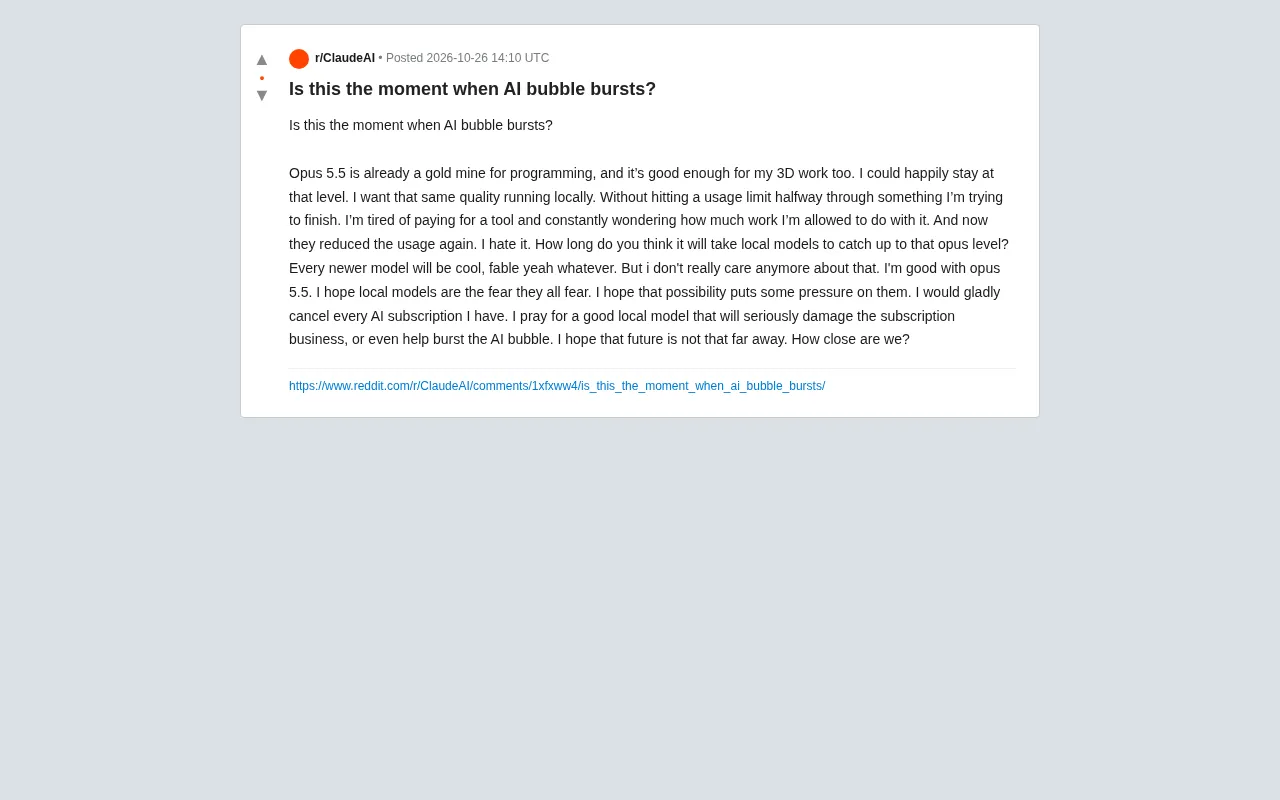
A Reddit user's post recently struck a chord with many: he admitted that Opus 5.5 is already "good enough" for coding and 3D work, that he isn't chasing a more powerful model, and that all he wants is an equivalent-quality tool he can run locally—one that doesn't hit usage caps and doesn't force him to constantly calculate "how much work can I still get done today." After his subscription service cut usage limits yet again, he couldn't help but ask: how long will it take for local models to catch up to Opus? He even hopes the rise of local models will put pressure on the subscription business and become the needle that pops the AI bubble.
The User's Pain Point: It's Not That the Model Isn't Strong Enough—It's That They're Afraid to Use It
The most interesting thing about this post is that it doesn't complain about insufficient model capability. On the contrary, the poster explicitly states that Opus 5.5 is "good enough" for coding and 3D work and that he "could happily stay at that level." What he's really unhappy about is the friction of the business model: he pays, yet has to constantly worry about usage limits, and a task might hit the quota ceiling halfway through.
This sentiment is not an isolated case. Once a tool's capability crosses the "good enough" threshold, users' attention naturally shifts to controllability—can I use it anytime, how much can I use, and will it be quietly downgraded? The post mentions "they reduced the usage again," and this kind of one-sided rule change is the most direct trigger for heavy users.
Opus 5.5 refers to the high-end model in Anthropic's Claude series (Opus is the flagship tier, while Sonnet and Haiku cover the mid- and low-end). These subscription services typically use time-window-based usage limits, such as the number of messages per 5 hours or per week, or the total tokens that can be consumed, after which users must wait for the window to reset or upgrade to a more expensive plan. When vendors adjust these thresholds during peak periods or under cost pressure, users experience it as a sudden shrinking of available capacity. For heavy users who rely on the model for long tasks, this uncertainty affects actual output more than the capability gap itself—because the cost of redoing an interrupted coding or 3D modeling task is often far higher than the difference in per-call fees.
How Far Are Local Models from Catching Up to Opus?
The poster's core question is very specific: how long will it take for local models to reach Opus level? He doesn't give a timeline, and the post contains no reference progress data, but the question itself reflects a reality—there is still a perceptible gap between open-source local models and top closed-source models; otherwise he wouldn't discuss "catching up" as an event to wait for.
His attitude is also very representative: "Every newer model will be cool... But i don't really care anymore about that." For some users, the marginal benefit of frontier capability is diminishing, while the certainty brought by local deployment—unlimited calls, data never leaving the machine, immunity to changes in terms of service—is rising in value. In other words, the focus of competition is shifting from "whose model is stronger" to "who can make users feel safe using it."
"Local models" refer to models run on users' own hardware via open-source weights, typically including Meta's Llama series, Mistral, Qwen, and various quantized derivatives. They run on inference frameworks such as llama.cpp, Ollama, and LM Studio, and users can run models with 7B to 70B parameters on consumer-grade GPUs (such as an RTX 4090 with 24GB of VRAM) or Apple Silicon devices with unified memory. Quantization techniques (such as 4-bit GGUF) can greatly reduce VRAM usage but come with some precision loss. Current open-source models are approaching usable levels for general conversation and moderately complex coding tasks, but there is still a perceptible gap compared with top closed-source models in long-context reasoning, complex tool calling, and multi-step agent tasks.
Can Local Models Really Pop the AI Bubble?
The sentiment at the end of the post is quite blunt: "I hope local models are the fear they all fear." He hopes local models will deal a substantial blow to the subscription business and even help the bubble burst.
This needs to be viewed calmly. Even if local models match in capability, deployment costs, hardware barriers, and maintenance complexity remain obstacles for ordinary users; and the value of subscriptions is not just the model itself but also infrastructure, updates, and ease of use. However, this shift in user mentality is worth vendors' vigilance: when "good enough" becomes the consensus, willingness to pay will be re-examined. The user's statement that he "would gladly cancel every AI subscription" is less a prophecy than a pressure signal that is accumulating.
The discussion of the "AI bubble" usually revolves around a core contradiction: AI infrastructure investment (data centers, GPU procurement, electricity) is in the hundreds of billions of dollars, while whether the corresponding revenue growth can match remains questionable. Subscriptions are one of the most mainstream monetization paths today, and their pricing logic is built on the scarcity created by continuously leading model capability. If the capability of local open-source models catches up to a "good enough" level, some users may exit paid services, thereby compressing vendors' revenue expectations. But it's important to distinguish: whether the bubble bursts depends on the overall return on capital, not on the migration willingness of a single user group; the revenue base formed by enterprise customers, API integration scenarios, and compliance needs is not on the same level as individual developers' sensitivity to usage limits.
What This Discussion Really Points To
Putting the post back into a larger context, it touches on a mandatory question for AI commercialization: at a stage where capability growth is slowing and user demand is stabilizing, how can subscriptions prove their ongoing value? Relying on continuously stacking stronger models to sustain payments may run into more and more users who say, "I don't need stronger, I just need more freedom."
As for "is this the moment the bubble bursts," the post has no answer, nor should a single post answer it. But it clearly shows a shift: users are starting to vote with their feet and pin their hopes on local models. Whether this expectation can be fulfilled will determine the competitive landscape of AI products in the next stage.
One-line Summary
Users say Opus 5.5 is good enough; what they're really unhappy about is usage limits, and they hope local models will pressure the subscription model.
Related articles

LangGraph in Production: The Pain of Silent API Changes
Explores the challenge of silent external API changes affecting LangGraph agents in production, analyzes monitoring and testing limits, and proposes semantic validation and regression testing defenses.

Salesforce CRM Hands-On Test: Performance and Cost Deep Comparison of 5 AI Agents
Hands-on comparison of 5 AI agents in Salesforce CRM: Claude Opus leads at 87% accuracy, DeepSeek hits 82% at 1/75 the cost. Key findings on tool false positives, self-checking, and automatic field changes.

Conference Badge Turned Game Boy Color: A Gemini-Assisted Hardware Hack
The GitHub Universe conference badge was hacked into a device that runs Game Boy Color emulators. Steve Francia used Gemini to port NES and Game Boy emulators; this article analyzes AI's real role in hardware hacking and the evolution of conference badges.