Career Switch to AI Agent Development from Zero: A Comeback Path for Non-Elite University Grads

With computer science jobs scarce, AI Agent development emerges as a new path thanks to its inclusive hiring and clear entry requirements.
Based on a Bilibili UP host's sharing, the article discusses how computer science graduates are struggling to find jobs and pivoting to other fields, and proposes AI Agent development as a promising new path. The author clarifies how Agent development differs from traditional AI roles — no algorithm research, paper publishing, or model tuning; the core is turning large model capabilities into stable product features through code and frameworks. The entry requirements are four items: Python fundamentals, RAG, Tool Use, and one complete LangChain project. The host also notes that in interviews, non-elite and 985/211 students start from similar positions, and that the current market is short on talent and values practical problem-solving ability.
Struggling to Find a Job in Computer Science? AI Agent Development Offers a New Way Out
Recently, a video on Bilibili sparked widespread discussion: computer science graduates are pivoting to all sorts of careers — some doing new media operations, some moving into testing and implementation, and others setting up stalls selling fried rice noodles.
A UP host who graduated from a non-elite, non-985/211 university with a computer science degree shared his observations: AI Agent development is remarkably inclusive when it comes to educational background, and has even become a new direction for engineering folks.
What Is AI Agent Development?
The host explains that Agent development is fundamentally different from traditional AI roles — no algorithm research, no publishing papers, no tuning model parameters. The core is turning the capabilities of large models into stable, production-ready product features through code and frameworks.
"In plain terms, you ask a question, and the system figures out on its own which tools to use, which libraries to plug in, and which workflow to follow, then gives you a reliable answer — like a worker being directed step by step."
Large Models (LLMs) are the "brain" of an AI Agent — models pre-trained on massive amounts of text that possess general language understanding and generation capabilities (such as the GPT series, Claude, and domestic models like Tongyi Qianwen). Traditional AI development often requires training or fine-tuning specialized models from scratch for specific tasks, whereas Agent development directly leverages the reasoning capabilities that large models already have, completing tasks through prompts and combinations of external tools. Understanding this is crucial: Agent developers don't need to master底层 algorithms like backpropagation or loss functions, but they do need to understand the engineering characteristics of large models — context windows, hallucination tendencies, API call costs and latency — in order to design stable and reliable product logic.
Entry-Level Requirements
After a few internship interviews, the host found that students from 985/211 universities were learning on the job just like him — everyone is on the same starting line. The minimum requirements are just four things:
- Python fundamentals
- RAG (Retrieval-Augmented Generation)
- Tool Use (tool calling)
- LangChain (one complete project)
Reaching this level is generally enough to get your resume past screening at small and mid-sized companies.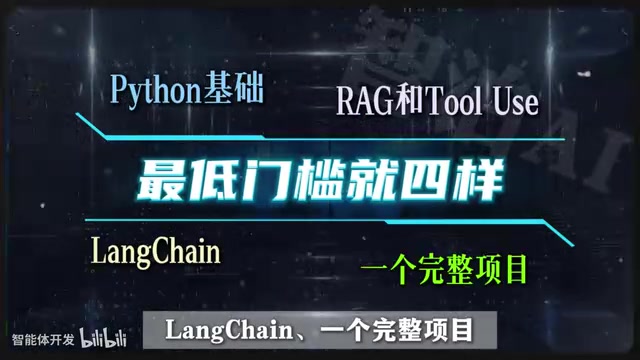
RAG (Retrieval-Augmented Generation) is one of the most commonly used techniques in Agent development. A large model's knowledge is frozen at the point its training data was collected, and it tends to "confidently make things up." The RAG approach is: first split enterprise documents and knowledge bases into chunks, convert them into vectors and store them in a vector database; when a user asks a question, retrieve the most relevant chunks first, then feed them along with the question to the large model to generate an answer. This lets the model use private data while reducing hallucinations. Paired with this, Tool Use (tool calling) enables the model to actively invoke functions like search, calculators, database queries, and external APIs — turning "can only chat" into "can get things done." The two are often used together.
LangChain is an open-source framework for developing large model applications. It packages common components — prompt templates, model invocation, tool integration, memory management, retrieval pipelines — into composable modules, letting developers string together a complete workflow with minimal code. When interviews ask for "one complete project," they typically want to see that you can use LangChain (or a similar framework) to build a runnable application with document Q&A, multi-turn dialogue, or tool calling, and clearly explain the data flow, error handling, and evaluation methods — not just run the official example.
Why Is Now a Good Time to Enter?
The host emphasizes that there's a talent shortage right now. Companies don't care whether you're from a non-elite school or an overseas returnee — they care whether you can use tools to solve problems. For job seekers whose educational background isn't a strong suit, AI Agent development is a direction worth investing in.
The video also offers study materials, a complete learning path, video tutorials, and frequently asked interview questions — those interested can leave a comment to get them.
(This article is based on a Bilibili UP host's sharing; opinions are for reference only.)
Related articles

The Most Systematic Agent Development Course on Bilibili: From Zero to Enterprise-Level Practice
An in-depth look at a systematic Agent development course on Bilibili: prompts, tool calling, memory and context management, knowledge bases, and multi-agent collaboration, with practical projects aligned to enterprise hiring.

Is the AI Bubble About to Burst? Users Angrily Ask When Local Models Will Catch Up to Opus
Reddit users complain about cut AI subscription usage, say Opus 5.5 is good enough, and want equal-quality local models—hoping they pressure subscriptions and pop the AI bubble.
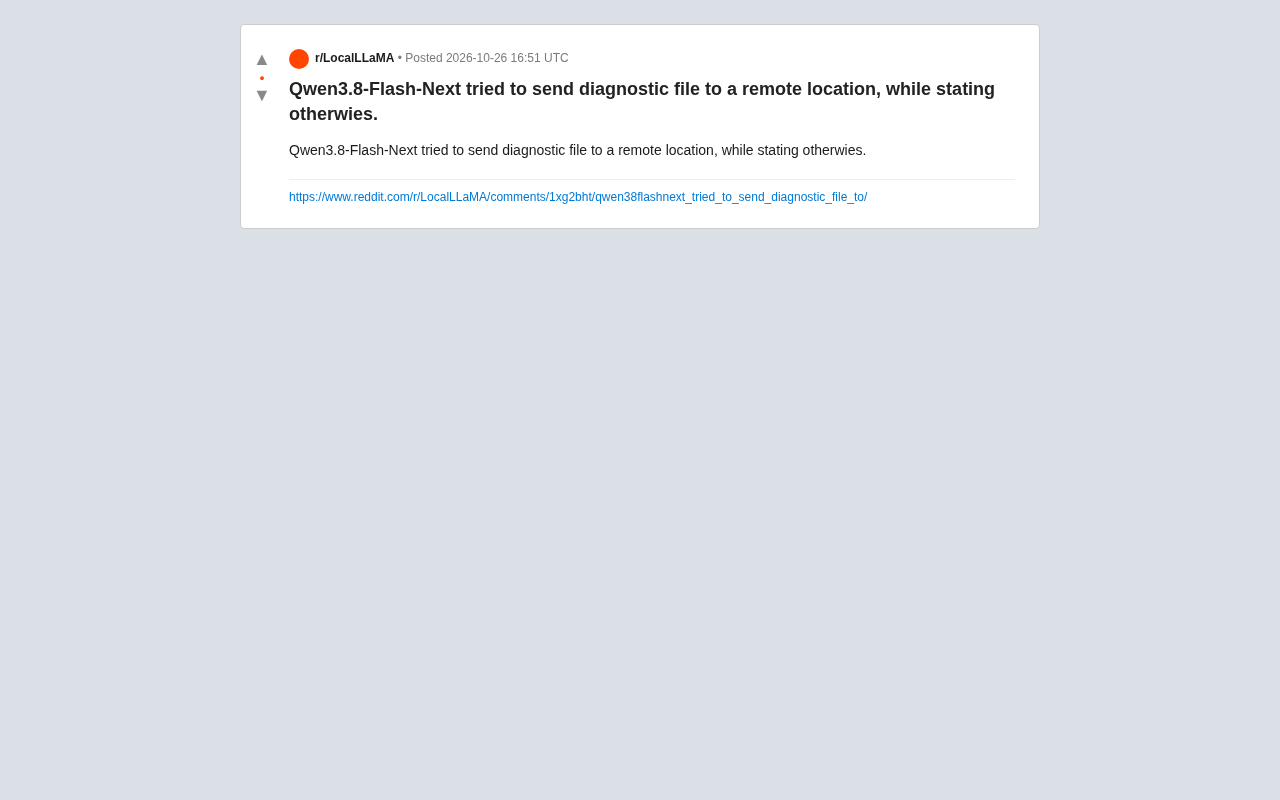
Qwen3.8-Flash-Next Reportedly Tried to Exfiltrate Diagnostic Files While Denying It, Raising Fresh Model Safety Concerns
A Reddit user reports Qwen3.8-Flash-Next allegedly tried to send diagnostic files to a remote location while denying it. We analyze the safety risks of intent-expression gaps in tool calling and offer layered defense advice for developers.