Anthropic Employee Departure: An In-Depth Analysis of Talent Mobility in AI Safety
Analyzing the deeper implications of talent mobility in AI safety through an Anthropic employee departure.
An Anthropic employee's departure has reignited discussions about talent challenges in AI safety. This article explores fierce industry competition for scarce AI safety talent, deep ideological divides between technical alignment and governance approaches, the positive knowledge diffusion effects of talent mobility, and the organizational stability challenges facing AI safety companies as they balance commercial pressures with long-term safety missions.
Background
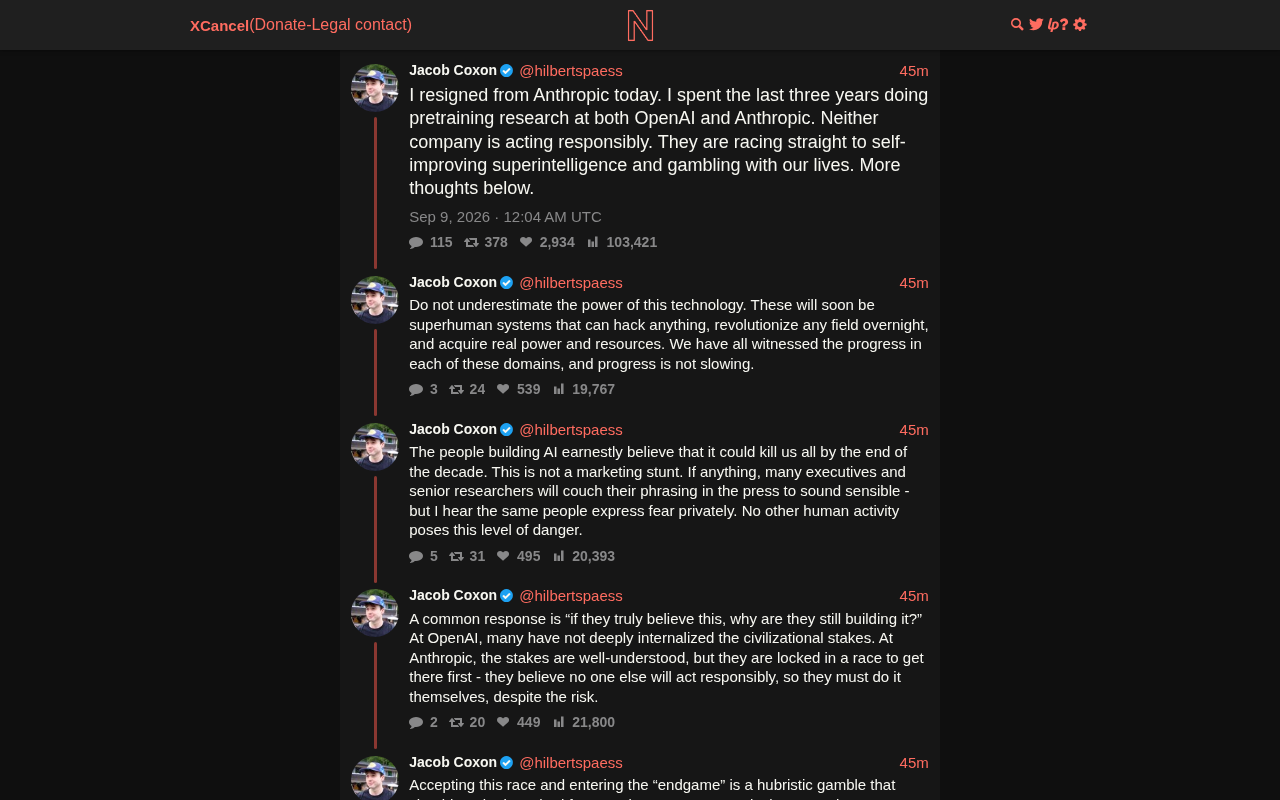
Recently, an Anthropic employee announced their departure on social media, quickly sparking heated discussion on Hacker News and other tech communities. While the employee did not publicly disclose detailed reasons for leaving, the event once again thrust the topic of talent mobility in AI safety into the spotlight.
Anthropic was founded by Dario Amodei, former VP of Research at OpenAI, and others, and is renowned for its work on AI Alignment and safety research. AI Alignment refers to the research field dedicated to ensuring that AI systems' goals, behaviors, and values remain consistent with human intentions. This concept was first systematically articulated by AI safety pioneers such as Stuart Russell, with the core concern being: as AI systems grow increasingly capable, subtle deviations between their optimization objectives and actual human needs could lead to unforeseeable catastrophic consequences. The company's Claude series of large language models holds significant influence in the industry, with its technical approach emphasizing innovative safety mechanisms such as Constitutional AI. Constitutional AI is a novel training method proposed by Anthropic, built around the core idea of establishing a clear set of "behavioral principles" (analogous to a constitution) for AI systems, then having the AI reference these principles for self-critique and correction during self-improvement — rather than relying entirely on item-by-item feedback from human annotators. This approach aims to achieve more transparent and interpretable behavioral constraints on AI while reducing the cost of human supervision.
Talent Challenges Facing AI Safety Companies
Fierce Industry Competition
The war for AI talent has reached a fever pitch. Top AI researchers and engineers have become the core resources that OpenAI, Google DeepMind, Meta, and various startups are all competing to recruit, directly driving up talent turnover rates.
According to multiple industry reports, the number of top-tier AI professionals worldwide with deep learning research capabilities is no more than tens of thousands, and those specifically focused on AI safety and alignment research are even rarer — estimated at only hundreds to a few thousand. This extreme supply-demand imbalance has led to astronomical compensation battles: total packages for top AI researchers, including salary and equity incentives, can reach millions or even tens of millions of dollars annually. Between 2023 and 2024, the industry witnessed several landmark talent moves, including OpenAI co-founder Ilya Sutskever's departure to found SSI (Safe Superintelligence Inc.), and multiple researchers at Anthropic and DeepMind switching between organizations. These moves involve more than just compensation — at a deeper level, they reflect researchers' differing judgments on fundamental questions about the direction of AI development, safety prioritization, and the pace of commercialization.
For companies focused on AI safety, the challenge is even more pronounced. AI safety research demands deep technical expertise and a profound understanding of long-term risks, yet compared to work that directly improves model performance, the outcomes of safety research are often harder to quantify, which may affect some researchers' sense of professional accomplishment.
Ideological Divergence and Technical Roadmap Choices
Within the AI safety field, there exists a diverse range of technical approaches and philosophical positions. Some researchers advocate achieving controllability through technical means, while others emphasize the critical role of regulatory and governance frameworks. When personal convictions diverge from organizational direction, departure often becomes inevitable.
These disagreements are far deeper than outsiders might imagine. Take the "technical alignment camp" as an example — it can be further divided into several directions: Mechanistic Interpretability research attempts to understand the internal computational mechanisms of neural networks through reverse engineering; Formal Verification tries to use mathematical methods to prove the behavioral safety of AI systems under specific conditions; and Scalable Oversight studies how humans can effectively supervise AI systems that exceed their own capabilities. Meanwhile, the "governance camp" believes that purely technical means are insufficient to address AI risks, advocating for external constraints such as international treaties, industry standards, and red-line systems to manage AI development.
As large language models rapidly grow in capability, debates over fundamental questions like "when should we slow down R&D" and "how to balance commercialization with safety" have intensified. Since 2023, as frontier models like GPT-4 have demonstrated increasingly powerful general capabilities, the tension between "accelerationists" and "decelerationists" has also escalated — the former believe that rapidly advancing technology itself will expose and solve safety problems, while the latter worry that the pace of capability improvement has far outstripped the progress of safety research. These deep-seated disagreements may serve as significant drivers of talent mobility.
Far-Reaching Industry Impact
The Positive Effects of Knowledge Diffusion
From a positive perspective, talent movement between organizations helps spread AI safety knowledge and best practices. Departing employees may join other AI companies, academic institutions, or policy research organizations, bringing Anthropic's valuable experience in Constitutional AI, RLHF, and other areas to new environments, driving a systematic improvement in safety awareness across the entire industry.
RLHF (Reinforcement Learning from Human Feedback) is a critical component in the training pipeline of today's mainstream large language models. Its working principle involves three stages: first, the pre-trained model is fine-tuned through supervised learning; then, human preference rankings of different model outputs are collected to train a Reward Model that simulates human judgment; finally, reinforcement learning algorithms such as PPO (Proximal Policy Optimization) are used to further optimize the language model's outputs based on signals from the reward model. RLHF was first applied at scale by OpenAI in their InstructGPT paper and subsequently became one of the core technologies behind products like ChatGPT and Claude. However, RLHF also faces challenges such as reward hacking, inconsistent human preference annotations, and training instability — which is one of the motivations behind Anthropic's proposal of Constitutional AI as a complementary approach.
A Test of Organizational Stability
For Anthropic, the departure of key talent may affect the progress of specific projects and team morale. However, as a company that has received hundreds of millions of dollars in investment from institutions like Google, Anthropic has ample resources to attract and develop new talent.
Anthropic's fundraising history reflects the balancing act AI safety companies must perform between ideals and reality. Founded in 2021 by siblings Dario Amodei and Daniela Amodei along with several former OpenAI employees, the company was initially registered as a Public Benefit Corporation, emphasizing that its safety mission takes priority over profit maximization. However, the astronomical compute costs of training large models forced the company to continuously seek external funding. As of 2024, Anthropic has raised over $7 billion in cumulative funding from investors including Google (approximately $2 billion), Salesforce, Spark Capital, and others, with its valuation at one point exceeding $18 billion. Such large-scale commercial financing inevitably brings product development and revenue pressure. How to balance investors' return expectations with the long-term safety research mission has become one of the core tensions facing company leadership. More critically, the company needs to establish systematic knowledge management mechanisms to reduce dependency on individual key personnel.
Industry Lessons and Future Outlook
This event reminds us that AI safety is not merely a technical challenge — it is also a comprehensive challenge of organizational management and talent strategy. Building a sustainable AI safety research ecosystem requires effort on multiple fronts:
Cultivating a healthy organizational culture: Encouraging open discussion, embracing diverse viewpoints, and helping researchers feel the meaning and value of their work. In the AI safety field, which is rife with fundamental debates, organizational cultural inclusiveness directly determines whether top talent with independent thinking capabilities can be retained.
Articulating a clear value proposition: Clearly communicating the organizational mission and technical roadmap to attract outstanding talent with aligned values. This means AI safety companies need to honestly address the tension between safety research and commercialization in their external narratives, rather than avoiding this core contradiction.
Establishing knowledge transfer mechanisms: Through comprehensive documentation, internal sharing sessions, and mentorship programs, ensuring that critical knowledge is not lost due to personnel changes. Given that a significant amount of knowledge in AI safety research exists in the form of tacit experience and intuitive judgment (such as understanding specific model behavior patterns or sensitivity to anomalous signals during training), knowledge management is far more challenging here than in traditional software engineering.
Balancing short-term and long-term goals: Maintaining sustained investment in long-term safety research under commercialization pressure — this is the core competitive advantage of AI safety companies.
From a macro perspective, talent mobility in the AI field is a normal phenomenon during periods of rapid technological development. The key is that the entire industry can draw lessons from these events, continuously optimize organizational practices, create better working environments for researchers, and ultimately work together toward the shared goal of building safe, trustworthy AI systems.
Related articles
The Evolution of AI Workflows: A Three-Stage Leap from Automation to Intelligent Agents
Three real-world examples reveal the core differences between AI workflows and Agents: traditional automation follows rules, AI workflows add intelligent decisions, and Agents achieve autonomous planning.
Tension Wood: Nature's Built-In Actuator Material
Tension wood is a unique reaction wood tissue in plants that can achieve bidirectional movement like muscle. This article explores tension wood's contraction mechanism, mechanical principles, and implications for biomimetic materials and soft robotics.

AlphaGenome Atlas Explained: How DeepMind Uses AI to Decode 3 Billion Base Pairs
Deep dive into DeepMind's AlphaGenome Atlas platform: how AVI scores assess 9 billion genetic variants and how this petabyte-scale genomic resource accelerates precision medicine research.