Anthropic Files S-1: A $500 Billion Bet and Founder Absolute Control

Anthropic files its S-1 for an IPO, pairing rapid growth with massive compute commitments and founder control.
Anthropic filed its S-1 with Nasdaq on October 26, 2026, planning to list as ANT. Revenue soared from $41 million in 2023 to $16.3 billion in H1 2026, with Q2 operating profit of $974 million—its first—but a net loss of $80.7 billion, $72 billion of it non-cash convertible debt revaluation. Compute spending hit $8.9 billion in H1 2026, and post-2025 contracts commit about $417 billion, while Amazon and Google are shareholders, suppliers, and channels. Most notably, five share classes cap public voting power at 49.9%.
Anthropic has finally taken the key step toward an IPO. The AI company, which has never achieved an annual profit, filed its S-1 with Nasdaq on October 26, 2026, planning to list under the ticker "ANT." The filing reveals an astonishing growth curve—alongside equally astonishing cost commitments and a share structure that leaves public shareholders with almost no ability to influence decisions.
From OpenAI Departure to a Hundred-Billion Valuation: A Five-Year Growth Trajectory
In 2021, seven researchers left OpenAI to found Anthropic, with Dario Amodei as CEO and Daniela Amodei as President. Five years later, all seven co-founders remain at the company. Dario Amodei once explained the departure to Fortune: they believed larger models would keep getting better, but safety requires more than scale.
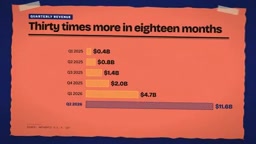
The company's growth has been driven almost entirely by developers. When Claude launched in 2023, annual revenue was just $41 million; it reached $386 million in 2024 and $4.6 billion in 2025. After the Claude Code preview in February 2025, quarterly revenue soared from $376 million in early 2025 to $11.6 billion in Q2 2026. As of the end of September 2026, more than 1,900 customers were paying over $1 million annually.
Valuation swelled accordingly: $61.5 billion in March 2025, $183 billion six months later, $380 billion in February 2026, and $965 billion after a $65 billion round in May—at one point surpassing OpenAI.
Accounting Magic and Real Losses: The Truth Behind the $80.7 Billion Net Loss
In Q2 2026, Anthropic posted operating profit of $974 million for the first time. But overall operations still lost $693 million in the first half, and the net loss reached a staggering $80.7 billion. That astronomical figure stems mainly from accounting: $72 billion of it comes from the revaluation of convertible debt, because the company's own value surged dramatically—with no cash outflow.
The real cash burn is equally striking. Operating losses alone reached $8 billion in 2025, and the S-1 warns that costs will continue to rise and losses will persist. The largest cost item is compute: $8.9 billion in the first half of 2026, more than half of revenue.
Convertible debt is a hybrid financing instrument: investors first provide funds as debt, which under agreed conditions (such as an IPO or the valuation reaching a certain threshold) can be converted into equity at a preset price. In accounting terms, when the company's own valuation rises sharply, the fair value of the conversion right increases accordingly, and under U.S. GAAP this must be recognized in the income statement as a fair-value change loss—creating a huge book loss without any accompanying cash payment. Conversely, if the valuation falls, a non-cash "gain" appears on the books. Such losses are therefore a different concept from operating cash burn: the former reflects the company's financing structure, while the latter reflects the true pace of cash consumption. When reading an S-1, investors should typically combine the cash flow statement and free cash flow to judge the company's actual financial health.
$417 Billion in Compute Commitments: The Landlord Is Also a Shareholder
The S-1 itemizes compute contracts: at least $114 billion to Google (through 2033), at least $110 billion to Amazon (through 2036), at least $45 billion to Microsoft, up to $120 billion in compute purchased from SpaceX's AI division (formerly xAI), and roughly $160 billion in equipment leases. The total minimum payments under contracts signed after the 2025 accounts amount to about $417 billion. Analysts add the items together to arrive at total commitments exceeding $500 billion—the origin of the "$500 billion bet" in the headline.
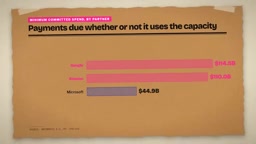
More subtly, Amazon and Google are both landlords and shareholders. Amazon had already invested $8 billion by 2024, and in 2026 the two companies pledged billions more, partly tied to Anthropic hitting compute milestones. In the first half of 2026, 48% of revenue came through these two companies' cloud marketplace channels. Investor, supplier, sales channel, and competitor—four roles in one—and the S-1 acknowledges this may create conflicts of interest. The company's top five customers contribute about a quarter of revenue, and many lack long-term contracts.
Five Share Classes: A 49.9% Voting Cap
The most unusual part of the S-1 is the control arrangement. Anthropic will establish five classes of stock: Class A shares sold to the public carry one vote each, but the combined voting power of all Class A shares is capped at 49.9%. Class F consists of a single share, held by a company owned by the seven co-founders, carrying 50.1% of voting power but no rights to profit distribution. Class T is likewise a single share, held by a trust, which does not vote at shareholder meetings but directly elects a majority of board members. Class N carries profit rights but no voting rights, held mainly by strategic partners such as Amazon and Google. Class E is for employees and can vote only on a few limited matters.
The trust is called the "Long-Term Benefit Trust" and has five seats, one of which is vacant; one of the four trustees is former Federal Reserve Chair Ben Bernanke. Trustees may not hold company shares, but the filing acknowledges that in practice they work closely with Anthropic executives to select new trustees. The S-1 states plainly that this structure "may effectively eliminate the ability of Class A shareholders to influence important decisions (including a sale of the company)."

Founder control is nothing new—Fortune compares it to the structures of Zuckerberg, Musk, and The New York Times. What is new is the stated rationale: mission. The company is also contributing 5% of its shares to its own public interest fund, and each co-founder has pledged to donate 80% of their estate, with each holding about 240 million shares—value dependent on an offering price not yet determined.
Dual-class or multi-class share structures are not uncommon among tech companies—Google, Meta, and Snap being typical examples—and their core purpose is to give founders high-voting-power shares so management can retain control of the company's direction after going public. But Anthropic's design goes further: the voting power of public Class A shares is set at a hard aggregate cap of 49.9%, rather than calculated naturally by ownership percentage; Class F carries 50.1% of voting power in a single share, and the single Class T trust share directly controls a majority of board seats. Such arrangements typically require meeting the "controlled company" exemption under U.S. exchange listing rules, which can waive governance requirements such as a majority of independent directors. Nasdaq and NYSE permit such structures, but they must be fully disclosed in the prospectus, and investor protection relies primarily on disclosure rather than voting rights.
A 90-Page Risk List: From Government Lawsuits to Softened Safety Commitments
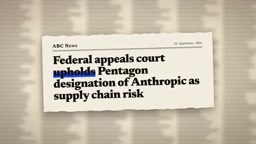
The S-1's risk factors exceed 90 pages. The filing acknowledges that advanced AI could pose catastrophic or existential risks to humanity. The most unusual risk involves the U.S. government: Anthropic says its technology should not be used for mass domestic surveillance or fully autonomous weapons, and in February 2026 the President promptly directed all federal agencies to stop using its technology, with the Pentagon designating it a national security supply chain risk. Anthropic sued; in August a federal judge in California ruled the measures were retaliation against protected speech, but in September a Washington appeals court ruled 2-1 that one of the determinations was lawful, and the company has requested en banc review. Government contracts account for only about 1% of its revenue; the real risk is that government suppliers may avoid it as well.
Meanwhile, according to Time, Anthropic revised its own safety rules, abandoning its flagship commitment not to train models "unless we can guarantee adequate safety measures in advance." Co-founder Jared Kaplan argued that unilaterally stopping does not truly help anyone when others continue to push forward. In September, a departing researcher warned that AI labs are "gambling with our lives."
In a leaked memo first reported by Wired in 2025, Amodei acknowledged that seeking investment from the UAE and Qatar could enrich dictators, writing, "This is a real downside, and I'm not excited about it." The filing also estimates that 5% to 7% of revenue this year came from customers later found to have violated its usage rules.
Comparison with OpenAI: Different Standards, Different Stories
Anthropic was born to be different from OpenAI. OpenAI completed its restructuring in 2025, with a nonprofit foundation controlling the company and Microsoft holding about 27%. According to The Wall Street Journal, in Q2 2026 OpenAI had revenue of $6.7 billion and an operating loss of $12.3 billion; Anthropic had revenue of $11.6 billion, but the two companies recognize revenue differently, so they are not strictly comparable. OpenAI is negotiating financing at a $1.25 trillion valuation and is expected to go public in 2027. Anthropic has not yet priced its offering; reports say Wall Street is discussing a range of $1.5 trillion to $2 trillion, with trading possibly starting in mid-November. Analysts are divided, with some institutions already calling it "the most absurd IPO of 2026" and others seeing it as a generational moment.
The S-1 makes one thing clear: Anthropic was founded on the belief that "AI could be the most dangerous technology ever." Five years later, it is asking the public to fund this race on the founders' terms.
Differences in revenue recognition are one of the key reasons financial data across AI companies is hard to compare directly. In cloud vendor channel sales, a company may recognize the full amount paid by the customer under the "gross method," or only the net revenue after deducting the cloud vendor's share under the "net method"; moreover, how multi-year subscription contracts are recognized over time and how compute purchases are matched to revenue periods can significantly affect quarterly figures. Nearly half of Anthropic's revenue comes through Amazon and Google cloud marketplaces, meaning its revenue figures may include gross amounts before channel fees, whereas OpenAI, if it primarily uses direct sales or a different channel structure, cannot be simply compared side by side. When making horizontal comparisons, analysts typically adjust to a common standard before calculating revenue multiples and gross margins.
One-line Summary
Anthropic files its S-1 to sprint toward an IPO, with rapid growth accompanied by massive compute commitments and founder control.
Paragraph Summary
Anthropic filed its S-1 with Nasdaq on October 26, 2026, planning to list under the ticker ANT. The filing shows revenue soaring from $41 million in 2023 to $16.3 billion in the first half of 2026, with operating profit of $974 million in Q2—the first ever—but a net loss of $80.7 billion in the first half, of which $72 billion comes from convertible debt revaluation, a non-cash accounting treatment. The real cash burn is equally striking: $8.9 billion in compute spending in the first half of 2026, and compute contracts signed after the 2025 accounts carry minimum payments of about $417 billion, with Amazon and Google simultaneously shareholders, suppliers, and sales channels. Most notable is the five-class share structure: public Class A shares are capped at 49.9% of total voting power, a single Class F share holds 50.1% of voting power, and the Long-Term Benefit Trust directly elects a majority of directors; the S-1 acknowledges this may effectively eliminate the ability of public shareholders to influence major decisions.
Related articles

AI Can Read Neural Network Weights Directly: Do Models Already Exceed Expectations?
A Reddit developer experiment shows language models can directly read neural network weights and infer their function. Astra, Opus 5.5, and Muse Spark 1.3 all passed the test, sparking discussion on model generalization and training sources.

India's Microdrama Market Explodes: EloElo Secures $80M Investment from NBCUniversal
EloElo secures $80M from NBCUniversal to boost StoryTV, its microdrama platform with over 33M monthly active users, as India's microdrama market draws global capital.

Acoustic Detection of Multi-Rotor UAVs: Fusing Handcrafted Features with Pre-Trained Embeddings
Study reveals data leakage from random splits in UAV acoustic detection, proposes source-disjoint protocol with stacked ensemble of handcrafted features and YAMNet embeddings, achieving 95.29% accuracy for low-cost drone detection.