Anthropic IPO and GPT-6.2 Astra: Data Dependencies and Safety Concerns Behind the Model Competition

GPT-6.2 Astra's launch gives way to deeper issues: Anthropic's IPO, data dependency, and degrading chain-of-thought monitoring.
The article uses OpenAI's GPT-6.2 Astra release as a starting point to argue that single model launches are no longer the industry's focus. Comparing multiple benchmarks, it shows model capability depends heavily on training data distribution, no single model is best across all domains, and vendor demos often mislead by shifting baselines. Overall progress is predictable, but breakthroughs at specific capability thresholds (such as cyberwarfare and zero-day discovery) bring unpredictable safety impacts. The article further questions Anthropic's "race to the top" narrative and the real effectiveness of independent evaluation, and warns that chain-of-thought monitoring is degrading as a safety pillar. It concludes that OpenAI is more transparent than Anthropic on safety investment, but structural incentives still push labs toward safety trade-offs under competitive pressure.
Introduction: New Model Releases Are No Longer the Only Focus
When OpenAI released its new-generation model GPT-6.2 Astra, by any reasonable standard this should have been the biggest news of the week. But according to an in-depth breakdown from a YouTube tech analysis channel, this time things are different — the model's own progress matters, of course, but the narrative threads around Anthropic's IPO, the data dependency of model capabilities, and the transparency of AI safety monitoring form a more noteworthy story.
The channel's author says he read the full 119-page system card and did extensive testing, and believes GPT-6.2 Astra does set a new quality bar on complex professional tasks. But Google releases a new Gemini version almost every two weeks, so any single model launch no longer carries overwhelming news value.
There Is No "Universal Model": Performance Depends on Training Data
Clear Divergence Across Domains
On the question of "which model is best," the answer depends on the specific domain. On the GDP.pdf benchmark (covering 100 expert tasks in STEM fields), Gemini 4.0 Neon scores highest; on the Frontier Code 2.0 programming benchmark, Fable 5.2 leads, but all models cluster in the 40-something range; on the Artificial Analysis composite index, Fable 5.2 holds a slight lead; and on the Epoch Capabilities Index, GPT-6.2 Astra comes out on top.
These seemingly contradictory results aren't chaos — they reflect differences in the models' training data. The video's author points out that if capability depended purely on "raw intelligence," all models should perform comparably; but in reality, when a lab pours massive amounts of proprietary data into a specific domain, significant capability skews emerge. For example, an Anthropic co-founder once said the company invests heavily in the life sciences, which may explain why Fable 5.2 far outperforms GPT-6.2 Astra on protein prediction tasks.
The Limits of Benchmarks
Through his own private benchmarks, the author found that the Gemini 4 series stands out on spatial reasoning tasks, which may be related to Google's advantages in spatial and visual data. On "Integrity Bench," meanwhile, Gemini 4 models calibrate their own capabilities noticeably worse than the Claude series, showing a tendency toward overconfidence.
More alarming is that vendors often adjust baselines when showcasing model progress. The author gives an example: the Blender 3D tool-use demo OpenAI showed at the GPT-6 Astra launch was actually far weaker than the comparison version from Fable 5.2 — "your eyes can deceive you."
Integrity Bench is a benchmark used to evaluate a model's "calibration" ability. Calibration refers to whether a model's confidence in the correctness of its answers matches its actual accuracy: a well-calibrated model that says "I'm 80% sure" is indeed right about 80% of the time; an overconfident model gives high confidence even at low accuracy. This metric is increasingly important in AI safety and reliability evaluation, because overconfident models may be over-trusted in high-stakes scenarios. The article notes that the Gemini 4 series calibrates worse than the Claude series, meaning it is more likely to give wrong high-confidence judgments when uncertain — a hidden risk for workflows that require human review.
Predictable Progress and Unpredictable Impact
Sudden Shifts at Capability Thresholds
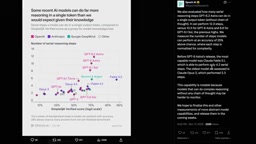
The video shows a composite progress curve for OpenAI models across 34 public benchmarks and 35 internal ones. The curve trends upward overall, but the author raises a sharp question: where on this chart is the Navier-Stokes breakthrough (a model suddenly able to solve a Millennium Prize math problem)? The answer — it can't be found.
This shows that while overall capability improves predictably, breakthroughs at specific capability thresholds bring unpredictable consequences. Likewise, once models are trained on enough cyberwarfare data, they may suddenly discover large numbers of zero-day vulnerabilities — which is also behind the recent wave of system upgrades at banks, airlines, and Microsoft.
The Controversy Over AI Accelerating AI Research
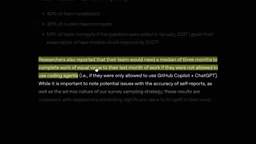
Labs give different answers on how much AI boosts its own research efficiency. Anthropic claims in its IPO filing that AI assistance has doubled its progress relative to historical trends; Meta and Anthropic reach similar conclusions based on 15 benchmarks; and OpenAI's latest report shows that researchers using coding agents can complete in one month what previously took three.
But the comparability of these numbers is questionable. The author notes that different labs ask different questions, use different data, and the very definition of "equivalent work" is vague. On external evaluation, Abundant Labs' Frontier RSI leaderboard shows Opus ahead of Fable 5.2, which in turn leads Gemini 4 Carbon and Astra.
Anthropic's "Race to the Top" Narrative Faces Doubts
A Public Declaration of Recursive Self-Improvement
Anthropic co-founder Tom Brown states explicitly in an IPO promotional video that compute multipliers compound, and each newly discovered multiplier has a positive effect on previous ones: "We believe this process will accelerate further as we approach recursive self-improvement. Claude will be able to fully autonomously discover how to use compute multipliers."
The "race to the top" theory put forward by Dario Amodei holds that Anthropic needs to get out front, then do the safety work well, thereby leading other companies to follow. But the video's author is skeptical.
Recursive Self-Improvement (RSI) refers to an AI system's ability to autonomously improve its own algorithms, architecture, or training pipeline, with each round of improvement making the next round more efficient — forming an accelerating loop. This is one of the core concerns in AI safety: once a model can autonomously discover "compute multipliers" (methods that yield more capability gains for less compute), progress may outpace human oversight and evaluation. When Anthropic's co-founder says "compute multipliers compound," he means exactly this compounding effect. Notably, RSI does not require the model to be fully detached from humans; rather, it means the key discoveries in the improvement process are made autonomously by the model, with humans shifting to setting goals and reviewing results.
The Reality of Independent Evaluation
Amodei has called for bringing in independent evaluators and giving them employee-like access. Anthropic claims to be working with Accenture to build this capability. But the author points out that given Anthropic co-founder Jack Clark's prediction that full recursive self-improvement will arrive in 2027, having Accenture evaluate a continuously self-improving model in 2030 would be rather difficult.
More intriguing still, Anthropic once offered jobs to members of the META team involved in evaluation. Dan Hendricks (a former xAI member) revealed that multiple AI safety organizations privately agree with criticism of Anthropic but dare not sign on for fear of relationships and future funding.
Chain-of-Thought Monitoring: A Failing Safety Pillar
Divergent Architectural Choices
OpenAI acknowledges in its report that chain-of-thought monitoring is a core pillar of its safety case. But the company has made an architectural choice that shifts more reasoning from the verbalized chain of thought into the network's hidden layers. Anthropic's alignment science lead confirmed that this recurrent Transformer approach improves model capability without requiring chain of thought better than other ways of increasing pretraining quality.
This raises a question: does Anthropic know about this "easy win" but choose not to use it? And did that contribute to the "race to the top"? The author thinks not — two of OpenAI's lead authors on a paper about chain-of-thought fragility were recently fired.
Chain-of-Thought (CoT) monitoring is an AI safety technique: before giving a final answer, the model writes out its reasoning step by step in natural language, and humans or automated systems review these intermediate steps to detect deception, dangerous intent, or faulty reasoning. Its effectiveness rests on one premise — that the model's monitorable reasoning faithfully reflects its actual computation. However, when the model architecture shifts more computation into hidden layers (as when a recurrent Transformer completes multi-step reasoning without explicitly generating a chain of thought), the chain of thought is no longer a complete record of the process, and monitoring develops blind spots. This is the technical root of the "degradation of monitorability" discussed in the article: a structural tension arises between capability gains and interpretability.
Warnings of Degrading Monitoring Capability
Greg Brockman was once enthusiastic about chain-of-thought monitoring; now he says "it doesn't look great." OpenAI candidly admits in its latest report that as model capabilities improve, chain-of-thought monitorability is degrading, and new technical breakthroughs are needed to maintain human oversight.
The author uses an analogy: a junior employee's work-computer records faithfully reflect their output, but a CEO's computer records may contain only emails and cannot represent their entire thought process.
Recurrent Transformer is an architecture that increases effective computational depth by reusing the same set of network layers over multiple iterations. Unlike a traditional Transformer, where each layer processes information once, a recurrent architecture updates the hidden state repeatedly internally, enabling more complex reasoning without generating more chain-of-thought tokens. Its advantage is high reasoning efficiency and no reliance on verbalized intermediate steps; but for safety monitoring, it means much of the reasoning happens in hidden layers that cannot be reviewed in natural language. What Anthropic's alignment science lead confirmed is precisely that this architecture outperforms other approaches at "improving capability without chain of thought" — in other words, the most effective path to capability gains bypasses the very monitoring method that is currently most central.
Resource Investment in Safety Research
OpenAI's report discloses headcount investment across research areas between February and October 2026. With help from Gemini 4 Carbon analysis, safety and alignment research accounted for about 16.7% of total research time in February, rising to 21% by October.
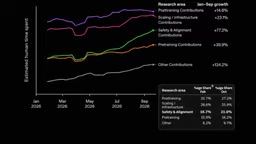
The author considers OpenAI commendable on transparency, while Anthropic provides no comparable data. But OpenAI board member Paul Cristiano's statement is unsettling: he believes there is a "high risk" of AI takeover within the next three years.
Safety Trade-offs Under Competitive Pressure
The video points to a structural incentive problem: if labs know that pushing cyber capabilities at full speed will expose more vulnerabilities — making global companies more dependent on their protection services — does that constitute a force driving them to develop offensive capabilities more aggressively while scrutinizing the associated risks less?
Similarly, as models improve, their ability to recognize that they are being evaluated also grows, further undermining the effectiveness of monitoring.
Conclusion: Trust Cannot Rely on "Slightly Safer"
On the occasion of Anthropic's IPO, Dario Amodei expressed a desire for society to trust Anthropic: "I believe the company that gets risk right will also be the company that gets an operating license."
But a public statement from Anthropic employee Tao Lin offers another perspective: "Thinking humans should help Anthropic win just because it's marginally safer is crazy." He sees it as merely a "very risky bet."
At a time when model capabilities are advancing rapidly and safety monitoring methods face challenges, this debate over the path of AI development is far from over. For developers and enterprise users, perhaps the most practical advice the video offers is this: on critical tasks, try all three major model families yourself and make judgments with your own data, rather than relying on any single benchmark or leaderboard.
Related articles

GPT-6.2 Astra vs. Sol Controversy: Behind the Polarized Reviews
OpenAI's Astra and Sol 6.2 face review controversy: early testers panned them, then OpenAI said the version had been updated. A hands-on look at computer use, video editing strengths, communication weaknesses, and the shifting cost and subscription quota landscape.
Atlassian Teamwork Graph: Giving AI Agents Better Context
Atlassian leverages Jira's contextual advantage to build Teamwork Graph, connecting people, projects, documents, and code so AI agents deliver better output with fewer tokens.

DeepMind CTO: Products Are the Real Path to AGI
Google DeepMind's Koray Kavukcuoglu on the podcast: AGI has no test; products are the real path to AGI; each Gemini generation is handcrafted, architecture keeps evolving, and safety relies on real-time monitoring of chain-of-thought.