Atlassian Teamwork Graph: Giving AI Agents Better Context
Atlassian uses Teamwork Graph to give AI agents organizational context, improving output and cutting token use.
The article explains how Atlassian built Teamwork Graph on Jira's widespread use to provide AI agents with rich organizational context. By connecting people, projects, documents, and code into a relationship map, agents don't have to understand the work environment from scratch. Benchmarks show agents with graph access deliver better output with fewer tokens.
AI agents are increasingly becoming part of the daily work of technical professionals, but there's an awkward reality: if the effort required to configure an agent exceeds that of simply completing the task yourself, its value is greatly diminished. Atlassian—the company behind Jira—is trying to solve this problem with "context."
Context: The Invisible Bottleneck of AI Agents
Jira is one of the most widely used project management and issue tracking tools in the world, which gives it a unique advantage: context. According to the video, Atlassian is leveraging this advantage to build a system called "Teamwork Graph."
For anyone working in the tech industry, AI agents have become part of everyday life. But an agent's effectiveness depends heavily on the information environment it can access. Agents lacking context often require users to repeatedly supply background information, which actually increases the workload.
Context Window refers to the maximum number of tokens a large language model can process in a single inference pass, which determines how much information an agent can "see" in a single conversation or task. The larger the context window, the more material the model can reference—but not all information is equal: irrelevant content dilutes attention, leading to the "lost in the middle" phenomenon. Therefore, context engineering pursues not just window capacity but also the structuring and relevance filtering of information. The value of Teamwork Graph lies precisely in pre-organizing organizational knowledge into high signal-to-noise ratio context, rather than simply piling up raw data.
How Teamwork Graph Works
The core capability of Teamwork Graph is connection. It links together the applications and tools you use in your work, building a map of people, projects, documents, and code, and revealing the relationships among them.

This relationship mapping enables any AI tool to become more efficient and better tailored to needs through richer context. In other words, agents no longer need to understand your work environment from scratch—they can directly draw on already-structured organizational knowledge.
Knowledge Graph is a technology that organizes data in a graph structure, where nodes represent entities (such as people, projects, documents) and edges represent relationships between entities (such as "responsible for," "references," "belongs to"). Unlike relational databases, knowledge graphs excel at expressing multi-hop, heterogeneous associations and support semantic querying and reasoning. Teamwork Graph is essentially a knowledge graph oriented toward enterprise collaboration scenarios; it uniformly models heterogeneous data such as Jira issues, Confluence documents, and code repositories, enabling AI agents to retrieve context along relationship paths that traditional keyword search struggles to uncover.
Benchmarking: The Gap Between With and Without Context
Atlassian benchmarked AI agents with and without access to Teamwork Graph, and the difference was quite striking.
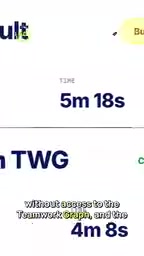
According to the video, when using Teamwork Graph, agents produced better output quality while consuming fewer tokens. This finding points to a key insight: context quality directly affects agent efficiency and cost. Teamwork Graph does the heavy lifting behind the scenes to ensure agents are genuinely useful, so users don't have to do everything themselves.
Token consumption is a core metric for measuring the cost of large model calls; both input and output tokens are billed. Without context, agents often need multiple rounds of follow-up questions and repeated trial-and-error to fill in information gaps, causing token consumption to multiply. Conversely, structured context enables agents to hit key information on the first try, reducing redundant interactions. Therefore, "better output with fewer tokens" is no coincidence—it's the efficiency dividend brought by improved context quality, which simultaneously improves both result quality and inference economics—particularly critical for enterprise-scale deployment.
Implications for AI Agent Adoption
This case reveals an important trend in enterprise AI applications: beyond model capabilities, context engineering is becoming the key variable determining agent practicality. Platforms with rich collaboration data have a natural advantage when building agents, because they can bypass the "cold start" problem and directly provide agents with structured organizational memory.
For technical teams, this means that when choosing AI tools, they should not only focus on the model's own capabilities but also examine whether it can connect to the team's existing knowledge network. Atlassian's attempt shows that when context is rich enough, agents can do more with fewer resources—which may be more practically meaningful than simply pursuing larger models.
The cold start problem refers to the difficulty agents face in giving answers tailored to organizational reality when lacking historical data and domain knowledge, requiring extensive manual configuration and prompt engineering to compensate. Platforms with rich collaboration data (such as Jira, Slack, GitHub) naturally accumulate personnel relationships, project context, and decision records, and can directly transform this data into an agent's "organizational memory," bypassing the cold start phase. This is also the structural advantage of platform vendors in the AI agent race: models can be purchased, but context assets are hard to replicate.
One-line Summary
Atlassian uses Teamwork Graph to provide AI agents with organizational context, improving output quality and reducing token consumption.
Paragraph Summary
The article introduces how Atlassian built Teamwork Graph based on Jira's widespread use to provide AI agents with rich organizational context. Teamwork Graph connects people, projects, documents, and code to build a relationship map, enabling agents to understand the work environment without starting from scratch. Benchmarks show that agents with access to the graph produce better output quality and consume fewer tokens. The article notes that context engineering is becoming the key variable for enterprise AI agent practicality, and platforms with rich collaboration data have a natural advantage in bypassing the cold start problem. For technical teams, choosing AI tools requires not only looking at model capabilities but also examining whether they can connect to existing knowledge networks.
Related articles

GPT-6.2 Astra vs. Sol Controversy: Behind the Polarized Reviews
OpenAI's Astra and Sol 6.2 face review controversy: early testers panned them, then OpenAI said the version had been updated. A hands-on look at computer use, video editing strengths, communication weaknesses, and the shifting cost and subscription quota landscape.
Anthropic IPO and GPT-6.2 Astra: Data Dependencies and Safety Concerns Behind the Model Competition
In-depth analysis of Anthropic's IPO and GPT-6.2 Astra: model performance depends on training data, not universal intelligence; chain-of-thought monitoring is failing as a safety pillar.

DeepMind CTO: Products Are the Real Path to AGI
Google DeepMind's Koray Kavukcuoglu on the podcast: AGI has no test; products are the real path to AGI; each Gemini generation is handcrafted, architecture keeps evolving, and safety relies on real-time monitoring of chain-of-thought.