Anthropic Merges Cowork and Chat into a Unified Claude Experience
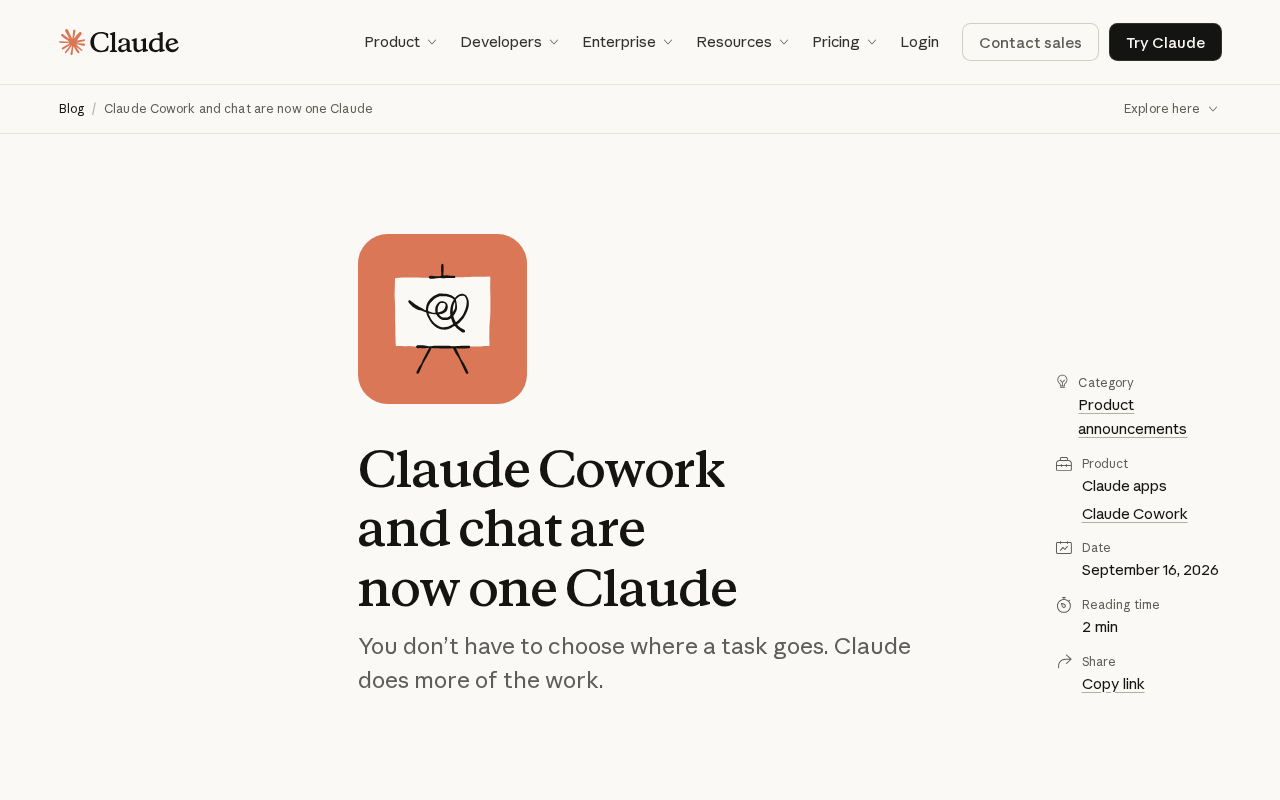
Anthropic unifies Claude Cowork and Chat into a single interface, reducing user friction and cognitive overhead.
Anthropic has merged Claude Cowork and Claude Chat into a single unified Claude experience, eliminating the need to switch between a lightweight chat tool and a collaborative workflow product. The core rationale: the boundary between chatting and working is inherently blurry, and forcing users to choose between two entry points only adds friction. A unified interface lets the system dynamically adapt to where a conversation leads — fitting the industry-wide push toward seamless experiences. The move mirrors a broader trend seen in ChatGPT and Gemini, both converging toward single super-platforms to maximize retention. For developers, a unified product may mean more consistent API integration, though existing users will face some transition adjustment.
Claude's Product Consolidation Move
Anthropic recently announced the merger of Claude Cowork and Claude Chat into a single, unified Claude experience. This change means users no longer need to switch between different product entry points — everything from casual conversation to collaborative work now happens within the same interface.
The news sparked discussion on Hacker News (27 upvotes, 14 comments), reflecting the developer community's ongoing interest in how AI assistant products continue to evolve. While the official announcement was light on details, the logic behind the consolidation is worth unpacking.
Why Merge Cowork and Chat
Cowork and Chat originally represented two distinct use cases. Chat was designed for lightweight Q&A and conversational interaction — the first touchpoint for most people getting started with an AI assistant. Cowork, on the other hand, emphasized collaborative workflows, helping users tackle more complex and continuous tasks such as document writing, project management, or multi-step analysis.
Merging the two is fundamentally about eliminating the cognitive split between the two products. In practice, the line between "chatting" and "working" with AI is often blurry — a simple question can naturally evolve into a complex, multi-turn collaborative task. Forcing users to choose between two separate products only adds friction and cognitive overhead.
Lowering the Cognitive Barrier for Users
The biggest advantage of a unified entry point is that users no longer need to decide upfront whether their need falls under "chat" or "collaboration." The system can dynamically provide the right capabilities based on where the conversation naturally leads. This design philosophy aligns with the "seamless experience" that AI products have been pursuing in recent years.
From a product evolution perspective, the separation of Cowork and Chat was a fairly common pattern in the early days of AI assistants. The prevailing assumption was that "Q&A dialogue" and "task collaboration" represented two fundamentally different user intents, each requiring its own dedicated product form. But as large language model capabilities have advanced rapidly, a single conversation can now support increasingly complex multi-step reasoning and content generation — "chatting is working" has become a reality. The rise of tools like Notion AI and GitHub Copilot Chat reinforces this point: users are increasingly comfortable completing an entire workflow — from initial questions and brainstorming to final output — within a single conversation window, without wanting to switch context between different products. This shift in user behavior is an important backdrop for Anthropic's consolidation decision.
The Industry Trend It Reflects
This consolidation isn't an isolated move — it's a microcosm of the broader trend toward "unified platforms" in AI assistant products. Mainstream products like ChatGPT and Gemini are also continuously integrating more capabilities, each aiming to become the single entry point users reach for across all kinds of tasks.
For Anthropic, consolidating a fragmented product line into a single Claude helps reinforce brand consistency, allows for more focused R&D investment, and avoids redundant feature development. From a business standpoint, a single product also makes subscription models clearer and improves user retention.
Simplicity as a Competitive Advantage
In an era where AI tools are proliferating and growing ever more complex, "doing less" often demands more product discipline than "doing more." What users actually need isn't more buttons and entry points — it's a frictionless path to getting things done. Anthropic's move can be seen as a deliberate effort to rein in product complexity.
The push toward "unified platforms" in AI assistants reflects a deeper competition around daily active retention. Every point of friction when switching between tools is a potential drop-off. OpenAI integrating GPT-4o, DALL·E, the code interpreter, and web search into a single ChatGPT interface, and Google deeply embedding Gemini into the Workspace ecosystem, are both fundamentally attempts to build a "single entry point users can't live without." For subscription-based AI products, how often users open the product each day directly determines renewal intent — and a unified platform maximizes coverage of users' daily workflows, driving stickiness. Anthropic's consolidation is a deliberate move to stake out position within this competitive logic.
Impact on Users and Developers
For everyday users, the most immediate effect is a simpler workflow: one Claude that handles everything from quick questions to deep collaboration. For developers and enterprise users, a unified product form may also mean more consistent APIs and integration patterns, reducing the complexity of getting started.
That said, product consolidation can also come with transition costs. Users who were accustomed to working within Cowork or Chat will need to re-familiarize themselves with the merged interaction model. Whether changes like this succeed ultimately depends on whether the new experience is genuinely more efficient than the old separated design.
Conclusion
Anthropic merging Claude Cowork and Claude Chat into a single Claude is a signal that AI assistant products are moving from "scattered features" toward "unified experiences." While the official announcement lacked detail, the move aligns with the industry-wide direction of pursuing simplicity and lowering users' cognitive load. For users, a Claude that can handle both conversation and collaboration in one place may be exactly what an AI tool should look like.
Related articles
The Siberian Ice Maiden and the Archaeological Mysteries of the Scythian World
The Siberian Ice Maiden is a Scythian female mummy from the Ukok Plateau. Her tattoos, silk garments, and grave goods reveal ancient nomadic art, social hierarchy, and cross-regional trade — alongside ongoing repatriation controversies.
SQL Row Pattern Matching: Implementing "Row-Level Regex" with MATCH_RECOGNIZE
MATCH_RECOGNIZE gives SQL regex-like power over row sequences. Detect brute-force attacks, fraud patterns, and user behavior flows with clean, declarative syntax — no more messy self-joins.
Hackers Break Into Flock Surveillance Cameras, Exposing the Inner Workings of License Plate Recognition Systems
Hackers breached Flock Safety's ALPR cameras, exposing how license plate recognition systems collect data and the privacy and security risks they pose.