Anthropic Open-Sources Claude Community Plugin Marketplace: From AI Tool to Developer Platform

Anthropic launches an open-source community plugin marketplace for Claude Cowork and Claude Code.
Anthropic has open-sourced the claude-plugins-community repository on GitHub, creating a community plugin marketplace for Claude Cowork and Claude Code. Using a read-only mirror with centralized submission via clau.de/plugin-directory-submission, the project combines quality control with community contribution. Built primarily in Python, it signals Claude's strategic evolution from AI tool to extensible developer platform, competing with Cursor, GitHub Copilot, and others in the race for ecosystem completeness.
Claude's Ecosystem Enters the Plugin Era
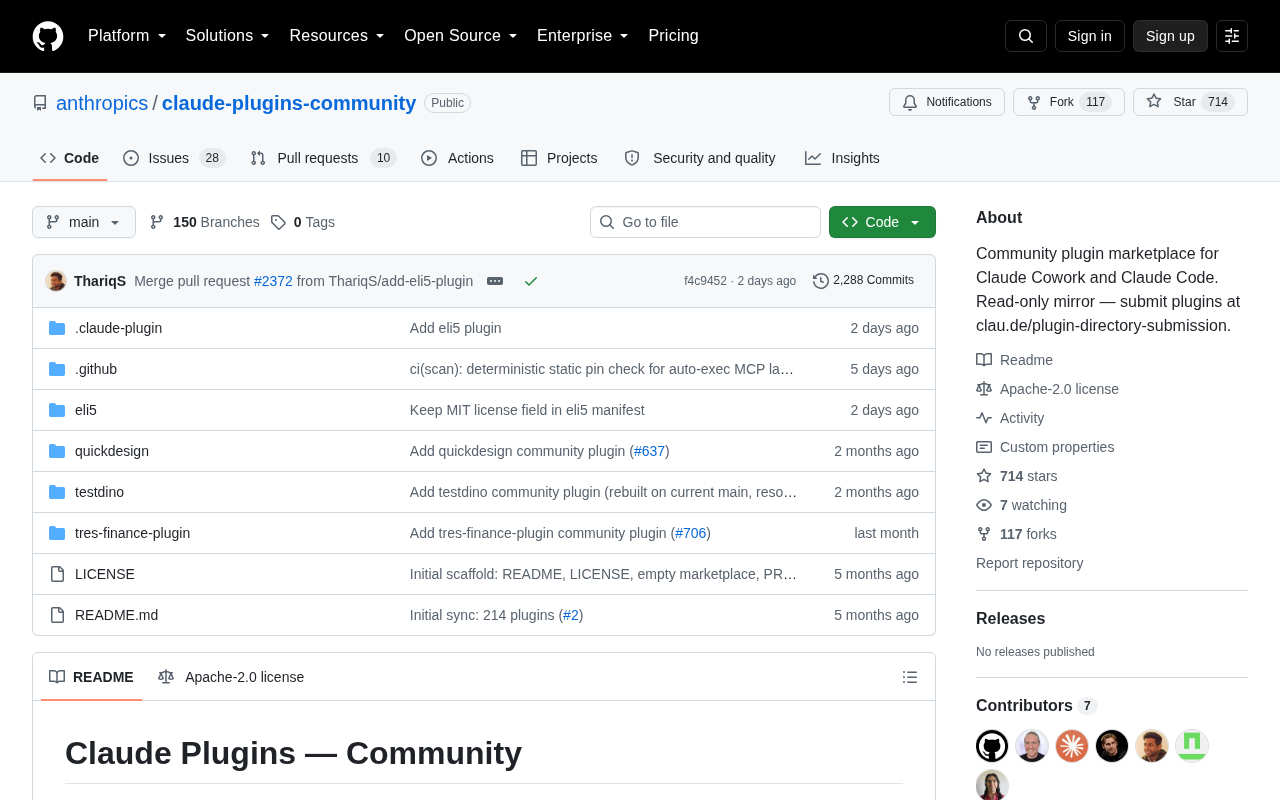
Anthropic recently open-sourced the claude-plugins-community repository on GitHub — a community plugin marketplace for Claude Cowork and Claude Code. The project quickly gained traction after launch, adding 190 stars in a single day to reach a total of 694 Stars, with Fork count hitting 116, demonstrating significant community interest.
What you might not have noticed is that the repository itself is a read-only mirror. Read-only mirrors are a common code hosting strategy in the open-source community, referring to maintaining a browse-and-clone-only copy of a repository on public platforms like GitHub, while actual code commits and change management occur in another internal or controlled system. This pattern is widely used in open-source projects from major tech companies like Google and Facebook. Its core advantage lies in leveraging GitHub's community discovery and distribution capabilities while maintaining complete control over the code merge process.
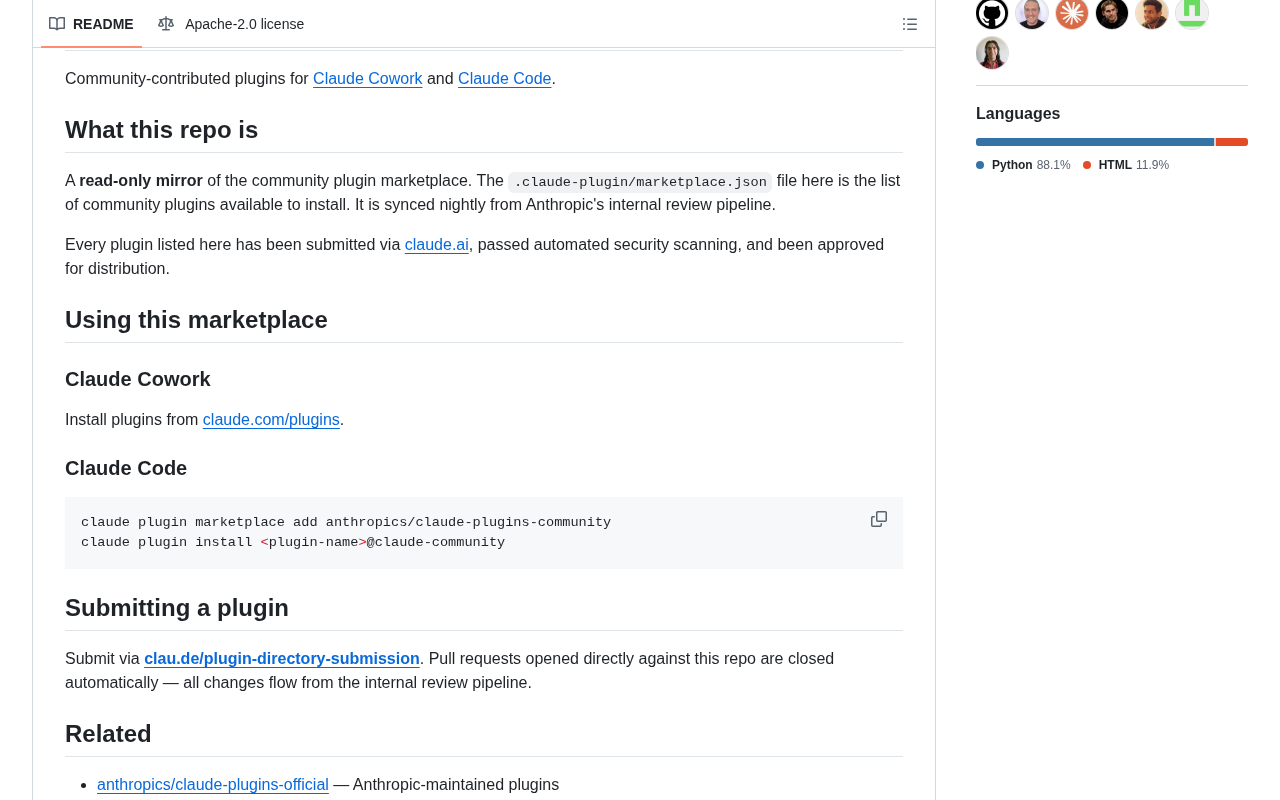
As a result, developers cannot submit Pull Requests directly to the repository. Instead, they need to submit their plugins through the officially designated entry point at clau.de/plugin-directory-submission. This design ensures centralized management and quality review of the plugin directory while keeping contribution channels open to the community.
Why the Claude Plugin Marketplace Matters
A Critical Step from Tool to Platform
For any AI product, the plugin mechanism is virtually unavoidable when transitioning from a standalone tool to a platform ecosystem. Looking back over the past few years, whether it's browser extensions, IDE plugins, or various SaaS app marketplaces, plugin architecture has been the core approach for activating developer communities and expanding product capability boundaries.
As a product architecture strategy, plugin systems have successful precedents throughout the history of the software industry. From the early Eclipse IDE plugin system (2001), to the Chrome browser extension store (2010), to VS Code's Extension Marketplace (2015), every successful plugin platform has followed a similar evolutionary path: the core product first establishes a stable user base, then opens capabilities to third parties through standardized API interfaces and developer toolkits, ultimately forming network effects — more plugins attract more users, and more users motivate more developers to invest. In the AI space, OpenAI's ChatGPT Plugins launched in 2023 was the earliest attempt. Although it later evolved into GPTs and Actions, it validated the feasibility of plugin systems for AI products.
Anthropic's plugin marketplace covers two important product lines:
- Claude Cowork: Targeting enterprise team collaboration scenarios, emphasizing multi-person collaboration and workflow automation. Think of it as embedding Claude's capabilities into daily team operations, covering document collaboration, project management, meeting follow-ups, and more. Plugins can further extend its capabilities within team workflows.
- Claude Code: Targeting programming and development scenarios, positioned as a terminal-native coding agent that runs directly in developers' command-line environments, understands entire codebase context, and executes complex tasks like code writing, debugging, and refactoring. Plugins can enhance its code comprehension, generation, and automation capabilities.
These two product lines target enterprise collaboration and developer productivity respectively — two high-value markets. The introduction of a plugin system enables both products to be deeply customized according to specific industry and team needs. This layout demonstrates that Anthropic is extending Claude's capabilities into more segmented, vertical use cases, no longer limited to officially built-in features.
Community-Driven Extension Model
The repository is primarily built with Python, lowering the barrier to developer participation. Choosing Python is a well-considered ecosystem strategy — according to Stack Overflow and GitHub annual surveys, Python has consistently ranked among the most popular and fastest-growing programming languages for years, especially dominating in machine learning, data science, and automation scripting. This means the potential contributor base for the Claude plugin marketplace is enormous, as virtually all AI-related developers possess Python skills. Additionally, Python's rich third-party library ecosystem (over 500,000 packages on PyPI) allows plugin developers to easily integrate various external services and functionalities, reducing the development cost of building complex plugins from scratch.
By using an official submission portal rather than direct PRs, Anthropic has effectively built a hybrid model of centralized review + community contribution. This governance model has mature precedents in the software ecosystem. Apple's App Store employs a strict centralized review mechanism — while review cycles are longer, it establishes extremely high security trust among users, with iOS ecosystem malware rates far lower than other platforms. By comparison, the Chrome Web Store's relatively lenient review process has repeatedly resulted in malicious extension incidents.
This model has two significant advantages: on one hand, it ensures the quality and security of plugins entering the directory, preventing proliferation of malicious or low-quality plugins; on the other hand, by leveraging community creativity, it can quickly cover long-tail needs that are difficult for official teams to address.
Practical Implications for Developers and the Ecosystem
New Opportunities for Developers
For developers, the Claude plugin marketplace provides a channel to directly reach a massive Claude user base. As Claude Code's influence in programming assistance continues to expand, plugins built around it are poised to establish new tool ecosystem niches. Whether it's integrating specific frameworks, connecting internal systems, or packaging industry-specific workflows, there's considerable room for innovation.
The submission process being centralized at clau.de/plugin-directory-submission means developers need to follow official specifications and review standards. In the short term, this may raise the entry barrier, but in the long run, it helps build trust in plugin quality among the user base.
Comparison with Competing Ecosystems
Viewing the Claude plugin marketplace in an industry context, competition among AI coding tools is shifting from "model capability" to "ecosystem completeness." Since 2024, the gap between mainstream large language models on benchmarks has continued to narrow — GPT-4, Claude 3.5, Gemini Pro, and other models show increasingly similar performance on core tasks like coding, reasoning, and content creation. When model capability itself is no longer the decisive differentiating factor, the competitive focus naturally shifts to user experience, toolchain integration, and ecosystem building.
This closely parallels the iOS vs. Android competition logic from the mobile internet era — what ultimately determines platform success isn't a single hardware parameter, but the richness of the app ecosystem and the vitality of the developer community. In the AI coding tools space, products like Cursor, GitHub Copilot, and Windsurf are all actively building their respective extension ecosystems. Claude Code's plugin marketplace is Anthropic's response to this competitive landscape.
Anthropic's choice to publicly release the plugin directory as an open-source mirror demonstrates transparency while sending a clear signal to the community: Claude is serious about building an extensible developer platform.
Key Questions Worth Watching
Despite a solid start, several core questions are worth tracking:
- Review Efficiency and Standards: While centralized review ensures quality, will it slow down plugin listing speeds? Are review standards sufficiently transparent and consistent? Apple spent over a decade gradually optimizing App Store review efficiency to reach its current level. Anthropic needs to establish clear review SLAs (Service Level Agreements) early on to manage developer expectations.
- Plugin Security: In highly sensitive scenarios like coding and collaboration, how plugin access permissions to code and data are managed will directly impact user trust. Permission model design needs to balance functional flexibility with security isolation — a universal challenge facing all plugin platforms.
- Incentive Mechanisms: No clear developer revenue or incentive programs are visible yet. Historically, successful developer ecosystems have all established explicit value return mechanisms — the App Store's 70/30 revenue split created substantial income for independent developers, Shopify's app marketplace allows developers to charge merchants through subscriptions, and Salesforce's AppExchange has spawned dozens of publicly traded companies. While purely community-driven open-source projects can remain active, they typically rely on developers' personal interest or internal enterprise needs, facing sustainability challenges for long-term maintenance. For the Claude plugin marketplace, whether paid plugins, revenue sharing, or developer fund incentive programs will be introduced will directly affect the supply scale of high-quality plugins.
The launch of claude-plugins-community marks an important milestone in Claude's evolution from a "powerful AI assistant" to an "extensible developer platform." With Python's broad ecosystem foundation, official review quality assurance, and dual product line coverage through Cowork and Code, this plugin marketplace has the potential to become a significant growth engine for Claude's ecosystem.
For developers following AI programming and tool ecosystems, now is an excellent time to observe and participate. Whether the plugin marketplace can truly flourish will depend on Anthropic's sustained investment in review efficiency, security governance, and developer incentives.
Related articles

Gaussian Process Bandit Optimization: Exploration Strategies and Inference Regret Guarantees
Cumulative regret guarantees in Bayesian optimization fail to reflect final recommendation quality. This article examines a new study that provides inference regret guarantees for Gaussian process bandit optimization through exploration query strategies and fill distance analysis, validated on hyperparameter optimization and control tasks.
The Most Detailed Codex Guide on Bilibili: From Installation to Real-World Practice
The most detailed Codex guide on Bilibili: from app store installation to daily work mode configuration, with a real coffee shop project demonstrating file organization, data extraction, dashboard creation, and other practical tasks. Learn to use Plan Mode and desktop pets to leverage Codex efficiently.

Appearance Compensation in Volume Rendering: Why RGB Accuracy Cannot Guarantee Density Correctness
Volume rendering research reveals that volumetric data perfectly reproducing external RGB views may still contain density errors: appearance compensation can double central density and keep external rays unchanged even when L2 error exceeds 14.52%. Density recovery depends on appearance capacity, spatial resolution, and measurement design.