Anthropic Opens a Biology Lab: The Double-Edged Bet Between AI Curing Disease and Biosecurity Risk
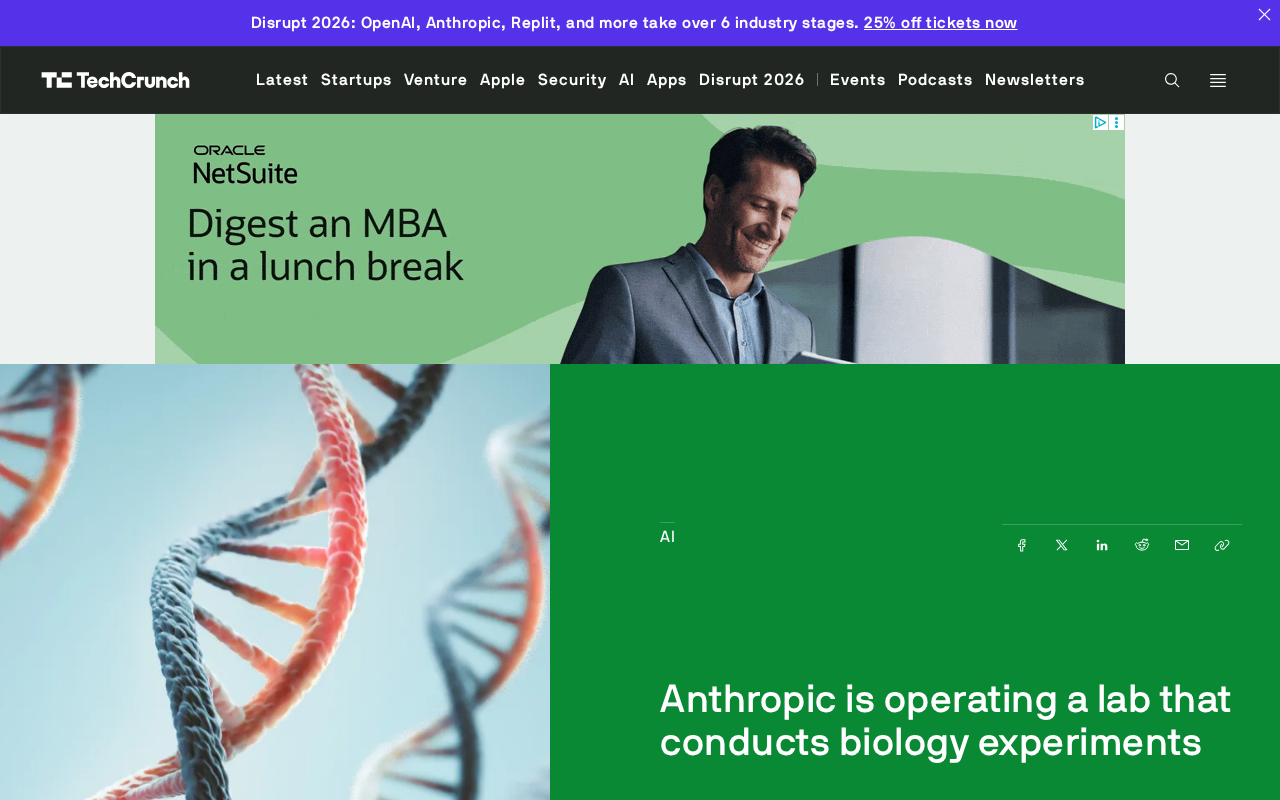
Anthropic opens a biology wet lab, turning AI's disease-curing promise into practice while raising biosecurity concerns.
Anthropic is now operating a biology wet lab, marking a shift in the AI industry from promising to cure disease in theory to pursuing it in practice. The move highlights a deep internal tension: while Anthropic advances life sciences research with AI, its own researchers warn of existential-level risks — a contradiction made especially acute by biology's dual-use nature. Competitively, building a wet lab signals that model value is shifting from benchmark scores to verifiable real-world results. With limited public information available, the lab's research boundaries and safety governance framework still require greater transparency, making this a key signal in AI safety and governance worth tracking long-term.
What Anthropic's Biology Lab Actually Means
AI company Anthropic is operating a laboratory that conducts biological experiments. This move takes the AI industry's long-standing grand promise — that AI is the key to conquering human disease — from rhetoric into practice. When a company best known for large language models steps into wet lab experiments, the signal it sends carries far more weight than an ordinary R&D investment.
For years, AI leaders have repeatedly emphasized that AI will become the key to curing human disease. From protein structure prediction to accelerating drug development pipelines, the industry has painted a picture of an algorithm-driven medical revolution. By establishing a biology lab, Anthropic hopes to connect model capabilities with real biological data and experimental feedback loops — validating AI's practical value in the life sciences.
The Tension Between Promise and Warning
What makes this news worth paying attention to is what it reflects about the deep contradiction within Anthropic — and across the entire industry. On one hand, AI is expected to save lives; on the other, Anthropic's own researchers have continuously warned that AI could pose an existential threat to humanity.
This tension is especially sharp in the biological domain. Biological experiments can lead to vaccines, drugs, and therapies — but they can also brush against sensitive boundaries in biosecurity. Anthropic has consistently positioned itself as a company that takes AI safety seriously, and its research team's vigilance about potential model harms is well known in the field. When a company like this personally ventures into biological experimentation, observers naturally ask: is it exploring pathways for AI to benefit humanity, or is it studying up close the risks of AI being misused in the biological domain?
The two possibilities aren't mutually exclusive. One of the best ways to understand risk is often to engage with it hands-on in a controlled environment.
Why an AI Company Is Doing Wet Lab Work
Traditionally, biological experiments have been the territory of pharmaceutical companies, university labs, and specialized research institutions. An AI company building its own biology lab reflects a shift in the competitive logic of the industry: a model's value is no longer measured solely by benchmark scores, but increasingly by whether it can produce verifiable results in complex real-world tasks.
The life sciences happen to be an ideal proving ground for AI capabilities. Biological systems are highly complex, data is noisy, and experimental costs are high. If an AI model can generate valuable hypotheses in such an environment and have them confirmed by experiment, the persuasive power far exceeds pure text-based reasoning. By owning the complete chain from hypothesis generation to experimental validation, Anthropic has the opportunity to build a flywheel in which data and models reinforce each other.
Wet lab experiments refer to experiments conducted in a physical laboratory setting using liquids, chemical reagents, cells, or biological tissue — as opposed to "dry lab" work, which is purely computational simulation or data analysis. For an AI company, entering the wet lab domain means taking on an entirely different cost structure and professional threshold: not only recruiting experimental biologists, but also maintaining biosafety-compliant laboratory facilities, handling reagent procurement, and managing waste disposal — a host of physical operational matters. This is fundamentally different from the typical software company model of scaling on compute alone. DeepMind, a subsidiary of Google, previously achieved a breakthrough in protein structure prediction through AlphaFold, but that work remained primarily on the computational side. Anthropic's move signals a desire to connect the model's "predictions" with the laboratory's "validation" to form a genuine scientific feedback loop — rather than merely providing a tool that assists researchers.
Potential Controversy Under the Safety Narrative
Anthropic has long anchored its narrative to AI safety, which means its biology lab faces a higher standard of scrutiny. The dual-use issues involved in the biological domain are extremely sensitive: the same knowledge and tools can be used to develop life-saving therapies, or they can be used to cause harm.
If a company is simultaneously warning about AI's biological risks and actually operating a biology lab, it must respond to public concerns with transparency and governance mechanisms far above the industry average. Where are the boundaries of the experiments? How are sensitive capabilities prevented from leaking? Who provides oversight? These questions will all come under the spotlight. The publicly available information is still quite limited and is insufficient to judge the lab's specific research direction and safety framework.
Dual-use is one of the core challenges in biosecurity — the idea that the same research findings, technologies, or knowledge can be used to benefit society (such as developing vaccines or antiviral drugs) while also being repurposed by malicious actors to create biological weapons or enhance the harmfulness of pathogens. In 2011, Dutch and American scientists independently published research making the H5N1 avian influenza virus capable of airborne transmission between mammals, sparking fierce global debate about whether "gain-of-function" research should be published openly — a textbook case of the dual-use dilemma. When AI models become involved in biological research, the problem is further amplified: AI could lower the knowledge barrier for synthesizing dangerous pathogens or designing biological toxins, making techniques that once required highly specialized training far more accessible. This is the context behind Anthropic having previously identified biological risk as a priority concern in its internal assessment reports.
Conclusion: A Move Worth Tracking
Anthropic's decision to open a biology lab is another landmark moment in AI's expansion from the digital world into the physical and life sciences. It simultaneously carries the industry's most optimistic vision and its deepest anxieties: AI is seen as a hope for curing disease, yet it is also listed by the company's own researchers as a potential existential risk.
Whether this move will deliver on AI's promise to benefit medicine, or amplify concerns about biosecurity, remains to be seen — and will require both time and more information. For those who follow AI's cutting edge and safety governance, this is undoubtedly a signal worth tracking for the long term.
Related articles

WorkBuddy Full Tutorial: Build an AI Office Automation Agent from Scratch
A complete WorkBuddy tutorial: installation, three working modes, multimodal picture book video practice, expert team agent building, and workflow configuration for low-cost AI office automation.

WorkBuddy Agent Complete Guide: From Beginner to Automation in 7 Days
Based on Bilibili's 256-episode WorkBuddy masterclass, this systematically breaks down Tencent's AI office workbench core capabilities: Agent principles, Skill encapsulation, cross-platform connectors, scheduled automation, knowledge bases, and zero-code development, with learning path recommendations.

8 AI Accounts, 7 Failed: An Honest Review of Using AI to Get Work Done
Only 1 of 8 AI-run Bilibili accounts succeeded. We break down the real difference between "performing AI" and "using AI to get work done."