Anthropic Plunges 8.5% the Day After Listing: Why the Largest IPO in History Crashed

Anthropic's record IPO crashed the next day, triggering a systemic $4T weekly selloff in U.S. stocks.
On Nov 19, 2026, Anthropic raised $93.5B at $83/share, rose 17% on day one, and broke $2T in market cap—but closed down 8.5% the next day, at one point just 5 cents above the issue price. The Nasdaq fell 5.3% that week, wiping out ~$4T, with the semiconductor index down 11%. Triggers included Jensen Huang's resignation and Nvidia's seven-day slide, ambiguous Fed rate hikes with 10-year Treasury yields near 5%, Democrats' pledge to slow data center construction, and circular-financing doubts. Early employees cashed out $25B on day one, and some hedge funds that chased at $111.5 were down ~20% in two days. BofA sees short-term sentiment dominating while long-term fundamentals still matter.
A Fractured Wall Street Frenzy
On November 19, 2026, AI company Anthropic debuted on the capital markets under the ticker "Ant" with an issue price of $83, raising a massive $93.5 billion and setting a new global record for IPO fundraising. Tech giants including AMD, Google, Microsoft, and Nvidia collectively invested approximately $119.5 billion in the issue-price placement (of which $26 billion was cornerstone placement). With such a star-studded lineup, the title of "largest IPO in history" was all but preordained.
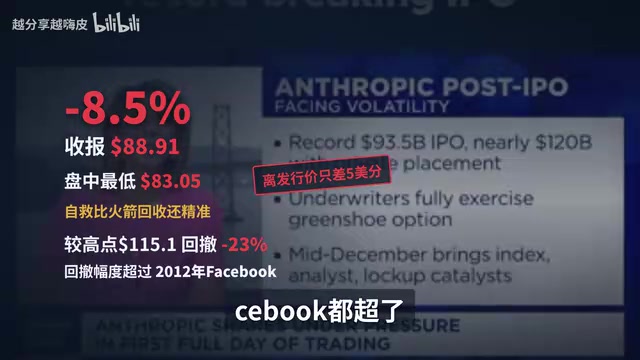
First-day performance was initially convincing: the stock rose 17%, market cap broke through $2 trillion, and the bell-ringing ceremony was all smiles. But the celebration lasted only one day. By Friday's close, Ant stood at $88.91, down 8.5% for the day, having touched an intraday low of $83.05—just 5 cents above the issue price. Measured from the intraday high of $115.1, the drawdown reached 23%.

This drawdown even exceeded Facebook's post-IPO performance in 2012. For a company expected to become the "infrastructure of the AI era," the market completed a sharp turn from euphoria to sobriety in just two days.
The Crash Wasn't Just Anthropic: $4 Trillion Wiped Out in a Week
Zoom out, and Anthropic's flash crash was merely the first domino to fall. The Nasdaq plunged 5.3% the same day and 10% for the week—the worst weekly performance since March 2020—wiping out all of 2026's gains in one swoop. Within a week, U.S. equities shed roughly $4 trillion in market value, the semiconductor index fell 11% in a single day, and both the S&P and Dow entered technical correction territory.
In other words, Anthropic is not an isolated case but a concentrated manifestation of a systemic shift in sentiment. When a stock backed by every major tech giant and boasting a record-breaking raise cannot sustain its first-day gains, investors begin to question the pricing logic of the entire high-valuation tech sector.
Technical correction is a market technical analysis term, typically referring to a stage where a major stock index falls 10% from a recent high but less than 20%; if the decline reaches 20%, it enters a technical bear market. It is not a fundamental judgment but a mechanical definition based on price action, often used to describe a phased shift in market sentiment. In this article, both the S&P and Dow entering technical correction means selling has spread from individual stocks to the broader market, but has not yet reached the bear market threshold, leaving a window for observing subsequent trends.
A Stacked Set of Triggers: From Nvidia to the Fed
This correction was not triggered by a single piece of bad news but by multiple pressures resonating in the same week.
Nvidia's "Backyard on Fire"
The news of Nvidia CEO Jensen Huang's resignation became the most direct shockwave, sending the stock down for seven consecutive trading days. That said, the SAC accounting investigation, the Fed's ambiguous stance on rate hikes, and the 10-year Treasury yield approaching 5% collectively weighed on high-valuation assets—for AI companies reliant on discounted future cash flows, every uptick in the risk-free rate amplifies the valuation denominator.

On the political front, Democrats' pledge to slow data center construction further undermined the long-term demand narrative for AI infrastructure. Computing power expansion had been the core support for this AI rally, and marginal changes in policy direction were enough to make investors re-examine the growth curve.
The 10-year Treasury yield is the anchor for global asset pricing. It represents the return on holding a risk-free asset (U.S. Treasuries) and is therefore often used as the risk-free rate in stock valuation models for discounted cash flows. When this yield rises, the present value of future cash flows discounted to today declines, hitting tech growth stocks reliant on distant earnings especially hard. The article mentions it approaching 5%, meaning high-valuation assets must offer higher risk premiums to attract capital—this is precisely the macro transmission path through which the AI sector's valuation comes under pressure.
The Hidden Worry of Circular Financing
The most intriguing skepticism points to the "circular financing" model: Nvidia invests in customers, who then use that money to buy Nvidia chips—capital flows in a closed loop within the ecosystem. This structure amplifies growth during boom cycles and amplifies doubt when sentiment reverses—the market begins to ask: how much of this is genuine end demand, and how much is paper prosperity manufactured by capital circulation? There is no standard answer to this question, but it is enough to put the most valuation-sensitive assets under pressure first.
Circular financing refers to a supplier investing in or lending to customers, who then use that capital to purchase the supplier's products, forming a closed funding loop. This model is not uncommon in cloud computing and semiconductor ecosystems—for example, Nvidia invests in AI startups that then buy its GPUs. The risk is that revenue growth may partly stem from the supplier's own capital output rather than independent end-customer demand; once financing tightens or sentiment reverses, paper prosperity can quickly turn into inventory and accounts receivable pressure. Identifying genuine demand requires observing whether customers are purchasing with their own operating cash flow rather than relying on supplier funding.
Early Employee Cash-Outs and Hedge Funds' Chase-the-High Disaster
An easily overlooked detail: early employees could sell on the first day, involving cash-outs totaling $25 billion. The concentrated release on the supply side, combined with the ebbing sentiment on the demand side, constituted direct pressure driving the stock down.

More dramatic still were the hedge funds that secured allocations. Some institutions chased the stock at the $111.5 opening price, suffering paper losses of about 20% within two days. This case shows that even professional institutions can make chase-the-rally decisions when swept up in the "largest IPO in history" narrative. Scarce primary-market allocations do not equal a margin of safety in the secondary market.
Cornerstone investment is an arrangement in an IPO to allocate shares to specific large institutional investors (such as sovereign funds or industrial capital), typically with a 6- to 12-month lock-up period. Its purpose is to provide endorsement for issue pricing, stabilize market confidence, and ensure the fundraising completes smoothly. In this article, giants including AMD, Google, Microsoft, and Nvidia collectively invested $119.5 billion, of which $26 billion was cornerstone placement—precisely using industrial capital's long-term holding commitment to offset short-term selling pressure. However, the cornerstone lock-up does not cover early employees' first-day cash-outs, so supply shocks can still overwhelm the stock price.
Bubble Burst or Golden Pit?
Bank of America's assessment is relatively measured: short-term sentiment dominates, but long-term fundamentals still matter. This framework actually applies to all current controversies.
The bearish logic is clear—high valuations, high rates, doubts about the authenticity of demand from circular financing, and a shift in policy direction; the bullish arguments are equally valid—AI penetration is still early, Anthropic's enterprise customer base is solid, and giant placements have locked in long-term holdings. The real question is not "is AI a bubble" but whether the current price has fully reflected future growth delivery.
For ordinary investors, whether to catch Nvidia's falling knife or Anthropic's bell with $100,000 in hand is essentially a question of risk appetite, not stock selection. In this fractured week, the only certain conclusion may be this: when an IPO is large enough to go down in history, it often also marks the peak of some kind of sentiment.
Related articles

A 19-Year-Old's Rental Horror Story: Ceiling Collapse, Bug Infestation, and the Lessons It Taught Me
At 19, my first off-campus rental brought bug infestations, no heat, a collapsed ceiling, and a ruined laptop with no renter's insurance. Here are the hard-won lessons for first-time student renters.

Veda Nurse's Cranial Nerve Exam: Why ASMR Role-Play Is Going Viral
Bilibili creator Veda's cranial nerve exam ASMR video goes viral, blending humor and sensory triggers through nurse role-play. This article analyzes its unique appeal and the audience psychology behind ASMR role-play.

LG Cinebeam AI Review: 120-Inch Giant Screen + 3000 Lumens, a New Choice for the Living Room Theater
LG Cinebeam AI projector review: 3000 ANSI lumens, 4K, 100 inches from about 8 cm and 120 inches from about 18 cm. Built-in webOS, AI Concierge voice recommendations, AI Sound Pro 11.1.2 virtual surround, and Game Optimizer—positioned for fixed living room installation, complementing the portable Cinebeam S.