Anthropic Proposes AI Model Ban Threshold: $1 Billion in Damages or 50 Casualties

Anthropic proposes banning AI only if it causes over $1 billion in losses or 50 casualties, sparking debate over quantification.
Anthropic proposes that AI models should only be forcibly banned when they could cause over $1 billion in economic losses or more than 50 deaths/serious injuries, sparking heated debate on Reddit. Supporters see quantitative thresholds as making regulation operable, while opponents question whether life can be simply quantified and suspect a "straw man" strategy of floating extreme numbers first and then walking them back. The article analyzes the numbers from economic and ethical dimensions, noting that 50 casualties equate to about $500 million under VSL, inconsistent with the $1 billion threshold; meanwhile, high thresholds may create a big-business exemption effect and increase compliance costs for startups. It further points out that static thresholds struggle to address dynamic AI risks and ignore diffuse harms such as algorithmic bias and privacy erosion, ultimately advocating a dynamic, tiered, auditable governance framework.
Background: Anthropic Throws Out Quantitative Standards for AI Bans
According to heated discussions in the Reddit community, Anthropic has put forward a controversial proposal: AI models should only be forcibly banned when they could cause more than $1 billion in economic losses, or lead to more than 50 deaths or serious injuries. This quantitative threshold quickly sparked debate—are 50 lives and $1 billion a matter of prudent risk management, or a deliberately planted "straw man" to steer public opinion?
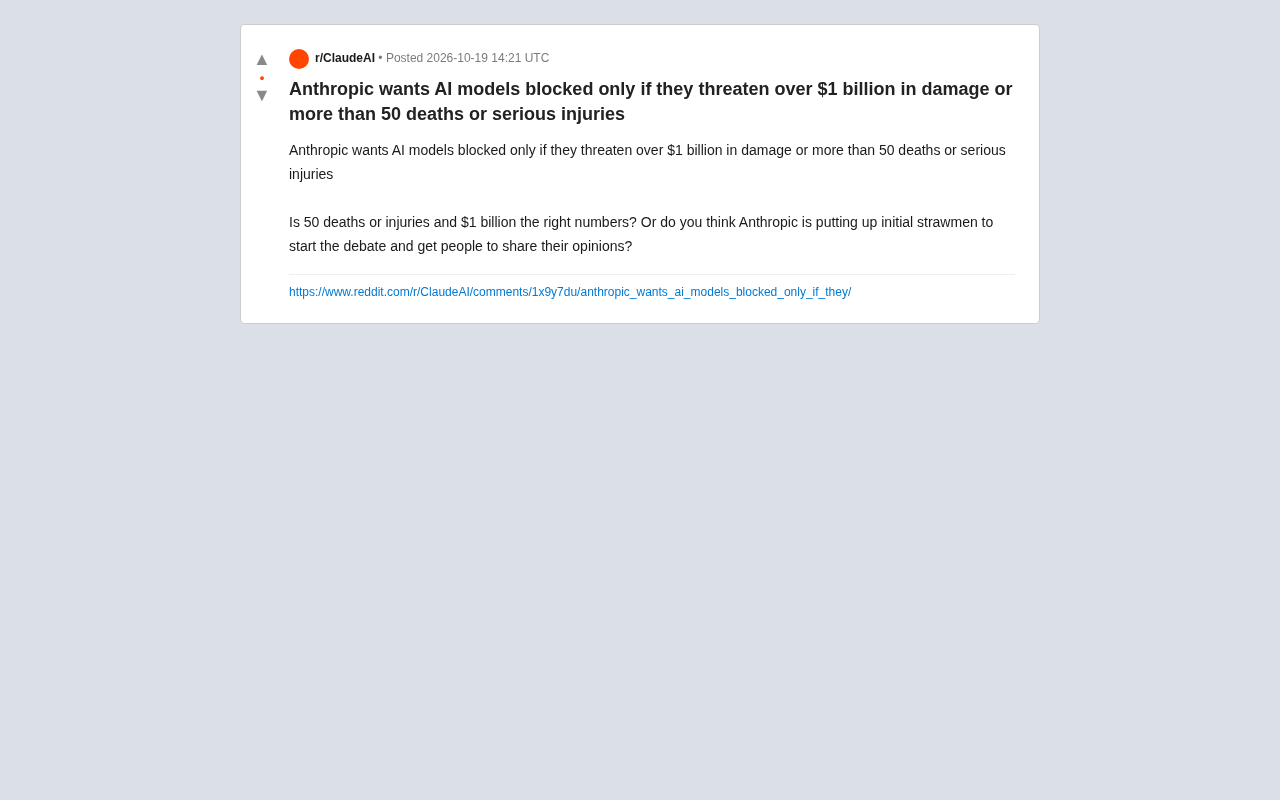
The core of this proposal lies in setting operable trigger thresholds for AI safety regulation. Supporters argue that clear numbers are easier to enforce than vague "significant risk"; opponents question how loss of life can be measured in numbers. Some further suggest that Anthropic may be floating a radical framework first, then gradually walking it back through public discussion to ultimately anchor a looser regulatory position.
The Logic Behind the Numbers: Why $1 Billion and 50?
From an economic perspective, the $1 billion threshold is close to the order of magnitude of a large enterprise's annual risk exposure, similar in spirit to the "systemically important institution" approach in financial regulation. Anthropic may be trying to align AI risk with existing regulatory frameworks to avoid excessive bans that hinder innovation.
But from an ethical perspective, using 50 casualties as the red line for bans implies that harm below this number may not fall within the scope of mandatory intervention. This raises the core controversy: can the value of life be quantified? If estimated using the value of a statistical life (VSL), the economic value corresponding to 50 people may far exceed $1 billion—are the two figures even self-consistent?
One detail: Anthropic has not publicly disclosed how these numbers were derived, which makes the "straw man" speculation more convincing—float extreme numbers first, observe public reaction, then adjust.
The value of a statistical life (VSL) is a core tool in risk economics and public policy for monetizing health and safety benefits. It does not put a price on any individual life; rather, through revealed preference or wage-differential methods, it estimates the total amount the public is willing to pay to reduce a small mortality risk, then converts that into the implied value of "per statistical death avoided." U.S. federal agencies often use a VSL of about $10 million per person in regulatory cost-benefit analysis. By this rough estimate, 50 casualties correspond to an economic value of about $500 million—below the $1 billion threshold, so the two are not fully consistent in order of magnitude. This discrepancy also suggests that Anthropic's two thresholds may not have been derived from the same cost-benefit model, but rather set separately from corporate risk exposure and ethical intuition.
Community Reaction: Support, Skepticism, and the "Straw Man" Hypothesis
In the Reddit discussion, one view holds that this is a pragmatic starting point for regulation: without numbers, AI safety laws will remain empty talk. Clear thresholds give developers something to follow and regulators something to rely on.
Another voice sharply criticizes: a threshold of 50 deaths is too cold, amounting to tacit approval of lower-intensity harm. One user retorted: "If AI causes 49 deaths, does that mean no ban is needed?" In addition, the $1 billion threshold is out of reach for small and medium-sized enterprises, potentially creating a "big business exemption" effect.
Some analyses further point out that Anthropic, as a leading AI company, may have competitive considerations behind proposing such standards—high thresholds favor large companies that already have safety capabilities, while startups struggle to bear compliance costs.
The straw man argument refers to deliberately proposing an exaggerated, easily refuted position and then knocking it down through "discussion," so that the truly intended moderate position appears reasonable. In regulatory games, this often manifests as anchoring extreme numbers first, triggering public backlash, then gradually walking them back to ultimately land on a looser level that would have been difficult to push directly. The key to identifying a straw man strategy is whether the proposer discloses the derivation process and participates in subsequent revisions. Anthropic's failure to disclose the basis for $1 billion and 50 provides exactly the space for such speculation; but if the thresholds are substantially lowered in subsequent discussions and accepted by Anthropic, that would be closer to normal policy trial rather than pure manipulation.
Regulatory Implications: Are Quantitative Thresholds Progress or a Trap?
Quantifying AI risk into specific numbers is indeed easier to implement than vague principles. But the essence of risk lies in uncertainty: AI's chain reactions may far exceed initial estimates. Can $1 billion and 50 casualties, as static thresholds, cope with dynamically evolving model capabilities?
Moreover, the proposal focuses only on "direct harm" while ignoring chronic, diffuse harms such as algorithmic bias and privacy erosion. These harms are difficult to measure as single events, yet may have profound societal impacts.
Anthropic's proposal is more like a discussion draft than a final position. Its real value lies in forcing the industry to think: what AI risks are we willing to accept? Who decides these numbers?
Algorithmic bias and privacy erosion belong to "diffuse harms": they do not manifest as single measurable explosive events, but produce social impact through long-term, large-scale, low-intensity differential treatment or data accumulation. For example, recommendation systems may systematically suppress the exposure of certain groups, and facial recognition may continuously erode anonymous spaces. Such harms are difficult to attribute to a single model or a single decision, nor can they be measured by "loss amount" or "casualty count." If the regulatory framework focuses only on direct, sudden damage thresholds, it may systematically miss such cumulative risks—which are precisely the areas in AI governance that most need proactive intervention.
Conclusion: Beyond Numbers, Dynamic Governance Is Needed
Whether or not it is a "straw man," the $1 billion and 50-casualty thresholds have successfully put the quantification challenge of AI regulation on the table. The controversy itself shows that AI safety cannot rely on static numbers alone; it requires a dynamic, tiered governance framework.
For developers, rather than arguing over whether the numbers are too high or too low, it is better to focus on building auditable risk assessment mechanisms. For regulators, a transparent threshold-setting process matters more than the numbers themselves. Anthropic's proposal may be just the beginning, but the discussion about the boundaries of AI risk has only just begun.
Related articles

When Did Paid Childcare Become the Norm? Working Mothers and the Evolution of Childcare
When did paid childcare become the norm? This article traces the evolution from the rise of childcare centers in the 1970s–80s and the 1990s linking of federal subsidies to work requirements, to declining stigma and rising costs, and explores advocates' 25-year effort to catch up with other countries on childcare and paid parental leave.

Red Flags for Product-Market Fit: A Practical Guide from Top VCs and the Superhuman Founder
Investors from Iconiq and Sapphire Ventures and Superhuman founder Rahul Vohra share PMF red flags and practical methods, including the 40% disappointment rule, retention curves, and acquisition costs.

What Task Should AI Agents Take Over Most? Heated Reddit Discussion
Reddit discussion: Which task do you most want AI agents to take over completely? Cross-app data migration, CRM updates, and report generation top the list, but insufficient reliability and the trust gap are the biggest obstacles to automation adoption.