Anthropic Python SDK v1.7.0 Released: New Tool Compaction and Rate Limit Improvements

Anthropic Python SDK v1.7.0 adds context compaction, updates rate limit fields, and fixes union type and Bedrock issues.
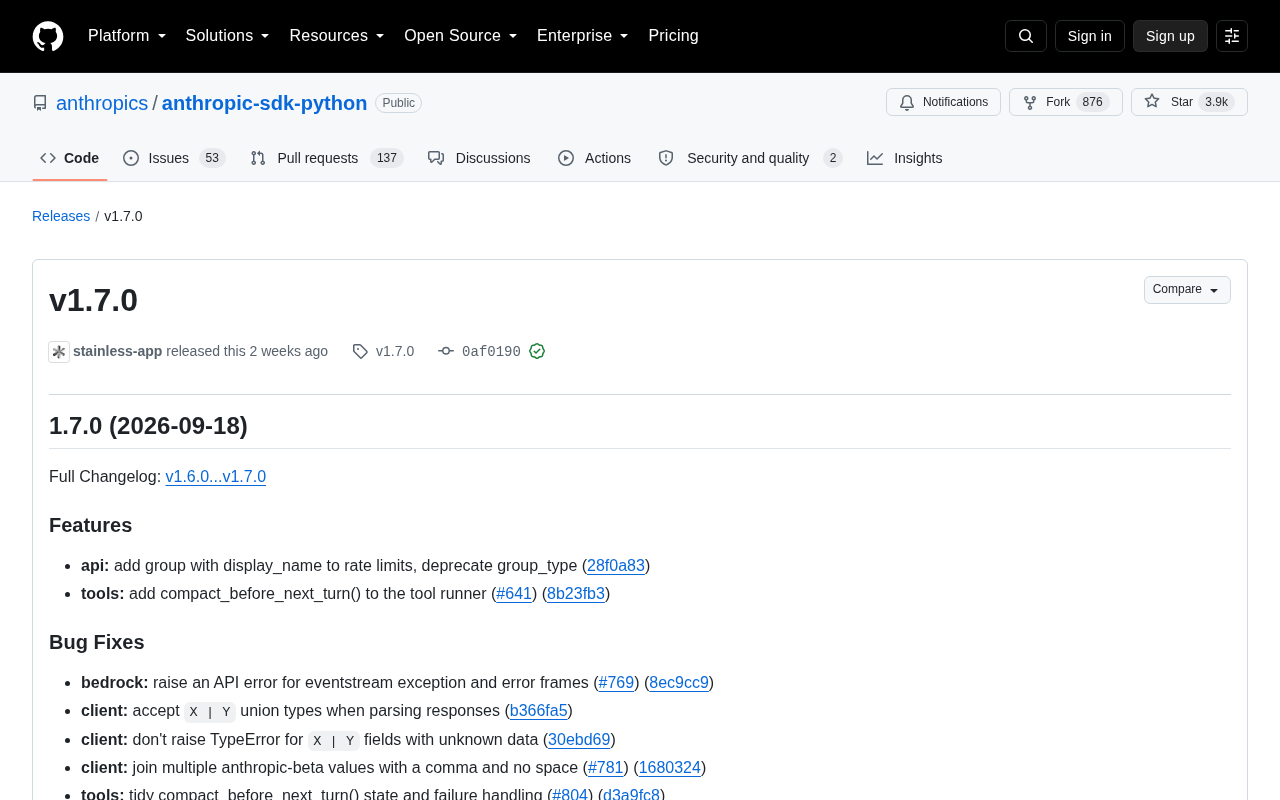
Anthropic Python SDK v1.7.0 introduces two key features: a `compact_before_next_turn()` context compaction method for long-running agent scenarios, and a migration of rate limit group identifiers from `group_type` to a new `display_name`-based group field (the old field is now deprecated). On the stability front, the release fixes a `TypeError` thrown when parsing `X | Y` union types with unknown data, and improves error surfacing for exception frames in AWS Bedrock streaming calls. The minimum required Pydantic version has been raised to 1.10, and the toolchain now targets Python 3.10+. Developers should verify Pydantic compatibility and audit any code relying on the deprecated `group_type` field before upgrading.
Anthropic's official Python SDK has shipped its v1.7.0 update. As the official development toolkit for the Claude model family, this release focuses on enhanced tool use capabilities, adjustments to the API rate limiting mechanism, and a round of client stability fixes. For developers integrating Claude's API via Python, these changes have a direct impact on day-to-day development experience.
Core New Features: Tool Compaction and Rate Limit Refactoring
The two most noteworthy feature updates in this release both address real developer pain points.
First, a compact_before_next_turn() method has been added to the tool runner. This capability targets context management in long-running conversations — when multi-turn tool calls accumulate a growing message history, developers can now compact the context before entering the next turn, easing token bloat and context window pressure. Accompanying documentation has also clarified the tool_changes field and the description of tool changes for compaction, signaling that this feature is being steadily refined into a stable engineering solution.
Second, the API layer has been updated with changes to rate limits: a new group field with a display_name has been added, while the existing group_type field is now deprecated. This means the way rate limit groups are identified is shifting from type enumerations to more human-readable display names. Production systems that monitor and handle rate limiting will need to proactively adapt their logic to avoid future reliance on the deprecated field.
Context compaction essentially involves discarding or collapsing historical messages during a long conversation — summarizing the results of early multi-turn tool calls into a more concise form before passing them into the next request. This is necessary because large language models have a fixed token limit on their context window (200K tokens for the Claude 3 family). After an agent has executed dozens of tool calls, the full message history can approach or exceed this limit, causing request failures or a sharp rise in costs.
compact_before_next_turn()encapsulates this cleanup logic, freeing developers from manually trimming message arrays. The SDK takes responsibility for deciding what context to retain and what history to compact — making it a critical piece of infrastructure for building long-running agents.
Stability Fixes: Union Types and Cross-Platform Compatibility
If new features define the upper bound of what the SDK can do, this batch of bug fixes directly affects everyday reliability for developers.
Several improvements have been made to response parsing on the client side. The SDK can now correctly accept X | Y union types for response parsing, and will no longer raise a TypeError when an X | Y field contains unknown data. This is especially important for projects that use modern type annotations and need to handle unexpected fields in API responses, improving forward-compatibility resilience.
Another small but meaningful fix involves beta feature headers: when multiple anthropic-beta values are provided, the SDK now joins them with a comma and no space. Seemingly minor formatting details like this can prevent edge-case parsing issues on the server side.
On the Bedrock integration front, the SDK now raises API errors for exception frames and error frames in event streams, rather than silently swallowing them. For users running Claude on AWS Bedrock, this makes errors in streaming calls much easier to catch and diagnose. Additionally, state management and failure handling for compact_before_next_turn() have been cleaned up and improved.
Python 3.10 introduced
X | Yas shorthand forUnion[X, Y], a new type annotation syntax brought in by PEP 604. Before that, type unions could only be written asUnion[str, int]orOptional[str]. The SDK previously had a flaw in its support for this newer syntax: when an API response field contained an unknown value not yet defined in the SDK, the parser would raise aTypeErrorinstead of degrading gracefully. This kind of issue is particularly dangerous in scenarios where the API is continuously evolving and the server-side may add new enum values before the client is updated — a single unexpected enum value could cause the entire response to fail parsing, impacting production stability. This fix allows the SDK to tolerate such forward-compatibility scenarios, representing a meaningful improvement for projects using modern Python type annotations.
Engineering Maintenance and Dependency Changes
Beyond user-facing changes, this release also includes a set of internal maintenance updates, a few of which affect runtime environment requirements.
The most important change to be aware of is a dependency update: the SDK now requires Pydantic 1.10 or higher. Projects using older versions of Pydantic will need to confirm dependency compatibility before upgrading. Separately, Ruff's target version has been set to Python 3.10, and a strict= argument has been passed to zip() in MCP tool helper functions — both reflecting a broader push toward a more modern, stricter Python toolchain.
On the documentation side, descriptions have been added for enum values and path parameters, improving the overall completeness of the API reference. Other changes, such as removing unused noqa comments and adding cast annotations, fall under routine code quality maintenance.
Pydantic is a widely used data validation and serialization library in the Python ecosystem, and the Anthropic SDK relies on it to perform structured validation of API requests and responses. There are significant, non-backward-compatible API differences between Pydantic v1 and v2. Pydantic 1.10 is the last stable maintenance release of the v1 series and includes several important performance fixes and type system improvements. Pinning the minimum dependency to 1.10 means the SDK can safely use features introduced in that version while remaining compatible with projects that have migrated to v2 (Pydantic v2 provides a v1 compatibility layer). For legacy projects still on Pydantic 1.9 or earlier, this upgrade requires extra attention to dependency management to avoid version conflicts.
Practical Impact for Developers
Taken together, v1.7.0 is an iteration that balances feature evolution with stability refinement.
For teams building agents or multi-turn tool-calling applications, compact_before_next_turn() provides an officially supported entry point for context compaction — worth testing as part of your optimization strategy for long-running conversation scenarios. For production environments focused on rate limit management, it's time to migrate from the deprecated group_type field to the new display_name-based group field. Meanwhile, fixes to union type parsing and Bedrock error handling broadly reduce hidden risks during integration.
Upgrade recommendation: Confirm that your Pydantic version is at least 1.10 before upgrading, and audit any code that depends on the deprecated group_type field. For the full list of changes, refer to the official changelog from v1.6.0 to v1.7.0.
Related articles

Random Pruning of the DPO Computation Graph: 1.4x Training Speedup and Lower Peak Memory
DPO training too slow and memory-hungry? This paper proposes a random pruning framework for the DPO computation graph, sampling independently across position, sequence, and branch dimensions; branch pruning achieves a 1.426x step-time speedup and cuts training time by about 30%, with in-depth attribution of memory and time gains.

Why Does JEPA Underperform MLM in Longitudinal EHR Representation Learning?
New study compares JEPA and MLM for longitudinal EHR representation learning on MIMIC-IV: three JEPA variants train stably without collapse but underperform MLM; target size, not heterogeneity, drives prediction error.

Transfer Learning + Visible Light Communication: A New Approach to Energy-Efficient Indoor Positioning
A study proposes a transfer learning-based visible light communication indoor positioning method, achieving 47% accuracy improvement on the BOSCH factory dataset, 67.5% model efficiency under high noise, and introducing the ME composite metric for energy-efficient positioning in energy-constrained industrial IoT scenarios.