Anthropic Races Toward IPO as Google's Gemini Releases a Flurry of Updates
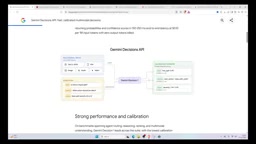
Google releases a decision API, DNA vision model, and mid-tier model Hydrogen; Anthropic launches Claude Meetings and paves the way for an IPO.
The article rounds up multiple updates from Google and Anthropic during the same period. Google launched a decision-making API positioned to select paths based on fixed data rather than generate open-ended answers, aimed at customer service triage and robot action selection; it also released a model that can visually understand human DNA, pointing toward DNA research, vaccines, and cancer research; in addition, there is the mid-tier model Hydrogen, benchmarked against Claude Sonnet and ChatGPT Terra, emphasizing execution speed, with computer use capability weaker than Sonnet. On Anthropic's side, Claude Meetings allows Claude to join meetings as a team member, responsible for recording key points, generating artifacts, and answering questions in real time; there are also reports that Anthropic's IPO is expected around November 18 or 19. The article notes that much of this information comes from a relay of a single video source, and benchmark scores, revenue figures, and listing dates have not been cross-verified, so it should be viewed with caution.
Google and Anthropic each pushed out multiple updates within a similar time window: on one side, Gemini made a series of moves across decision models, DNA visual understanding, and its new-generation model Hydrogen; on the other, Claude entered collaboration scenarios as a "meeting member," alongside signals that Anthropic is paving the way for an IPO. According to roundups published by several YouTube AI news creators in the same period, these stories were interpreted together in a single episode.
Google Gemini: From "Giving Answers" to "Making Decisions"
According to the video's author, Gemini launched a decision-making API. Its biggest difference from conventional chat models lies in its positioning—it is not responsible for generating open-ended answers, but rather for determining which path to take or which option to choose based on a fixed set of data.
The applications of this capability are very concrete: customer service triage, robot action selection, and similar scenarios are all essentially about deciding "what comes next" given a certain input. The video mentions that this model outperforms its comparison targets in benchmarks from multiple institutions; the targets listed by the author include typesafe, jeff, ChatGPT Luna, and Gemini Flashlight, and he claims "almost everyone says Gemini is better."
It should be noted that the video does not disclose the specific names, test conditions, or scores of these benchmarks, so the conclusions should be viewed with caution.
Differences Between Decision-Making APIs and Generative Chat Models
Conventional chat models (such as ChatGPT and the general-purpose versions of Gemini) are essentially "open-domain generation": given some input, the model outputs a natural language reply, and correctness is often probabilistic and requires human judgment. Decision-making models, by contrast, are typically confined to a closed action space—for example, choosing one of three options: "transfer to a human / self-service resolution / escalate the ticket," or a set of discrete commands a robot can execute—and the model's task is to score each candidate action and select the best one, outputting an action rather than text.
Such models generally require fine-tuning for specific business contexts or a few examples, and the evaluation metrics shift from "whether the answer is fluent and correct" to "whether the choice is optimal and how high the cost of misjudgment is." Therefore, the "judging which path to take based on a fixed set of data" described in the article is closer to a combination of traditional recommendation/ranking systems and language models, rather than an extension of general chat capabilities.
DNA Understanding and Hydrogen: Two Extension Lines for Google
The same source also mentions that Google launched a new model capable of visually understanding human DNA. According to the video, this capability can serve DNA research, vaccine development, and cancer-related research. The original text does not provide the model's name or performance metrics, and can only confirm that the direction is "processing DNA information visually."
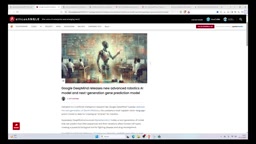
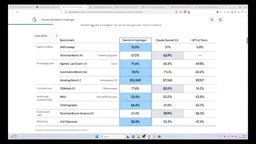
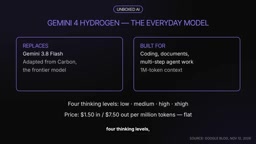
The third item is the model Hydrogen. The author states that Google had previously released Argon and Carbon, and Hydrogen is the third, positioned as a mid-tier model comparable to Claude's Sonnet and ChatGPT's Terra. Its standout feature is fast execution speed, enabling quicker answers.
In terms of benchmark performance, the video gives the following figures: 13.5 versus 1 on agent decoding, and 57 on another knowledge work benchmark, with the author claiming Hydrogen is superior on all benchmarks. Regarding computer use capability, Hydrogen is stronger than Terra but weaker than Sonnet. These figures lack full benchmark names and evaluation criteria, making them more suitable as directional references than definitive conclusions.
The Approach of Processing DNA with Vision Models
Treating DNA as an "image" to understand is an approach that has emerged in recent years: encoding base sequences or genome alignment results into two-dimensional matrices (similar to heatmaps or sequence logo plots), and then feeding them into vision backbone networks to extract local patterns. The motivation is that convolution and attention mechanisms excel at capturing local motifs in sequences (such as promoters and splice sites) and their spatial combinations, and image representations allow models to reuse mature vision architectures.
However, such methods are highly sensitive to the encoding scheme and require large amounts of annotated genomic data; the vaccine and cancer research mentioned in the article usually refers to downstream tasks such as antigen prediction and variant effect assessment, which are still quite far from clinical application.
Claude Enters the Meeting Room: Treating AI as a Team Member
On Anthropic's side, the update is Claude Meetings. According to the video, you can add Claude to a meeting as a team member; it records key points, listens in on discussions, generates artifacts, and organizes key conclusions. If there are questions related to the discussion during the meeting, you can also ask it directly, and it will respond in real time.
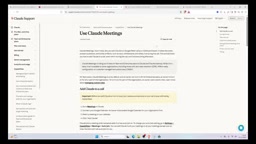
The significance of this positioning lies in the change to the collaboration interface: AI is no longer just a post-meeting notes tool, but is placed within the meeting process itself. However, the video does not explain which meeting platforms it supports or how it handles permissions and data retention—exactly the parts enterprise users care about most, which remain blank for now.
Technical Prerequisites for artifacts and AI Meeting Members
Artifacts refer to structured outputs generated by AI during a conversation, such as documents, spreadsheets, code snippets, or interactive pages, rather than plain text replies. In a meeting context, this means Claude can directly organize discussion content into reusable documents or to-do lists, reducing post-meeting rework.
For AI to become a "meeting member," the technical requirements include real-time speech transcription, speaker diarization, context window management, and integration with meeting platforms for bot joining permissions. Enterprise scenarios also involve compliance issues such as recording notifications, data residency, and retention periods—exactly the key links the original article points out as undisclosed yet decisive for real-world deployment.
Anthropic IPO: Timing and Revenue Curve
The last item in the video is Anthropic's IPO, with the author stating that the listing date is approximately November 18 or 19. A Twitter user shared its revenue data: from 2 billion to 4.7, then to 11, then to 17. The author lets viewers decide for themselves whether to participate based on this.
The original text does not specify the currency, statistical period, or methodology for these figures, and they come from a social media relay, constituting single-source information that readers should treat with caution. The only confirmable aspect is the trend direction—revenue is rising rapidly across multiple stages.
Looking at These Stories Together
Placing these updates side by side reveals the different pace of the two companies. Google is making intensive deployments at the model layer: a dedicated decision-making model, DNA visual understanding, and a mid-tier speed-oriented model, all covering the expansion of capability boundaries; Anthropic, meanwhile, is focusing on collaboration entry points and capital markets—Claude Meetings competes for a position in workflows, while the IPO relates to the sustainability of future investment.
Worth noting is the mid-tier model line. Hydrogen is explicitly benchmarked against Sonnet and Terra, indicating that the focus of competition is shifting from "the strongest" to "good enough and fast"—for most actual businesses, response speed and cost are often more important than being number one on the leaderboard.
The above information mainly comes from a relay of a single video source; the parts involving benchmark scores, revenue figures, and listing dates have not been cross-verified by multiple parties, and official releases should be taken as authoritative.
Why "Mid-Tier Models" Have Become the Focus of Competition
Mid-tier models refer to models positioned between flagship and lightweight versions, selling on cost-effectiveness and latency, such as Claude's Sonnet series. As inference costs and response speeds become business bottlenecks, most enterprises do not need the top-ranked model on a leaderboard, but rather an option that is "good enough, cheap, and fast," making mid-tier models the main volume drivers.
This also explains the positioning of Hydrogen in the article, which emphasizes execution speed and makes trade-offs in computer use capability: vendors often control costs through distillation, sparsification, or smaller parameter scales, at the expense of performance on complex agent tasks.
One-line Summary
Google releases a flurry of updates including a decision API, a DNA vision model, and the mid-tier model Hydrogen, while Anthropic launches Claude Meetings and paves the way for an IPO.
Paragraph Summary
The article rounds up multiple updates from Google and Anthropic during the same period. On Google's side, it launched a decision-making API positioned to select paths based on fixed data rather than generate open-ended answers, aimed at customer service triage and robot action selection; it also released a model that can visually understand human DNA, pointing toward DNA research, vaccines, and cancer research; in addition, there is the mid-tier model Hydrogen, benchmarked against Claude Sonnet and ChatGPT Terra, emphasizing execution speed, with computer use capability weaker than Sonnet. On Anthropic's side, Claude Meetings allows Claude to join meetings as a team member, responsible for recording key points, generating artifacts, and answering questions in real time; there are also reports that Anthropic's IPO is expected around November 18 or 19. The article notes that much of this information comes from a relay of a single video source, and benchmark scores, revenue figures, and listing dates have not been cross-verified, so it should be viewed with caution.
Related articles
Cheapest Gemini 4 Tested: Scores 51 to Narrowly Beat a Flagship at Double the Price
Google's cheapest Gemini 4 model Hydrogen narrowly beats the double-priced Argon 51-50 on an independent leaderboard, but GPT 6.1 Tera ties it at half the cost. This article analyzes its pricing, terminal-task performance, the cost of the extra high level, and buying advice.

Gemini 4 Hydrogen Released: A Lightweight AI Option Focused on Speed and Cost-Effectiveness
Google releases lightweight model Gemini 4 Hydrogen, positioned as a Gemini 3.8 Flash replacement. It beats its own Argon in benchmarks, costs less than Sol and Opus, leads peers in speed, and can generate a playable game from a single prompt.
Google Gemini 4 Hydrogen Hands-On: Fast and Cheap, But It Won't Check Its Own Work
Google Gemini 4 Hydrogen hands-on: six apps scored 24.9/60, ranking near the bottom, but six tasks took only $6 and 31 minutes. A deep dive into its behavior patterns—no thinking, no screenshot checks, tests written to pass—and its correct use as an agent worker rather than a verifier.