Gemini 4 Hydrogen Released: A Lightweight AI Option Focused on Speed and Cost-Effectiveness

Gemini 4 Hydrogen enters everyday coding and agent workflows with lightweight positioning, low price, high speed, and near-flagship reasoning scores.
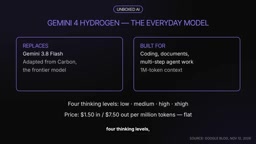
Google releases Gemini 4 Hydrogen after Gemini 4 Carbon, a lightweight model available to all users as a replacement for Gemini 3.8 Flash, focusing on speed, efficiency, and everyday coding and agent workflows. According to Average's hands-on test, Hydrogen scores 51 on the Artificial Analysis Intelligence Index at the default high thinking level, surpassing its flagship Argon's 50, and reaches 54 at extra high; it is priced at $1.50 per million input tokens and $7.50 output, officially targeting Claude Sonnet 5.5 and GPT 6.1 Terra. Speed is another advantage—Google claims 2.5x faster task completion and 12% to 23% lower token usage. In testing, it generated a playable 3D roguelike zombie FPS from a single prompt in about 15 minutes, earning positive marks for zero-shot capability.
Naming Logic: The Light-Heavy Distinction in the Periodic Table
Google's Gemini 4 series adopts periodic table naming. Hydrogen, the lightest element with an atomic weight of 1.008, corresponds to the lightweight model; Carbon, with an atomic weight of 12.011, corresponds to the frontier model; while Argon, with an atomic weight of 39.948, should theoretically be heavier, but its actual performance falls short of Carbon and may even lag behind Hydrogen. In the video, Average joked that this naming "feels a bit random with Argon."
Hydrogen's positioning is clear: bring Gemini 4's capabilities to everyone, covering all tiers of Google AI Studio, the Gemini API, Gemini for Business, the Gemini app, Google Search, and the paid Google AI Pro and Ultra plans. Google emphasizes that it is built for fast execution, while Carbon and Argon target deep, long-horizon reasoning.
Benchmarks: The Lightweight Model Outperforms Its Own Flagship
The most striking data comes from the Artificial Analysis Intelligence Index. Hydrogen scores 51 at the default high thinking level, surpassing Argon's 50; at the highest extra high thinking setting, it reaches 54. Average noted that this score even exceeds Opus 5.5 and 6.1 Sol (55 points), which sits below Opus 5.5 Max's 59. Considering Hydrogen's price positioning, this performance is "pretty cool."
In comparisons with other lightweight competitors, Hydrogen trails Claude Sonnet 5.5's Max score by just one point, leading on some benchmarks and lagging on others; against GPT 6.1 Terra Max, it leads by at least three points. However, Average also cautioned that Sonnet 5.5 still wins Terminal Bench 4.1, OS World, and Terminal Bench Science 0.1, and Terra also beats Hydrogen on one of these.
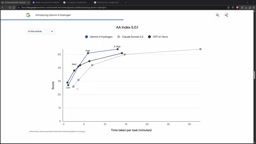
"It looks great on paper, the numbers are excellent, but that's just one factor," Average emphasized. Benchmarks cannot fully represent real-world experience.
Artificial Analysis Intelligence Index is a composite capability leaderboard maintained by the independent evaluation firm Artificial Analysis. It normalizes and weights scores from multiple mainstream benchmarks (such as reasoning, coding, math, and knowledge Q&A) into a 0–100 index, making it easy to compare across vendors. The index continuously tracks new models and distinguishes different "thinking budget" tiers (e.g., default, high, extra high), so the same model receives different scores at different reasoning intensities. Note that it is an aggregate metric that masks differences in individual capabilities—one reason the article reminds readers that "benchmarks cannot fully represent real-world experience."
Thinking level (reasoning effort) refers to the internal reasoning token budget a reasoning model is allowed to consume before giving a final answer. The higher the tier, the more the model tends to unfold longer chains of thought and try more solutions, usually yielding higher accuracy but also higher latency and cost. The "default high thinking level" and "extra high" mentioned in the article fall into this category; vendors typically offer multiple tiers for developers to trade off between quality and speed.
Pricing and Speed: A Strong Contender in Its Price Bracket
Hydrogen is priced uniformly across the full 1M-token context window: $1.50 per million input tokens and $7.50 per million output tokens. By comparison, Sol charges $2 input and $10 output, and Opus 5.5 charges $4 input, making Hydrogen clearly cheaper.
However, Average clarified that Hydrogen does not compete in the same price bracket as Opus and Sol; its real rivals are Sonnet 5.5, Haiku, and GPT 6.1 Terra. Terra and Haiku are actually cheaper, while Sonnet is slightly more expensive. Google officially states that it targets Claude Sonnet 5.5 and GPT 6.1 Terra.
Speed is another card Hydrogen plays. At the extra high setting, it is the fastest of the three compared models, with significantly shorter time-to-first-answer and per-task duration. Google claims that compared with Gemini 3.8 Flash, Hydrogen completes tasks 2.5 times faster at the high default setting, scores more than three times higher on Terminal Bench 4.1, and reduces fabricated claims by more than five times. Partner feedback indicates that in iterative repository coding and debugging scenarios, Hydrogen runs 2 to 2.8 times faster with 12% to 23% lower token usage.
Agents and Multimodality: Designed for Real Workflows
Hydrogen supports a 1M native token input context, with output also up to 1M tokens, and can synthesize dense PDFs, spreadsheets, charts, audio, and recorded video. In web development scenarios, Google says it can generate more complete functional layouts with fewer prompts on speed-sensitive tasks such as real-time UI prototyping and design-to-code iteration.
On agent capabilities, Hydrogen ranks fifth on Agent Arena, leads its peers on HLE Diamond, ranks first on Val's Tax Agent Bench, ties for first on Val's Legal Research Bench, and leads on Automation Bench AA. Average believes that within its price range, Hydrogen is a "very good candidate," especially for balancing cheapness and speed.
On the safety front, Google provided a set of figures: up to 81% reduction in overreach during agent tasks, 12 times fewer misaligned actions and task shortcuts in tool use and code evaluation, up to two times lower likelihood of bypassing permission boundaries when facing impossible or blocked tasks, and a score of 96% on internal agent honesty evaluations. Regarding reasoning transparency, Hydrogen maintained 99% chain-of-thought readability across more than 200,000 audit rounds, with zero deceptive reasoning edits. Average acknowledged this, noting that while some providers choose to obfuscate their reasoning processes, it is "always good" that Gemini prioritizes transparency.
Agent Arena is an evaluation platform where different models compete head-to-head or are scored in real agent tasks (such as multi-step tool calls, web operations, and file processing). Rankings reflect end-to-end task completion capability rather than single-turn Q&A performance. HLE (Humanity's Last Exam) is a set of highly difficult, cross-disciplinary expert-level questions, often regarded as a benchmark for measuring the upper limits of a model's knowledge breadth and depth; "HLE Diamond" in the article should be a more difficult subset or variant. Val's Tax Agent Bench and Val's Legal Research Bench are vertical-domain agent benchmarks that assess model performance in highly specialized, compliance-heavy scenarios such as tax filing and legal research, respectively; Automation Bench AA targets office and workflow automation tasks.
These benchmarks share the characteristic of being close to real workflows: they examine not only whether answers are correct but also whether tool selection is reasonable, whether steps are economical, and whether the model oversteps authority or takes shortcuts. Therefore, they complement traditional single-turn knowledge tests and better reflect whether a model can "actually get the job done."
Hands-On: Generating a Playable Game from a Single Prompt
In Google Anti-Gravity, Average tested Hydrogen with the same prompt used in a previous Claude video: "Create a fully playable, fun roguelike RPG. I'll give you full game design direction, but I want the game to be genuinely engaging, with hours of content."
Hydrogen ran for 21 minutes and generated a playable Node application. Average's feedback was somewhat nuanced: the result was "strikingly similar" to what other models had generated before, even the sound effects were close, leading him to suspect highly overlapping training data. However, this version had more sprites and nearly identical functionality, including 15 levels, a codex, permanent upgrades, and other systems.

The second prompt was "Create a fully playable roguelike zombie FPS," again requiring full design freedom and hours of content. Hydrogen took about 15 minutes to complete "Dead Sector Protocol: Zero," a playable 3D roguelike zombie FPS. Average's actual experience was quite positive: "This feels a bit like a Roblox game I've played before—not in a bad way. Actually, it feels pretty good; I don't hate it." The game includes three classes, an upgrade system, weapon switching, and skills like a cryo pulse.

"For a vague request, being able to generate a playable game from a single prompt says something about the model's capabilities," Average concluded. He acknowledged these were only zero-shot tests, but the results were telling enough.
Zero-shot means the model completes a task based solely on a natural language instruction, without examples, fine-tuning, or additional context. In the article, using the same prompt to let different models generate games is a typical zero-shot capability test: it examines the model's ability to understand vague requirements, fill in implicit assumptions, and produce a runnable result in one go. Good zero-shot performance indicates strong general priors, but it does not equal the upper-bound performance achievable in a specific domain with carefully crafted prompts or tool orchestration.
Node application refers to a program built on the Node.js runtime, typically written in JavaScript/TypeScript, which can run a game frontend in the browser via a local server. A model being able to directly produce a playable Node project means it must simultaneously handle game logic, rendering, assets, and runtime configuration—which is why such hands-on tests are considered persuasive.
Who Should Pay Attention to Hydrogen
Hydrogen is not "the most powerful model ever" and still loses to competitors in its price bracket on some benchmarks. But its value lies in the combination: reasoning scores close to flagship levels, significantly faster response times, lower token consumption, and availability across all channels from the API to the Gemini app and Google Search. For development teams that need rapid iteration, high-volume calls, and cost sensitivity, Hydrogen offers an option worth serious evaluation.
At the end of the video, Average mentioned that OpenAI seems to have had no new model activity recently, while Anthropic and Google are接连 playing cards. "I'm happy about it, I'll take it." This probably represents the mindset of many developers.
Token consumption is one of the key metrics for measuring a model's economics: for the same task, the fewer tokens consumed during output and reasoning, the lower the per-task cost and latency. The article mentions that Hydrogen reduces token usage by 12% to 23% in iterative repository coding; combined with a lower per-million-token price, the actual cost advantage is further amplified. For high-frequency calls, long contexts, or multi-turn agent loops, token efficiency often determines the total bill more than the single-call price—another reason not to evaluate lightweight models based on benchmark scores alone.
Related articles

Free Access to Gemini Coding Models: Methods, Risks, and Alternatives
A YouTube creator claims you can use Gemini coding models free via a third-party webpage to build a Ludo game. We examine the demo, authenticity doubts, security risks, and safer alternatives.

Gemini 4 Hydrogen Explained: Google's Lightweight, High-Speed AI Model
Analyzing Google's Gemini 4 Hydrogen: a lightweight, fast AI model with four thinking levels, multimodal support, ~100K token context, and the Carbon/Argon family roles.
Cheapest Gemini 4 Tested: Scores 51 to Narrowly Beat a Flagship at Double the Price
Google's cheapest Gemini 4 model Hydrogen narrowly beats the double-priced Argon 51-50 on an independent leaderboard, but GPT 6.1 Tera ties it at half the cost. This article analyzes its pricing, terminal-task performance, the cost of the extra high level, and buying advice.