Cheapest Gemini 4 Tested: Scores 51 to Narrowly Beat a Flagship at Double the Price
Hydrogen narrowly beats Argon 51-50, but GPT 6.1 Tera ties it at only half the cost.
Google released Hydrogen, the cheapest Gemini 4 model, replacing Gemini 3.8 Flash for everyday agent tasks in coding, document processing, and multi-step work, with flat pricing of $1.50/$7.50 per million input/output tokens that does not double after the introductory period. On Artificial Analysis it scores 51, narrowly beating the double-priced Argon (50), though the sub-half-point gap has limited statistical meaning. Terminal completion rises from 18% to 57% and bug-fixing scores 13.5%, but Claude Sonnet 5.5 still leads in terminal and computer use, and GPT 6.1 Tera ties at 51 with a per-task cost of only 96 cents—about half of Hydrogen's—undercutting its value story. The extra high level reaches 54 but costs 69% more and nearly triples token use.
Google has released Hydrogen, the cheapest Gemini 4 model in the family, and on an independent benchmark it narrowly beats Argon—which costs twice as much—by a score of 51 to 50. But that victory margin is less than half a point. More importantly, OpenAI's GPT 6.1 Tera ties Hydrogen at the same 51 points while costing only about half as much per task (96 cents). The value-for-money story is far more complicated than it appears.
Product Positioning and Pricing: Built for Everyday Multi-Step Tasks
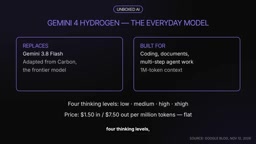
According to analysis by the YouTube channel Unboxed AI, Hydrogen launched on November 12 and is positioned as Google's "everyday model" for agent scenarios involving coding, document processing, and executing multi-step tasks, replacing Gemini 3.8 Flash. It is adapted from the same family's frontier model Carbon, offers a 1-million-token context window and 4 thinking levels, and uses flat pricing: $1.50 per million input tokens and $7.50 per million output tokens.
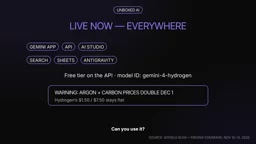
The core of this pricing strategy is "predictability"—there are no complex tiered charges, making it easier for developers to estimate costs. By contrast, Argon and Carbon are still on introductory pricing, and their prices will double after November 30, while Hydrogen remains stable.
"Context window" refers to the total number of tokens a model can read at once in a single request. One million tokens is roughly equivalent to hundreds of pages of documents or a medium-sized codebase, and it determines whether the model can digest long materials in one pass without losing earlier information. APIs priced by token usually distinguish between input and output prices, with output being more expensive because decoding requires more computation. So-called "introductory pricing" is a common promotional tactic: attract developers with a discounted price, then restore the standard price when the period ends, which can invalidate cost estimates based on current prices within a few weeks. Hydrogen's flat rate, which does not double after the introductory period, is aimed precisely at this uncertainty, making developers' long-term cost models more predictable.
Independent Evaluation: A Win, but a Barely There One
On the independent evaluation platform Artificial Analysis, Hydrogen scores 51 with default settings and can rise to 54 when the extra high level is enabled; Argon scores 50, Carbon scores 60, and the replaced old Flash scores only 31. In terms of per-task cost, Hydrogen is $1.87, Argon is $4.97, and Carbon is about $5.50—roughly one-third that of frontier models.
However, a lead of 51 to 50 is less than half a point and is statistically almost meaningless. The channel also notes that Google's own benchmarks are owned by Google, and although the independent leaderboard confirms the headline conclusion, two reruns produced lower scores.
Artificial Analysis is an independent large-model evaluation organization. Its Intelligence Index produces a composite score through a set of standardized benchmarks while also tracking token consumption and API prices for each task, converting them into per-task cost. The leaderboard does not rely on vendor-reported data, so it is often used to cross-check the credibility of official benchmarks. However, any single composite index weights and mixes different tasks such as coding, terminal operations, and reasoning, so models with the same score may perform very differently in specific scenarios; moreover, scores are usually based on a limited number of samples, and gaps of less than 1 point often fall within statistical noise. The article's mention that "two reruns produced lower scores" is exactly a manifestation of this sampling fluctuation, and it also shows that when interpreting leaderboards, one should focus on confidence intervals rather than just rankings.
Real-World Task Performance: Clear Progress in Terminal Work and Bug Fixing
According to cross-validation by Unboxed AI and the independent leaderboard, Hydrogen completes 57% of tasks on Terminal Bench (real terminal-operation tasks), compared with only 18% for the old Flash; on the SWE Sweep bug-fixing task it scores 13.5%, reportedly more than four times that of Claude Sonnet 5.5, and according to Google it is 2.5 times faster than Flash. The independent leaderboard shows that Hydrogen takes about 8 minutes per task on average, while the old model takes nearly 15 minutes.
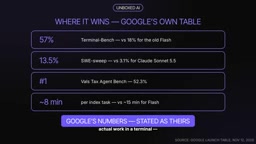
These data show that Hydrogen's practicality in agent scenarios has improved substantially and that it is no longer a "toy-grade" model. But the channel also honestly presents two losses.
Terminal Bench and SWE Sweep are two types of benchmarks that measure an agent's "hands-on ability." Terminal Bench requires the model to complete multi-step operational tasks in a real Linux terminal environment (such as file management, software configuration, and script debugging), testing command understanding, error recovery, and long-horizon planning. The completion rate refers to the percentage of end-to-end successfully solved tasks, not the accuracy of individual commands. Benchmarks such as SWE Sweep provide issues from real code repositories and require the model to locate defects, modify code, and pass tests; scores are usually calculated as the proportion of successful fixes. These tasks are closer to developers' daily use than question-answering evaluations, so vendors often cite relative figures such as "several times faster" or "several times higher" in marketing; however, such comparisons often lack a unified test set and runtime environment, and figures across vendors should not be compared directly.
Competitive Landscape: Dual Pressure from Sonnet and GPT 6.1 Tera
On the same Terminal Bench, Claude Sonnet 5.5 scores 63.9, ahead of Hydrogen; on computer use tasks, Sonnet also wins 83.9 to 77.6. More awkward still is OpenAI's GPT 6.1 Tera: it has the same 51 points on the independent index, but its per-task cost is only 96 cents, about half that of Hydrogen.
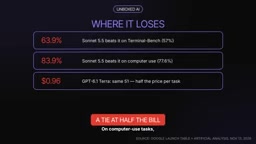
A tie at only half the price directly undermines Google's value-for-money narrative. In other words, Hydrogen is not the "best deal" choice—it is merely the best deal within the Google family.
The extra high Level: Stronger, but More Expensive and More Token-Hungry
Changing the setting from default to extra high raises the score from 51 to 54, but increases cost by 69% and token consumption by nearly three times. Google's official guidance also recommends using it selectively, because this level tends to "overthink" simple prompts. This means that for the vast majority of everyday scenarios, the default level is the reasonable choice.
"Thinking level" is a control parameter for reasoning models: before giving a final answer, the model generates internal reasoning tokens. The higher the level, the longer the reasoning chain allowed and the more paths it tries, making it more likely to solve complex multi-step tasks, but output and billed tokens also increase significantly. Because reasoning tokens are also billed at the output price, the cost increase from raising the level often far exceeds the score improvement, and it is prone to "overthinking" simple prompts—that is, taking a long detour to reach a conclusion that could have been answered directly. Google's recommendation to use it selectively is essentially a hint for developers to route by task difficulty: use the default level for routine tasks, and enable the high level only in complex coding or long-chain reasoning scenarios to control latency and cost.
Availability and Buying Advice
Hydrogen is already available in the Gemini app, API, AI Studio, Search, Sheets, and anti-gravity, with a free tier on the API.
The channel's conclusion is that Hydrogen is not the strongest model on the leaderboard—Fable 5.2 still leads at 65%, and Carbon leads by 9 points—but it is the most cost-effective choice in the Google family: near-flagship scores, one-third the cost of frontier models, and the fastest speed in the family. For everyday agent work, this is an honest choice. What developers need to weigh is this: if the task places extremely high demands on terminal operations or computer use, Sonnet is still the better solution; if the budget is sensitive and the task mainly involves general multi-step execution, GPT 6.1 Tera's equal score at half the price deserves serious consideration.
One-line Summary
Hydrogen narrowly beats Argon 51 to 50, but GPT 6.1 Tera ties it at half the cost.
Paragraph Summary
Google has released Hydrogen, the cheapest Gemini 4 model in the family, replacing Gemini 3.8 Flash and targeting everyday agent scenarios in coding, document processing, and multi-step tasks. It uses flat pricing of $1.50 per million input tokens and $7.50 per million output tokens, and the price does not double after the introductory period. On the independent evaluation platform Artificial Analysis it scores 51, narrowly beating the double-priced Argon (50), but the gap is less than half a point and statistically limited. In real tasks, terminal completion rises from 18% for the old Flash to 57%, bug-fixing scores 13.5%, and speed improves noticeably. However, Claude Sonnet 5.5 still leads in terminal and computer use, and OpenAI's GPT 6.1 Tera scores the same 51 while costing only 96 cents per task, about half of Hydrogen's cost, directly undermining its value-for-money narrative. The extra high level can raise the score to 54, but cost increases by 69% and tokens nearly triple, so Google officially recommends selective use.
Related articles

Free Access to Gemini Coding Models: Methods, Risks, and Alternatives
A YouTube creator claims you can use Gemini coding models free via a third-party webpage to build a Ludo game. We examine the demo, authenticity doubts, security risks, and safer alternatives.

Gemini 4 Hydrogen Explained: Google's Lightweight, High-Speed AI Model
Analyzing Google's Gemini 4 Hydrogen: a lightweight, fast AI model with four thinking levels, multimodal support, ~100K token context, and the Carbon/Argon family roles.

Gemini 4 Hydrogen Released: A Lightweight AI Option Focused on Speed and Cost-Effectiveness
Google releases lightweight model Gemini 4 Hydrogen, positioned as a Gemini 3.8 Flash replacement. It beats its own Argon in benchmarks, costs less than Sol and Opus, leads peers in speed, and can generate a playable game from a single prompt.