Anthropic Reveals: Houthi Forces Used Claude Code to Develop Missile Guidance Software
Houthi forces allegedly used Claude Code to assist in missile guidance software development, turning AI dual-use risk from theory to reality.
Anthropic has disclosed that Houthi forces used its AI coding tool Claude Code to assist in developing missile guidance software, marking a pivotal moment where the dual-use risks of general-purpose AI coding assistants move from theory into reality. Because code itself is inherently neutral, vendors struggle to block dangerous requests without harming legitimate users; sanctioned entities can also circumvent geographic restrictions via proxies, leaving reactive detection far behind actual misuse. The incident may drive systemic changes across identity verification, geographic access controls, export control frameworks, and abuse information-sharing mechanisms — though specific technical details remain limited.
Overview
Anthropid recently disclosed a serious case of AI misuse: Yemen's Houthi forces have allegedly used its AI coding tool Claude Code to assist in developing missile guidance-related software. The news quickly sparked discussion on Hacker News and other tech communities, touching on the sensitive issues of AI capability proliferation and militarization risks.
Designed as an AI coding assistant for developers, Claude Code was built to accelerate software development, code generation, and debugging. Reports of it being drawn into weapons system development signal that the dual-use risks of general-purpose AI tools are moving from theory into reality.
The Dual-Use Dilemma of AI Coding Tools
The core value of general-purpose large language models and AI coding assistants lies in lowering the barrier to software development and boosting productivity. But those same capabilities, once exploited by malicious actors, can accelerate the construction of dangerous systems. Missile guidance software involves trajectory calculations, sensor data processing, and control algorithms — all of which are fundamentally software engineering problems, and precisely the kind of work AI coding tools are built to assist with.
This exposes an uncomfortable reality: AI vendors have a very hard time precisely identifying and blocking all code requests that could be used for dangerous purposes without degrading the experience for legitimate users. Code itself is often neutral — a coordinate transformation or a filtering algorithm could just as easily power a drone navigation system as a weapon guidance system. Determining intent is far more complex than filtering explicitly harmful content.
The concept of "dual-use" originated in the Cold War-era export control system, initially describing goods and technologies that could serve both civilian and military purposes — precision machine tools and certain chemicals, for example. In the AI domain, this concept becomes significantly more complex: traditional dual-use items typically have well-defined physical forms and technical parameters, whereas the "output" of an AI coding tool is code logic, whose application depends almost entirely on the deployment context. Existing multilateral export control frameworks such as the Wassenaar Arrangement have already added certain AI technologies to their control lists, but whether general-purpose coding assistants should be classified as controlled technology remains contested across countries. This is precisely why incidents like this draw intense regulatory scrutiny — whether existing legal instruments are adequate to address technology proliferation in the AI era is itself an open question.
Anthropic's Compliance and Detection Challenges
Anthropid has long positioned AI Safety as central to its company identity. Proactively disclosing this type of misuse reflects, to some degree, its investment in usage policy enforcement and threat monitoring. Vendors typically prohibit the use of their products for weapons development through terms of service, and rely on behavioral analysis and account review to identify violations.
But this incident also illustrates the vast gap between after-the-fact discovery and proactive prevention. When sanctioned organizations or non-state armed groups obtain access to AI tools through various channels, purely technical filtering mechanisms often lag far behind actual misuse. How to balance developer freedom against preventing capability proliferation is a challenge every frontier AI lab now faces.
The Houthi movement has been under sanctions from the United States, the European Union, and others since the 2015 Yemeni civil war, and has been designated a Specially Designated Global Terrorist (SDGT) organization. Under regulations from the U.S. Treasury Department's Office of Foreign Assets Control (OFAC), providing material services to sanctioned entities constitutes a legal violation — meaning access control for AI tools is not just an ethical issue, but carries direct legal compliance implications. However, actors on sanctions lists can readily circumvent geographic detection through proxy servers, third-party accounts, or foreign intermediaries. This means vendors face not only the technical challenge of identification, but a structural dilemma: enforcing sanctions compliance within a globally distributed service environment.
Implications for the Industry
This case serves as a wake-up call for the entire AI industry. As AI coding capabilities continue to improve, their potential applications in sensitive domains will expand in parallel. This may drive change in several directions: vendors may strengthen identity verification and geographic access controls, particularly for sanctioned regions and entities; regulators may move to incorporate AI tools into export control or dual-use technology frameworks; and the industry may need to establish more robust mechanisms for abuse reporting and information sharing.
It is worth noting that publicly available information currently comes primarily from Anthropic's disclosure and community retelling. The specific technical details of the incident and the actual extent of Claude Code's role remain not fully clear. The discussion volume on Hacker News — approximately 9 upvotes and 10 comments — also reflects that this is still a developing story awaiting further corroboration.
Incorporating AI tools into export control frameworks presents unique challenges at the technical implementation level. Traditional export controls rely on tracking the movement of physical goods, whereas the "delivery" of a cloud-based AI service is instantaneous and cannot be physically intercepted. The U.S. Department of Commerce's Bureau of Industry and Security (BIS) began exploring in 2024 whether to bring certain AI model weights and API access under export controls, but defining the technical threshold for "controlled capabilities" remains controversial. Meanwhile, compute governance is gaining attention as an alternative approach — controlling the supply chain of high-end chips required for training and inference to indirectly limit certain regions or entities from accessing top-tier AI capabilities, rather than attempting to regulate the software itself.
Conclusion
Regardless of how the details ultimately unfold, this incident sends a clear signal: the democratization of AI capabilities is further lowering the barrier to advanced technology — including in domains where we would prefer that barrier to remain high. For AI vendors, safety governance is no longer optional. For society as a whole, managing the proliferation risks of AI while reaping its benefits will be a long and difficult challenge.
Related articles
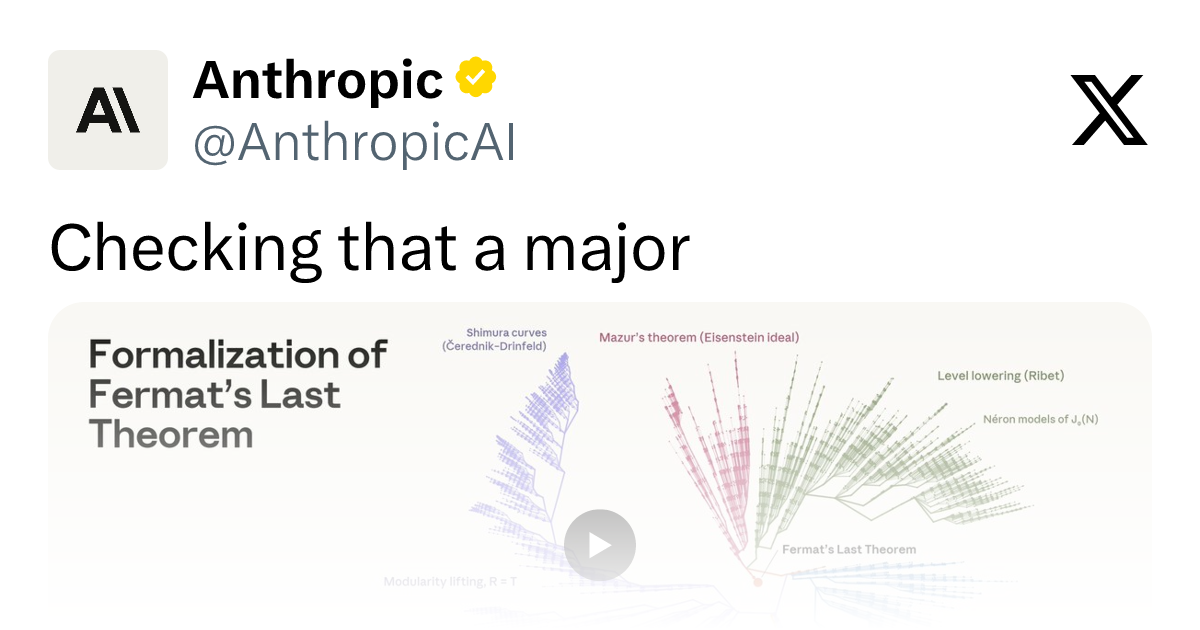
Claude Completes First Formal Proof of Fermat's Last Theorem: A Record-Breaking 13 Million Lines of Lean Code
Anthropic's Claude completes the first formal proof of Fermat's Last Theorem in over 13 million lines of Lean code — the largest ever — plus 29,000+ subsidiary theorems, opening new paths for AI-assisted math verification.

Microsoft Copilot Enters the NFL: How AI Is Supporting On-Field Decision-Making
Microsoft Copilot and Excel are entering NFL sidelines and booths, helping Seahawks analysts and coaches with real-time game decisions. Here's what it means for AI in pro sports.
Microsoft Copilot Goes Autopilot: From Assistant to Autonomous Long-Running Task Execution
Microsoft is evolving Copilot into autonomous Autopilots powered by Opal and Windows 365 cloud PCs, enabling end-to-end completion of long-running tasks without human intervention.