Anthropic's $1.4 Trillion IPO Bid: Hidden Concerns in AI Hardware

AI capital frenzy meets physical bottlenecks; five stories show hardware constraints matter in the second half.
Through five AI and tech hardware stories from a Bilibili investor, the article depicts capital frenzy coexisting with physical bottlenecks: Anthropic's $1.4T Nasdaq bid with $26B from seven giants and a three-day model migration undermining compute bundling; OpenAI's 20% price cut alongside Altman's chip bubble warning; Nvidia's $109B revenue expectation amid a trust crisis; a compute cloud provider's 168% revenue surge but widening losses; and an embodied AI firm's $500M raise with robotic hand durability as the real bottleneck. The takeaway: identifying physical bottlenecks is as important as spotting tech trends.
A dollar-cost-averaging investor shared his 962nd day of U.S. stock investing on Bilibili: a single-day floating loss of 547 yuan, total account value of 66,535 yuan, and a cumulative return of 14.66%. But what really made the comment section "collapse in their chairs" was his subsequent rundown of five major stories from the AI and tech hardware world—from Anthropic's bid for a $1.4 trillion valuation on Nasdaq to the harsh reality that robot hardware "wears out and breaks down in just a few weeks." Together, these stories paint a contradictory picture of today's AI industry: "capital frenzy" coexisting with "physical bottlenecks."
Anthropic's IPO: Seven Giants Co-Invest $26 Billion, the Compute-Bundling Myth Loosens
According to public reports cited by the UP host, large-model company Anthropic is about to list on Nasdaq with a target valuation of up to $1.4 trillion. Even rarer, seven giants including Google and Microsoft are jointly investing $26 billion to subscribe to new shares. The most striking detail: Anthropic ran its frontier model on a competitor's accelerator cards in just three days.
This directly undermines the camp logic of "exclusive compute bundling"—if models can quickly migrate to non-custom hardware, then chipmakers' strategy of locking in customers through software ecosystems faces a challenge. Capital is betting real money on the model layer rather than single-hardware binding, which may be the deeper reason the seven giants acted together.
Nasdaq listing refers to a company's initial public offering (IPO) on the Nasdaq stock market, enabling public trading of shares. Nasdaq is dominated by tech stocks, with relatively flexible listing thresholds, but companies must meet certain financial or market-cap standards. For AI companies, going public not only broadens financing channels but also means valuations are tested by the public market. A $1.4 trillion valuation, if realized, would place Anthropic among the world's most valuable companies, far exceeding most current tech giants and reflecting capital's extremely optimistic expectations for artificial general intelligence.
Compute bundling refers to chipmakers locking customers into their own hardware through proprietary software ecosystems (such as CUDA), creating high migration costs. Anthropic's model running on a competitor's accelerator cards within three days means the model layer's dependence on hardware is decreasing, shaking the industry convention that "buying chips means buying the ecosystem" and potentially reshaping the AI chip competitive landscape.
Model Price Cut of 20% and Altman's Cold Water: Efficiency Race vs. Chip Bubble
On the same day, OpenAI launched its new-generation 6.2 flagship model, cutting API call fees by 20%. But chief Altman poured cold water publicly at a summit: a large number of chipmakers are blindly expanding, ignoring data center and power constraints. He declined to comment on rumors about Jensen Huang.
On one side, price cuts force efficiency; on the other, warnings about a chip oversupply bubble—these seemingly contradictory moves actually point to the same judgment: AI inference costs must continue to fall to expand application scenarios, and the bottleneck in compute supply is not chip production capacity but power and data center infrastructure. For chip hoarders, this is a risk signal that warrants reassessment.

API call fees refer to the fees developers pay based on usage (such as per thousand tokens) when using large-model services through interfaces. A 20% price cut directly lowers AI application development costs and is a key lever for driving technology adoption. Altman's warning points to the risk of a chip bubble: many manufacturers are blindly expanding AI chip production while ignoring the physical limits of data center power supply and cooling capacity. The power bottleneck has become a core factor constraining compute expansion; in some regions, power grids can no longer bear the load of hyperscale data centers. This suggests to investors that the bottleneck in compute supply is shifting from chip production capacity to infrastructure, and hoarding chips may not translate into effective compute.
Nvidia's Earnings Test: $109 Billion Revenue Expected, Trust Crisis After Management Shakeup
Nvidia faces its first quarterly earnings report after a management shakeup, with the market expecting quarterly revenue of up to $109 billion. In response to calls from over 180,000 people to "strictly welcome him back," Jensen Huang softened publicly for the first time: if the board deems appropriate, he would be honored to return. That said, a large number of employees jointly warned of the risk of losing core talent.
Management turmoil coexisting with high performance expectations makes this earnings report a key window for observing Nvidia's organizational stability. What the market is really worried about is not the single-quarter numbers, but whether the loss of core team members will affect the delivery pace of next-generation products.

Warning from a Compute Cloud Provider: Revenue Surges 168%, Net Loss Widens to $709 Million
A once-hot compute cloud provider's latest quarterly report shows revenue surged 168% year-over-year to $3.66 billion, but depreciation and $846 million in net interest expense pushed its net loss to $709 million. Total debt approached $46.9 billion, forcing the company to suspend traditional unsecured bond issuance.
These figures reveal the fragility of the "lever up to buy chips" model—high revenue growth cannot hide the erosion of profits by depreciation and interest. When financing channels narrow, players that rely on debt to expand compute scale will be the first to feel the pressure.
Depreciation is the accounting allocation of hardware equipment costs over their useful life. Compute cloud providers purchase large amounts of GPUs and other equipment, and depreciation directly erodes profits. Net interest expense reflects the cost of a company's debt financing; $846 million in net interest expense indicates an extremely high leverage ratio. Unsecured bond issuance refers to bonds issued without collateral, relying on the company's own credit; suspending such issuance means financing channels are narrowing and liquidity pressure is rising. This "borrow to buy chips—depreciation erodes—losses widen" model is especially fragile when interest rates are high and financing tightens, revealing the financial risks of asset-heavy compute expansion.
Robot Funding Is Hot, but the Real Bottleneck Is the Robotic Hand
According to the UP host, embodied intelligence startup "Genesis AI" completed a $500 million first round of financing, with its valuation soaring to $3.5 billion. Nvidia, AMD, and former Google chief Schmidt all invested, betting on general-purpose dexterous robot hardware.
But the founder admitted: the real bottleneck is not large-model software, but the hardware durability of robotic hands—they wear out and break down after a few weeks of gripping heavy objects. This statement provides a sober footnote to the hot embodied intelligence track—no matter how strong the software capabilities, wear and reliability in the physical world remain hard constraints on large-scale deployment.

Embodied intelligence refers to intelligent systems with a physical body that can interact with the environment, such as humanoid robots. Its core challenge is combining the cognitive capabilities of large models with hardware execution. Robotic hand durability involves materials science and precision manufacturing; joints, tendons, and tactile sensors wear easily when gripping heavy objects, and breaking down in a few weeks means extremely high maintenance costs and difficulty in scaling deployment. This contrasts sharply with the speed of software iteration, highlighting the hard constraint of physical-world reliability on commercialization. Capital is betting on general-purpose dexterous robot hardware, but hardware durability remains a key bottleneck constraining mass production.
The Race Between Capital Frenzy and Physical Bottlenecks
Putting the five stories together, a clear tension emerges: capital is betting on AI's future with trillion-dollar valuations and tens-of-billions-dollar financing, but physical-world constraints such as power, depreciation, and mechanical wear have not disappeared. Anthropic's IPO and the seven giants' joint investment prove the value consensus at the model layer; Altman's warning and the compute cloud provider's losses remind people that infrastructure expansion is not without cost; and the robot founder's honesty about robotic hand durability pulls the "software defines the world" narrative back to hardware reality.
For ordinary investors and practitioners, the common lesson of these five stories may be: in the second half of the AI industry, the ability to identify "physical bottlenecks" will be as important as the ability to identify "technology trends."
(This article is based on and analyzed from the content of a Bilibili UP host's dollar-cost-averaging record video and does not constitute investment advice.)
One-line Summary
Capital frenzy and physical bottlenecks coexist in the AI industry; five stories reveal that the second half requires identifying hardware constraints.
Paragraph Summary
Through five AI and tech hardware stories rounded up by a Bilibili dollar-cost-averaging blogger, the article sketches a contradictory picture of the AI industry where "capital frenzy" coexists with "physical bottlenecks." Anthropic bids for Nasdaq at a $1.4 trillion valuation with seven giants co-investing $26 billion, and its model migrating to a competitor's accelerator cards in three days undermines the compute-bundling logic; OpenAI cuts its flagship model price by 20% while Altman warns that blind chip expansion ignores power constraints; Nvidia is expected to report $109 billion in revenue but faces a trust crisis after a management shakeup; a compute cloud provider's revenue surges 168% yet depreciation and interest widen its net loss to $709 million; an embodied intelligence company raises $500 million, but its founder admits robotic hands wearing out in weeks is the real bottleneck. The article concludes that in the second half of AI, the ability to identify physical bottlenecks is as important as identifying technology trends.
Related articles
Daybreak Red Deployment Guide: A Reference Architecture for Supervised Security Investigation
A breakdown of the Daybreak Red reference architecture: security control design, deployment configuration process, and runtime monitoring for supervised security investigation.
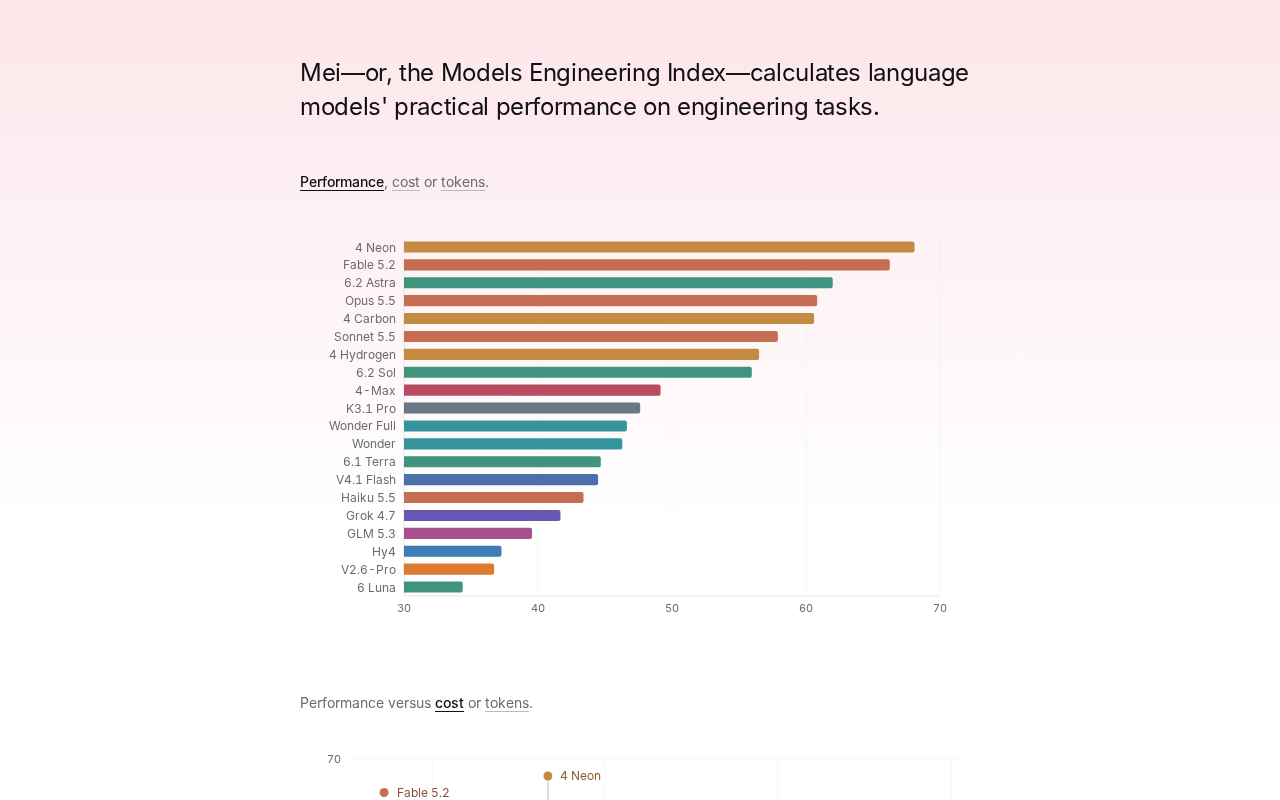
Gemini 4 Neon Tops the Models Engineering Index
Gemini 4 Neon tops the Models Engineering Index, sparking Hacker News debate over ranking credibility and evaluation methods. Here's what it means for developers.

Apple's Self-Developed AI Agent: An Agent That Can Operate Your Mac Is Coming
Apple is reportedly developing an AI agent that can operate a Mac, targeting Meta Muse, Claude, OpenAI Dots, and others. This article analyzes Apple's system-level advantages, the competitive landscape, and likely rollout paths in the agent race.