Anthropic's 288 Million Token Giveaway: A New Marketing Paradigm in the AI Developer Ecosystem Subsidy War

Anthropic distributed $48K in inference credits per attendee, revealing AI's new developer acquisition playbook.
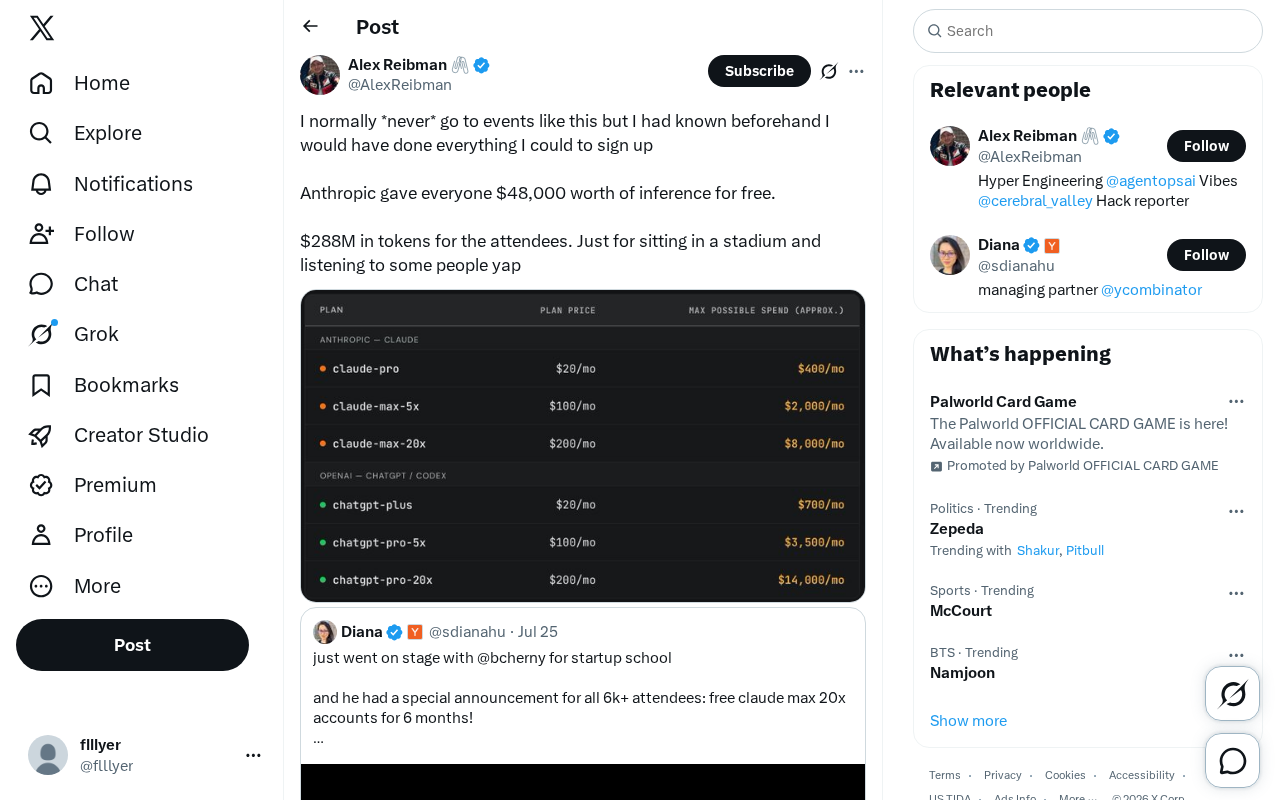
At a recent in-person event, Anthropic gave every participant $48,000 in inference credits — totaling $288 million in tokens at list price. While the headline number is eye-catching, the actual cost to Anthropic is far lower due to AI inference's low marginal costs. This strategy reflects a broader industry trend where AI companies invest heavily in developer ecosystem subsidies to build platform lock-in, generate organic social buzz, and secure long-term competitive advantages.
An Unusual Developer Event
In the fierce competition of the AI industry, major players are constantly devising new ways to capture developer mindshare. Recently, a Twitter post sparked widespread attention: Anthropic gave every participant at an in-person event inference credits worth a staggering $48,000.
Inference credits refer to the billing units consumed when users call AI model APIs for inference computation. In the large language model space, inference refers to the process where a model receives input and generates output — as opposed to the training phase. Inference costs are typically billed by token count — tokens being the basic unit of text processing for models, with one English word corresponding to roughly 1–1.5 tokens. Taking Claude 3.5 Sonnet as an example, its input price is $3 per million tokens and output price is $15 per million tokens. $48,000 in credits means developers can make model calls at the scale of billions of tokens — enough to sustain a medium-sized application for months of operation.
The person who shared this — someone who almost never attends such events — candidly admitted that had they known about this perk in advance, they would have done everything possible to sign up. In their words, participants simply had to "sit in a gymnasium and listen to people talk" to receive such generous rewards.
The Marketing Logic Behind 288 Million Tokens
According to the post, if calculated at $48,000 in credits per participant, the total inference credits provided to all attendees reached a value of $288M in tokens. While this number seems staggering at first glance, a deeper analysis reveals quite clear business logic behind it.
The Real Cost of Free Inference Credits
It's important to understand that the "$288 million in tokens" refers to inference credits calculated at list price, not Anthropic's actual cash expenditure. For model providers, the marginal cost of inference is far lower than the externally listed price.
The cost structure of AI inference services is similar to software and cloud computing — high fixed costs, low marginal costs. Anthropic's main fixed costs include GPU cluster procurement or leasing (such as NVIDIA H100/H200), data center power and cooling, and engineering team compensation. Once this infrastructure is in place, the marginal cost of each additional inference request includes only additional power consumption and minimal hardware depreciation. Industry estimates suggest the actual marginal cost of large model inference is roughly 10%–30% of the external list price. This means the $288 million in listed credits may have actually cost Anthropic only $30–80 million, or even less — if these credits won't be fully consumed.
More importantly, this strategy is essentially an investment in customer acquisition and retention. By distributing large free credits, Anthropic can:
- Allow developers to deeply experience the capabilities of the Claude model family
- Lower the barriers and concerns for developers trying new models
- Cultivate usage habits, creating technical dependency and platform lock-in
- Generate buzz and word-of-mouth effects
The Deeper Mechanics of Technical Lock-in
Vendor lock-in takes on unique forms in the AI domain. Once developers build applications on a particular model, the cost of migrating to a competitor increases significantly. This lock-in manifests at several levels: first, accumulated prompt engineering — different models respond differently to prompts, and prompts optimized for Claude may perform poorly on GPT; second, differences in API interfaces and SDKs — while the industry is pushing for standardization, each provider's advanced features (such as Anthropic's Computer Use and Tool Use) remain proprietary; third, evaluation benchmarks and quality assurance processes are all built around specific models. This multi-layered lock-in effect gives early free credit investments an extremely high long-term return rate.
The AI Developer "Subsidy War"
Anthropic's move is not an isolated case. In today's competition for AI infrastructure, providing developers with large free credits has become a common strategy. From OpenAI to Google to various cloud service providers, subsidizing inference costs to capture developer ecosystems is virtually an industry consensus.
This strategy has deep historical roots in the tech industry. In the early days of cloud computing, AWS, Azure, and GCP all offered substantial free credits to attract startups — AWS's Activate program provides startups with up to $100,000 in credits, and Google Cloud has similar programs. Even earlier, during the mobile internet era, Apple and Google's strategies for courting mobile developers also included heavy subsidies and tool investments. History shows that during the early window of platform competition, the scale of the developer ecosystem often determines the platform's ultimate success or failure.
Why the Developer Ecosystem Matters So Much
In the large model era, whoever controls the developers controls the gateway to the application ecosystem. The models and platforms developers choose early on often become long-term technical lock-ins as products grow. Therefore, trading short-term cost investment for long-term ecosystem positioning is a sound calculation.
This also explains why Anthropic is willing to invest credits at this scale in a single event. To understand the rationality of this decision, one needs to appreciate the scale of capital investment in the current AI industry: Anthropic had raised over $7 billion cumulatively by the end of 2024, including $4 billion from Amazon and $2 billion from Google. OpenAI reached a $157 billion valuation in its 2024 funding round, raising $6.6 billion in a single round. The computational cost of training a single frontier model alone can exceed $100 million, and Meta reported 2024 capital expenditures (primarily for AI infrastructure) of $37–40 billion. At this level of capital density, even tens of millions of dollars in actual marketing costs are merely a rounding error in overall investment — yet the brand exposure and developer goodwill they generate are very real.
Social Virality: The Best Marketing Is Organic User Sharing
What's particularly interesting is that this tweet itself is the best proof of this marketing campaign's viral effect. A user who "almost never attends events" proactively shared their experience because of the free credits, marveling at the generosity — this is exactly the kind of organic spread Anthropic hoped for.
In the social media age, the value of a well-designed in-person event lies not only in the participants reached on-site, but even more in the broader audience reached through word-of-mouth after the event ends. The figure of 288 million tokens sparks discussion precisely because it's shocking enough and newsworthy enough.
Implications for the AI Industry Competitive Landscape
This event reflects several key trends in current AI industry competition:
First, the developer ecosystem is the core battleground. Differences in model capabilities are narrowing, while ecosystem stickiness is becoming a critical competitive moat. Competition among AI models today is in a window period similar to early cloud computing and mobile internet — Android won market share through an open strategy, iOS maintained ecosystem vitality through superior developer tools and monetization capabilities, and ultimately platform outcomes often depend on who can build the most vibrant developer community early on.
Second, marketing tactics are becoming bolder. Using inference credits as "gifts" is a marketing innovation unique to the AI era — it both demonstrates a company's strength and precisely reaches target users.
Third, the unique cost structure matters. AI companies can create highly impactful marketing effects at relatively low actual cost — something difficult to replicate in traditional industries. This stems from the naturally high gross margins of AI inference services — external list prices include substantial profit margins and fixed cost allocations, but when credits are given away, those fixed costs are already sunk, requiring only marginal costs to be borne.
For developers, events like this are undoubtedly a boon — the ability to explore frontier model capabilities at zero cost. For industry observers, it's also a vivid case study in understanding the evolution of AI business models.
Conclusion
Anthropic's "288 million token" event appears on the surface to be a generous giveaway, but in substance, it's a carefully calculated ecosystem investment. It reflects both the high priority AI companies place on developer resources and the industry's unique cost and marketing dynamics.
In the foreseeable future, as model competition intensifies, similar "subsidy wars" will likely escalate further. And the ultimate beneficiaries will be the vast community of developers at the center of this competition.
Related articles

Beyond Vibe Coding: A Practical Guide to Enterprise-Level AI Programming
Go beyond Vibe Coding with enterprise AI programming: Claude Code, Codex tool selection, SuperPower plugin, and SDD workflows for production-ready projects.

Why Do ResNet Skip Connections Work? Reproducing the Deep Network Degradation Problem
Reproducing the deep network degradation problem on CIFAR-10: a 56-layer plain network achieves only 84% training accuracy vs. 95% for 20 layers. How ResNet skip connections solve this.

Entropic Scree: Reconstructing PCA Dimensionality Reduction by Replacing Variance with Information Entropy
Entropic Scree is a new information-theory-based dimensionality reduction method that replaces linear variance with entropy to estimate intrinsic data dimensions, with applications in neural network bottleneck design.