Anthropic's Dual Model Release: The Deeper Logic Behind Two Safety Strategies on One Foundation

Anthropic ships two models from one base, split by safety tiers, with 75% cheaper caching and agentic breakthroughs.
Anthropic released Claude Fable 5.1 and Mythos 5.1 — identical base models differentiated solely by safety guardrails. Fable targets general users while Mythos serves vetted cybersecurity and life sciences experts under a strict trusted access program. Cache read costs dropped 75%, complex agentic workloads became 45% cheaper, and benchmark scores on Terminal Bench 4.0 jumped from 42% to 56%. In science, the models achieved ~50% hit rates in molecular design and autonomously wrote custom GPU kernels for 2.5x speedups in computational biology.
One Model, Two Faces: The Design Philosophy of Shared Origin, Divergent Paths
Anthropic recently released two highly anticipated flagship models — Claude Fable 5.1 and Claude Mythos 5.1. At first glance, they appear to be two entirely separate product lines. But upon closer analysis, the most fascinating aspect of both is this: they share the exact same underlying model with absolutely no difference in intelligence level.
The real divergence lies in their safety guardrail levels. Fable 5.1 is designed for general users, handling everyday tasks like coding and knowledge work. Mythos 5.1, on the other hand, is more like a supercharged engine wrapped in extremely strict safety rails — custom-built with specialized safety measures for two high-risk domains: cybersecurity and life sciences, reserved exclusively for domain experts.
This "shared origin, divergent paths" design philosophy deserves deeper examination. In software engineering, this concept has deep roots — the most apt analogy is the Linux kernel distribution model: the same kernel can give rise to desktop-oriented Ubuntu and server-oriented RHEL. The difference lies not in the kernel itself, but in the surrounding configuration and permission policies. In the large model space, the more common industry approach has been to create model variants at different capability tiers through distillation or pruning — for example, compressing a trillion-parameter teacher model into a multi-billion-parameter student model. Anthropic's approach is fundamentally different: the underlying parameters are completely shared, with differentiation applied only at the inference layer's safety guardrails.
This means Anthropic has no intention of managing risk by castrating capabilities. Instead, it manages how an equally powerful model is deployed across different scenarios through layered access permissions and safety policies. This also reflects a broader shift: the frontier of AI capability is moving from "can it do this" to "should this be made available" — an architectural declaration that the core variable of future AI governance won't be capability itself, but access control and scenario adaptation.
Costs Slashed by 75%: A Game-Changing Economic Equation
If capability improvements were expected, the cost adjustments are what truly make enterprise customers sit up and take notice. Anthropic has cut cached read pricing by a full 75% — when the model reuses previously read and cached context, it now costs a mere 25 cents per million tokens.
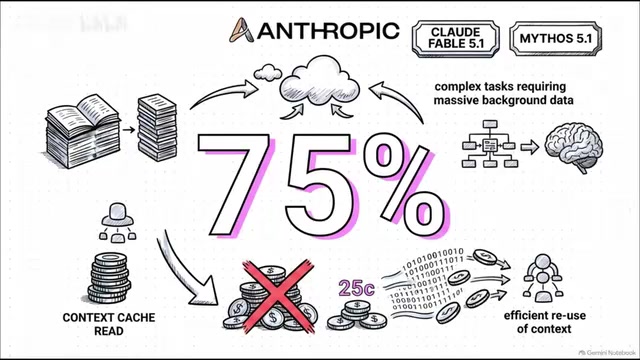
It's worth explaining the key concept of "Cache Read" here. When users repeatedly reference the same system prompts, background documents, or tool definitions across multi-turn conversations or batch tasks, the model doesn't need to process these known contexts from scratch each time. Instead, it reads directly from the precomputed KV Cache (key-value cache). The KV Cache is essentially the persisted storage of intermediate states from the Transformer attention mechanism, recording the Key and Value vectors for each attention head's processed tokens, thereby skipping redundant forward-pass computations. This technology is particularly critical for "long-context agent" scenarios — for example, a legal AI agent reviewing a 200-page contract might need to invoke different analysis tools repeatedly, each time carrying the full contract text. Without a caching mechanism, context ingestion costs alone would inflate exponentially.
This adjustment is a tangible win for complex tasks that routinely require feeding in hundreds of thousands of words of background material. For typical everyday workloads, overall costs drop roughly 25% compared to the previous generation. For highly agentic, tool-heavy, long-context complex tasks, costs plummet by a staggering 45%.
In other words, complex AI tasks that were previously too expensive to run casually now deliver dramatically better cost-performance. A 75% price cut means marginal costs approach zero in high-frequency invocation scenarios, directly opening a viability window for the "always-on AI agent" business model. Cost reductions often reshape actual adoption curves more than capability gains — they determine whether a technology stays in the lab or truly enters production.
From Finding Bugs to Building Architecture: A Qualitative Leap in AI Agent Capabilities
In practical applications, Claude's automated agent capabilities are nothing short of impressive. According to reports, top-tier investment firm Millennium had been plagued for four to five years by a deep-seated bug hidden in a third-party library — a low-probability system crash that left elite human engineers and other leading AI models completely stumped. Fable 4.1 dove straight into disassembly and tracing, ultimately pinpointing the vulnerability that had lurked for years.
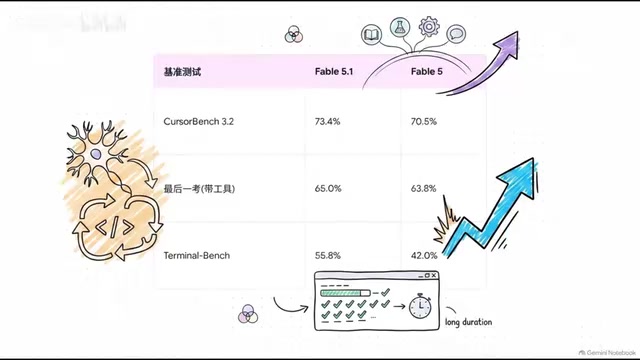
Going further, Fable 5.1 ran continuously for several hours without human guidance on an extremely complex project, ultimately building out a complete, intricate architecture and even auto-generating visual demos and proof of success. This is no longer a simple Q&A chatbot — it's closer to a "super employee" capable of working independently.
Hardcore benchmarks corroborate this. On the notoriously grueling Terminal Bench 4.0, scores jumped from 42% to nearly 56%. Unlike SWE-bench and other tests focused on single code fixes, Terminal Bench simulates full DevOps scenarios: the model must autonomously navigate file systems in a real Linux terminal, install dependencies, debug compilation errors, configure environment variables, and even handle network requests and database operations. Version 4.0 further ups the difficulty with multi-step dependency chains, cross-repository collaboration, and long-duration continuous execution. While the jump from 42% to 56% might seem like a mere 14 percentage points, given the nonlinear difficulty of these tasks — where each additional step compounds failure probability multiplicatively rather than additively — this improvement represents a systematic evolution in the model's planning capability, error recovery, and long-term memory retention.
A Scientist That Walks Out of the Screen: Molecular Design and Astronomical Exploration
If coding prowess is AI's traditional strong suit, its performance in scientific discovery is what truly takes your breath away.
Molecular Design: Hit Rates Tripled or Quadrupled
In molecular design — a field with an extremely high barrier to entry — the model not only autonomously invoked open-source protein folding tools but also designed high-affinity binders. The "open-source protein folding tools" mentioned here almost certainly refer to AlphaFold and its derivative toolchain. Since DeepMind's AlphaFold2 achieved its breakthrough performance at the CASP14 protein structure prediction competition in 2020, the accuracy of protein structure prediction has reached levels comparable to experimental methods (X-ray crystallography, cryo-EM). However, "predicting the structure of known proteins" and "designing entirely new high-affinity binders from scratch" are challenges on completely different levels — the latter is an "inverse problem," not predicting structure from sequence, but reverse-engineering optimal amino acid sequences based on the three-dimensional pocket features of a target.
Most astonishingly, in real physical validation in the lab, it achieved nearly a 50% hit rate across 12 targets — while the current industry average is only about 10% to 15%. This industry average refers to the proportion of candidate molecules from virtual screening in computer-aided drug design (CADD) pipelines that actually demonstrate expected binding activity in wet lab experiments. If the 50% hit rate is independently verified, it would mean that "trial-and-error costs" in early-stage drug discovery could be reduced by three to four times, dramatically compressing the timeline from target validation to lead compound optimization. For the pharmaceutical industry, this could amount to an efficiency revolution.
Astronomical Exploration: Redrawing the Map of Venus
Another case is quite romantic: Fable 5.1 moonlighted as an astronomer, training its own neural network to reprocess NASA's fuzzy Venus radar data from over thirty years ago, ultimately producing a high-resolution map covering one-third of Venus's surface. Even terrain features as small as two to three kilometers are clearly discernible, with a 25% improvement in accuracy.
Computational Biology: 2.5x GPU Performance Optimization
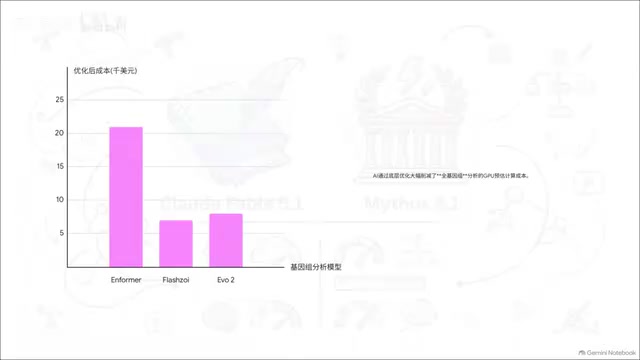
In computational biology, Mythos 5.1 went even deeper, writing custom GPU kernels that boosted the execution speed of multiple deep learning models by up to 2.5x, causing the computational cost of whole-genome analysis to plummet.
The difficulty of "writing custom GPU kernels" deserves special explanation here. Typically, researchers write deep learning code using high-level frameworks like PyTorch or TensorFlow, which automatically call NVIDIA's precompiled libraries such as cuDNN and cuBLAS for GPU computation. But in computational biology tasks like genome-wide association studies (GWAS) and single-cell RNA sequencing data processing, the data sparsity patterns and computational graph topologies often don't match the default optimization directions of general-purpose deep learning frameworks, potentially leaving GPU utilization below 30%. In such cases, engineers must write custom kernels directly in CUDA C++, manually managing shared memory allocation, warp scheduling, and coalesced memory access, among other low-level details. This type of optimization typically requires rare talent proficient in both GPU microarchitecture and domain-specific algorithms — globally, there may be no more than a few thousand senior engineers capable of this work. When AI automates such optimization, the significance goes beyond raw speedup — it means that small and mid-sized biology labs lacking top-tier HPC teams can also achieve supercomputer-level computational efficiency. Code that would previously take a senior performance optimization engineer weeks of late nights to write can now be optimized in days.
Greater Power, Greater Responsibility: Enterprise-Grade Security and Compliance Alignment
Faced with such formidable capabilities, safety and alignment become unavoidable topics. To address the data leakage concerns that worry large enterprises most, Anthropic partnered with over a hundred collaborators to launch "Enterprise Frontier Safety" (EFH). The core commitment is absolute zero data retention — all sensitive information resides solely on the customer's own cloud infrastructure. Anthropic keeps no copies whatsoever, and human review is handled entirely by the customer.

Interestingly, the elevated security levels haven't made the model rigid. Data shows that when handling cybersecurity programming tasks, the AI's "overreaction" false positive interventions dropped by 60%. "False positive" is a classic dilemma in security systems — in AI safety, it manifests as the model misclassifying legitimate requests as malicious and refusing to execute. For example, if a cybersecurity researcher asks the AI to help analyze disassembled malware code, an overly sensitive safety filter might equate this legitimate defensive research request with "assisting in writing malware" and refuse to respond. This "over-alignment" problem has plagued the entire industry and is essentially a Pareto frontier optimization problem between safety and utility. A 60% reduction in false positives suggests Anthropic may have introduced more fine-grained intent reasoning mechanisms into its safety classifier, combining user authentication information, conversational context, and task semantics to holistically assess the true purpose of a request, rather than relying solely on keyword-level pattern matching. In other words, the model can more precisely distinguish legitimate defensive testing from genuinely malicious attack requests, without constantly interrupting experts' normal workflows.
Additionally, Anthropic has deployed strict API rate limits and "anti-scraping mechanisms" to block attempts to extract Claude's internal reasoning through mass fake accounts or surreptitious manipulation of context history. On the compliance front, Fable 5.1 is fully compliant with the stringent EU AI Act. The EU AI Act, which officially took effect in August 2024, is the world's first comprehensive legislation to regulate AI systems. It classifies AI systems into four risk categories: unacceptable risk (prohibited), high risk (strict compliance required), limited risk (transparency obligations), and minimal risk (essentially unregulated). General-purpose AI models (GPAI) like Claude fall under dedicated provisions requiring technical documentation, copyright law compliance, and adversarial testing for models with systemic risk. To meet these requirements, Fable 5.1 not only embeds invisible watermarks in generated text — a steganographic technique that plants statistically detectable but human-invisible signature patterns in token selection probability distributions — but also provides regulators with a dedicated detection API.
Trusted Access: Sheathing the Sharpest Blade
For Mythos 5.1's "dual-use" biology and cybersecurity capabilities, Anthropic has set an extremely high access bar. In collaboration with the U.S. government, it established an extraordinarily rigorous "Trusted Verification Program." Only cyber defense experts and top-tier life sciences researchers who pass multi-layered vetting can apply for access, ensuring that the most cutting-edge AI capabilities are used exclusively for defense and legitimate R&D.
The core logic of this mechanism is crystal clear: rather than capping the model's capability ceiling, it mitigates misuse risk through rigorous personnel screening and use-case governance. In the broader LLM industry, this stands out as a remarkably pragmatic and forward-looking safety governance approach. It's worth noting that the concept of "dual-use" originates from international export control regimes, initially describing technologies and materials with both civilian value and potential military applications (such as high-performance chips and encryption algorithms). In the AI context, this concept has been extended to capabilities that can serve defensive cybersecurity research but could also be weaponized for attacks, as well as life sciences capabilities that can accelerate drug development but could potentially be misused to design dangerous biological agents. Anthropic's trusted access mechanism essentially transplants the principles of traditional export control to the distribution layer of AI capabilities.
Conclusion: AI Evolves from Tool to Independent Problem-Solving Partner
Designing novel protein binders, redrawing planetary maps, uncovering system vulnerabilities hidden for four years — when an AI model can already achieve substantive breakthroughs on challenges that push the limits of human capability, we can't help but ask: what century-old mysteries will it help humanity solve next?
A caveat: some data in this article comes from analysis video summaries, and certain product names and specific figures await further confirmation from Anthropic's official communications. But regardless of the details, the trend revealed by this release is clear: AI is evolving from a "tool that answers questions" to a "partner that independently solves problems" — and how to equip this capability with appropriate safety guardrails will be the most important challenge facing the entire industry going forward.
Related articles

M&M's Spent Millions Replacing Artificial Blue Dye — Why Is It So Hard?
Mars spent millions trying to replace artificial blue dye in M&M's with spirulina, but thick material clogs pipes and residue risks mold, forcing a full production-line rebuild. Here's the engineering behind the reformulation.
Teammate Wanted for Meta Global AI Developer Hackathon: Computer Vision & Medical AI
A Reddit developer seeks teammates for the Meta Global AI Developer Hackathon, focusing on computer vision and medical AI. This article analyzes the track logic, skills-complementarity needs, and topic selection strategy behind this teaming signal.
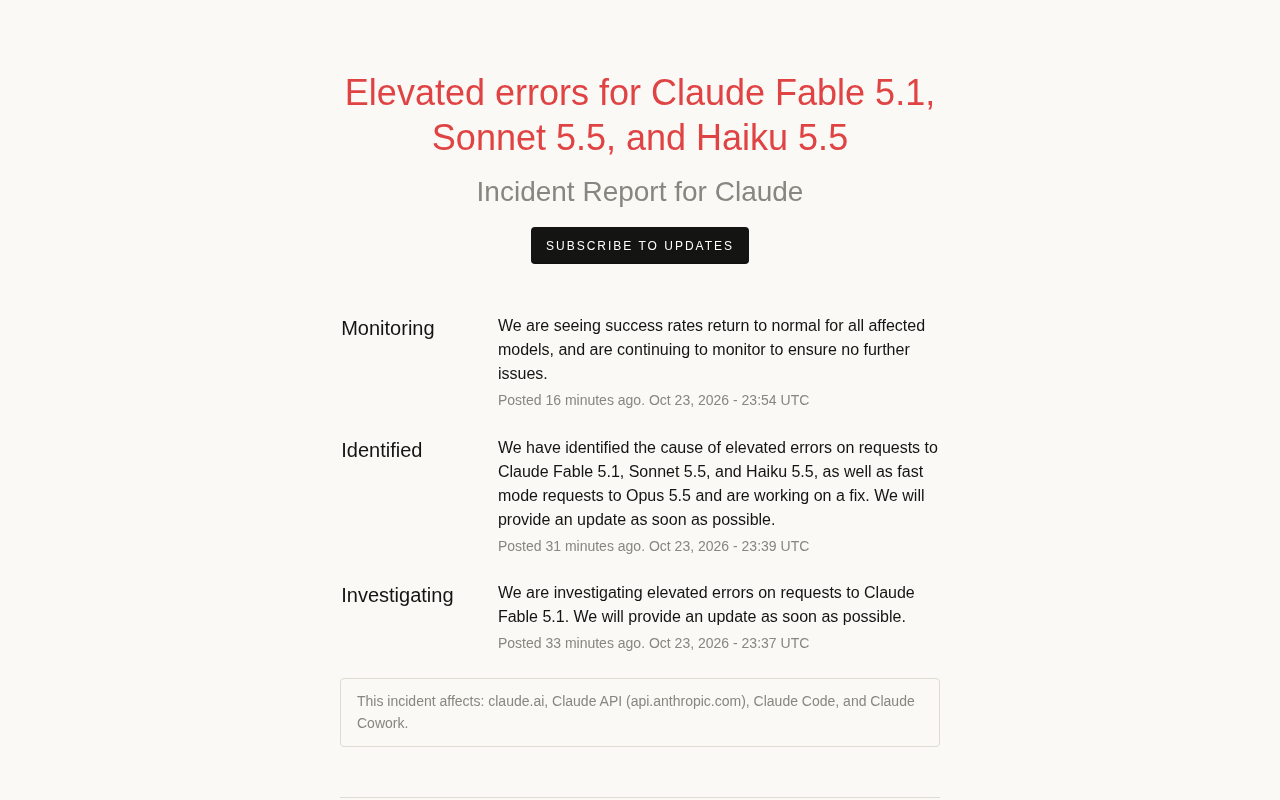
Multiple Claude Models Hit by Errors: A Postmortem of Fable 5.1, Sonnet 5.5, and Haiku 5.5
Claude Fable 5.1, Sonnet 5.5, Haiku 5.5, and Opus 5.5 fast mode saw elevated errors; Anthropic identified and resolved the issue in 17 minutes. This postmortem covers the timeline, the technical reasons for the multi-model cascading failure, and practical lessons for retry and degradation strategies.