Anthropic's IPO Philanthropy Blueprint: Governance Innovation Behind $156 Billion
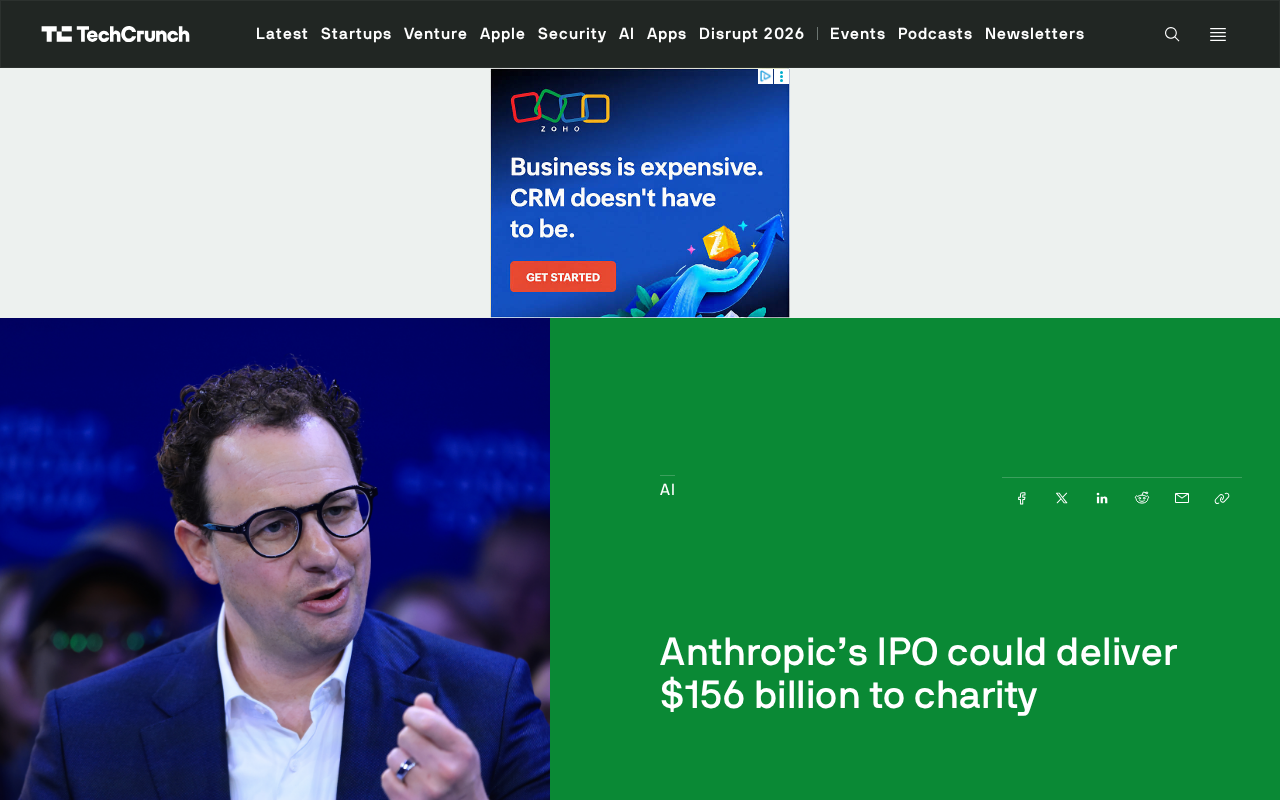
Anthropic's IPO could generate $156 billion for charity at $95 per share, spotlighting a governance experiment.
Anthropic's IPO plan has drawn attention for a $156 billion philanthropic commitment. At an assumed $95 share price, the Public Benefit Foundation, employee donations, and company matching combine to form this figure. The core is embedding philanthropy into equity design and employee incentives rather than post-IPO arrangements. The foundation differs from traditional CSR by structurally converting value growth into philanthropic resources. Matching gifts create leverage and reinforce culture. The plan may pressure the AI industry to review governance. But details on fund use, transparency, and legal binding remain undisclosed.
Anthropic's IPO plan is drawing attention from both the tech and philanthropic worlds. According to public information, if its stock price reaches $95, the combined total of the frontier lab's Public Benefit Foundation, employee donations, and company matching gifts could reach $156 billion. This figure not only sets a record for philanthropic commitments by tech companies, but also reveals a governance experiment that deeply binds commercial success to social mission.

1. Where Does the $156 Billion Come From?
This massive philanthropic funding does not come from a single source. Anthropic has established a Public Benefit Foundation as the vehicle for its long-term philanthropic commitment. At the same time, individual employee donations are included in the overall framework, with the company providing matching gifts to create a leverage effect. Combined, under the assumed stock price of $95 per share, the total reaches $156 billion.
The key to this structure is "pre-setting"—it is not an afterthought following the IPO, but rather an embedding of philanthropic mechanisms into the company's equity design and employee incentive system. For a company whose core philosophy is AI safety, this arrangement attempts to answer a sharp question: when AI companies reap massive capital returns, how can society ensure that a portion is directed toward public welfare?
According to the original reporting from the RSS source, the calculation of this figure is based on a specific stock price assumption, and the actual amount will fluctuate with the market. But even if only a portion is realized, its scale would be enough to make Anthropic a major player in tech philanthropy.
Public Benefit Foundation is a legal entity that sits between a traditional charitable foundation and a corporate social responsibility department, typically established under the nonprofit or public benefit corporation laws of a specific jurisdiction. Unlike ordinary corporate foundations, a public benefit foundation is often written into the company's articles of incorporation, and its mission is legally binding rather than relying solely on management's discretion. In the context of tech companies, such foundations are often used to hold a portion of equity or receive post-IPO funding injections, thereby structurally binding company value growth to philanthropic spending. Their governance usually includes an independent board, but the founding company may still retain seats or veto rights, so transparency and independence depend on the specific charter design. Anthropic's plan uses this vehicle precisely to turn philanthropic commitments from an "option" into a "default."
2. The Public Benefit Foundation: The Adhesive Between Mission and Business
The existence of the Public Benefit Foundation distinguishes Anthropic's philanthropic commitment from traditional corporate social responsibility (CSR) programs. Traditional CSR often depends on profits, with donation amounts fluctuating with business conditions; the Public Benefit Foundation is more like a structural arrangement that automatically converts a portion of company value growth into philanthropic resources.
Behind this design is the "responsible scaling" philosophy that Anthropic has long advocated. The company has repeatedly emphasized that the risks of frontier AI need to be governed in sync with capabilities. Directing massive wealth toward public benefit can be seen as an extension of this philosophy at the capital level—allowing a portion of the economic gains from AI development to flow back to society for safety research, ethical discussion, or broader public projects.
However, publicly available information is still limited regarding which areas the funds will be directed to, who will decide, and how transparency will be ensured. This is one reason why observers remain cautiously optimistic about the plan.
Corporate social responsibility (CSR) refers to a company's voluntary responsibility to stakeholders such as employees, communities, and the environment beyond profit maximization. Traditional CSR programs are mostly funded from annual corporate budgets, with amounts fluctuating with business conditions and lacking external mandatory constraints, and are therefore often criticized as "PR spending." In contrast, the environmental, social, and governance (ESG) framework attempts to incorporate non-financial performance into investment evaluation and requires companies to disclose relevant metrics. Anthropic's Public Benefit Foundation arrangement is closer to institutionalizing the "social" dimension of ESG, but it achieves this through equity structure rather than disclosure obligations, making it more rigid than typical CSR and harder to easily revoke after going public. Understanding this distinction helps determine whether the plan is governance innovation or brand narrative.
3. The Leverage Logic of Employee Matching
The combination of employee donations and company matching gifts is an easily overlooked part of the $156 billion figure. Company matching means that for every dollar an employee donates, the company adds an equal amount, which both amplifies the total philanthropic funding and signals values to employees.
In the context of fierce talent competition in the tech industry, this mechanism has a dual effect: on one hand, it strengthens internal cultural identity; on the other, it binds employees' personal wealth to the company's mission. When the IPO brings equity appreciation, employees are not only beneficiaries but also expected to be contributors. This "shared wealth" narrative echoes the public responsibility image that Anthropic has consistently emphasized.
However, details such as matching ratios, caps, and eligibility conditions have not been fully disclosed. If the matching mechanism is well designed, it can become a sustained philanthropic engine; if clear rules are lacking, it may become a PR gimmick.
Matching gift is a common philanthropic mechanism in the tech and finance industries: after employees donate to eligible nonprofit organizations, the company adds a donation at a certain ratio (commonly 1:1 to 3:1), usually with an annual cap. Its leverage effect depends on participation rate and matching ratio, not just the nominal ratio. In an IPO scenario, restricted stock units (RSUs) or options held by employees can only be cashed out after the lock-up period ends, and the timing of matching is closely related to equity liquidity, so the actual donation pace may lag behind the listing. In addition, matching funds usually come from company cash rather than equity, constituting a real cash flow expense. If Anthropic coordinates matching with the Public Benefit Foundation, it needs to clarify funding sources, caps, and eligible charitable areas; otherwise, the sustainability of the employee matching portion of the "$156 billion" will be greatly reduced. Restricted stock units (RSUs) are an important component of employee compensation at tech companies, and their value fluctuates with the stock price, which also explains why the overall philanthropic calculation is tied to a specific stock price assumption.
4. Demonstration Significance for the AI Industry
Anthropic is not the first tech company to commit to philanthropic donations, but directly linking the scale of philanthropy to IPO valuation is rare among frontier AI labs. Currently, leading AI companies are in a stage where capital-intensive investment and commercial return expectations coexist, and societal concerns about AI wealth concentration are rising.
According to analyses by several tech media outlets, Anthropic's move may trigger a chain reaction. If competitors face similar public expectations, they may need to re-examine their own philanthropic and governance structures. For investors, the Public Benefit Foundation also constitutes a non-financial risk assessment dimension—it shows that the company is willing to transfer part of its value to society, thereby reducing regulatory and public opinion pressure.
Of course, $156 billion is a theoretical value based on a stock price assumption, and actual implementation still depends on the IPO process, market conditions, and corporate governance execution. But the figure itself already sends a clear signal: the success of AI companies is increasingly being measured alongside social responsibility.
Frontier lab generally refers to AI research institutions that train and deploy at the forefront of model capabilities, such as Anthropic, OpenAI, and Google DeepMind. The notable characteristics of such institutions are extremely high training costs, commercial paths still being explored, and strong regulatory and public scrutiny. Their capital structure often relies on large private financings or strategic investments, and an IPO is seen as a key milestone for achieving liquidity and public accountability. Linking philanthropic commitments to IPO valuation is still rare among frontier labs, because most companies focus more on compliance disclosure than public benefit architecture before going public. Anthropic's approach therefore has signaling value: it attempts to answer the public question of "how AI wealth should be distributed" in advance at the entrance to capital markets, and sets a comparable governance benchmark for peers.
5. Unresolved Questions
Several key questions around this plan remain unanswered. The specific use of funds, governance architecture, decision-making transparency, and the legal binding force of long-term commitments will all affect its actual impact. In addition, the gap between the stock price assumption and actual market capitalization may also make the final philanthropic amount far different from $156 billion.
For readers concerned with AI governance, Anthropic's experiment is worth continued tracking. It is not only a business event but also a public test of "how AI wealth should give back to society." The outcome will depend on execution details, not the astronomical figure in the headline.
One-line Summary
If Anthropic's IPO reaches $95 per share, total philanthropy could reach $156 billion, drawing attention to a governance experiment.
Paragraph Summary
Anthropic's IPO plan has drawn attention for a philanthropic commitment of up to $156 billion. Under an assumed stock price of $95 per share, the Public Benefit Foundation, employee donations, and company matching gifts combine to form this figure. The core is embedding philanthropic mechanisms into equity design and employee incentives rather than making ad hoc arrangements after listing. The Public Benefit Foundation differs from traditional corporate social responsibility by attempting to structurally convert company value growth into philanthropic resources. Employee matching creates leverage, amplifying funding scale and strengthening cultural identity. The plan may exert demonstration pressure on the AI industry, prompting competitors to review their philanthropic and governance structures. However, details such as fund use, governance transparency, and legal binding force have not been disclosed, and actual implementation remains to be seen.
Related articles

DevWorkflow 5.0: From Idea to Launch with the AI Five-Step Method
DevWorkflow 5.0 is a Claude Code plugin that uses a five-step process to take AI-assisted development from idea to launch. It asks you before every decision, preventing AI from adding tables and fields on its own, keeping docs and code consistent, and stopping merges before tests are written. Supports multiple platforms and languages, for individual developers and small teams.

How Do Hermes Agent's .md Files Work? A Breakdown of the Core Mechanism
Explaining Hermes Agent's .hermes directory mechanism: user.md stores personal info, memory.md records details worth remembering, soul.md defines the Agent's personality. Learn how these pure Markdown files keep the Agent consistent across sessions.

UN "Killer Robot" Talks Stall Again: Why Autonomous Weapons Regulation Is Hard to Break Through
UN Geneva talks on autonomous weapons ("killer robots") ended a week of consultations with little progress; delegates only agreed to "begin discussing options." This article analyzes the definitional disputes, conflicting security demands, and limits of multilateral mechanisms behind the stalemate.