Anthropic's Lobbying of Religious Groups Sparks Controversy: AI Ethics Arrogance or Genuine Dialogue?

Insider accuses Anthropic of pressuring religious groups to adopt its AI philosophy rather than genuinely seeking their guidance.
An industry insider publicly accused AI company Anthropic of engaging major religious groups through one-way pressure rather than genuine dialogue — pushing them to accept Anthropic's philosophical interpretation of AI and even threatening to withdraw from events that didn't align with its positions. The whistleblower contrasted this with his own humble approach during time spent at the Vatican, framing Anthropic's conduct as symptomatic of the "moral arrogance and dogmatism" embedded in Effective Altruism culture. While AI companies have legitimate reasons to engage religious institutions — which hold deep ethical wisdom on questions generative AI is reawakening — the direction of that engagement matters enormously. The allegations remain unverified and single-sourced, but the underlying issue of tech companies' value-driven arrogance is a genuinely important one.
A social media post is making waves in the tech industry: an insider has publicly accused AI company Anthropic of running a lobbying campaign targeting major religious groups — attempting to get these faith communities to accept Anthropic's own philosophical interpretation of AI, rather than genuinely seeking their input. If accurate, this claim would bring a long-overlooked issue in AI ethics discussions to the forefront: when companies wielding cutting-edge technology attempt to define values, where exactly does the boundary of power lie?
The Core Controversy: Lobbying vs. Listening
The accuser's charges are straightforward. He claims Anthropic has been "lobbying major religious groups to accept the company's philosophical interpretation of AI, rather than seeking input from those groups." In other words, the criticism isn't about the fact that tech companies are engaging with religious communities — it's about the direction of that engagement. Is it a one-way broadcast or a genuine two-way exchange?
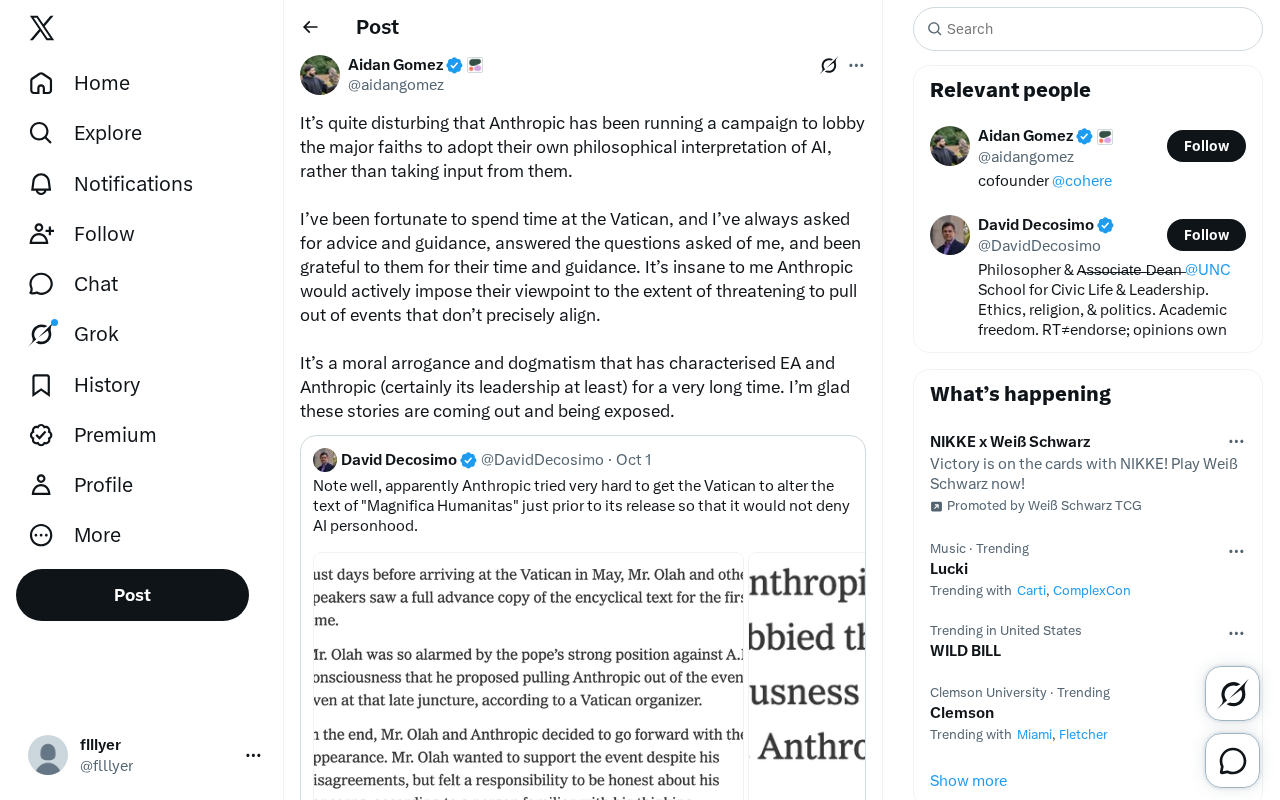
The whistleblower draws a contrast with his own experience at the Vatican. He mentions having "had the privilege of spending time at the Vatican," and emphasizes that he always approached those conversations by "seeking advice and guidance, answering questions posed to him, and remaining grateful for the time and direction offered." This posture stands in sharp contrast to how he describes Anthropic's approach. According to him, Anthropic not only pushed its own views but even "threatened to withdraw from events that didn't fully align with its positions."
If this description is accurate, the question shifts from "should tech companies engage in ethical dialogue" to "in what spirit should they engage." The use of threatening leverage transforms what should be a dialogue into something that looks more like coercion.
A Deeper Critique: EA Culture and Corporate Arrogance
The accusations don't stop at a single incident — they point toward a deeper cultural problem. The whistleblower argues that this kind of "moral arrogance and dogmatism" has long characterized the Effective Altruism (EA) movement and Anthropic — at least its leadership.
This criticism is worth unpacking. Effective Altruism, a movement that emphasizes using reason and data to maximize positive impact, has had an outsized influence in Silicon Valley and AI safety circles. But critics have long pointed out that EA tends to impose a top-down, highly quantified framework for defining what counts as "doing good" — a mindset that can come across as condescending when confronted with complex value systems rooted in religion or culture.
Applying this cultural critique to Anthropic, the whistleblower raises a pointed question: has a company that brands itself on "AI safety" and "responsible AI" fallen into the very arrogance it claims to guard against?
Effective Altruism (EA) evolved from the utilitarian philosophy of thinkers like Peter Singer and gained momentum in the 2010s. It advocates using rigorous rational analysis and quantitative assessment to determine which actions maximize global welfare. EA's influence in Silicon Valley is particularly pronounced — a significant number of founders and core members of leading AI safety organizations like OpenAI and Anthropic are deeply aligned with EA principles. Anthropic co-founders Dario Amodei and Daniela Amodei both have ties to the EA movement.
Critics of EA have long pointed to an internal contradiction: the framework claims to pursue "the greatest good," yet it presupposes a particular Western secular-rationalist lens for defining what "good" even means — one that has little room for values that resist quantification, such as religious belief, cultural tradition, or community belonging. Critics have called this "moral colonialism": treating one's own value system as self-evidently superior, under the banner of scientific rationality. This is precisely the underlying logic the whistleblower invokes when linking Anthropic's approach to religious groups with EA culture.
Why AI Companies Are Engaging with Religious Groups
Setting aside the specific allegations, the fact that AI companies are actively reaching out to religious organizations isn't surprising. As generative AI embeds itself deeper into the fabric of society, it has reawakened profound questions about consciousness, the soul, human uniqueness, and the meaning of life — questions that religious traditions have grappled with for millennia.
Religious institutions represent vast communities of believers and rich reservoirs of ethical thinking. The Vatican, for instance, has spoken out on AI ethics multiple times in recent years and has championed related ethical initiatives. For AI companies, earning the understanding — or even endorsement — of religious communities carries real weight in terms of social acceptance and the perceived legitimacy of their technological narratives.
This is precisely why how that engagement happens matters so much. Arriving with answers to convince, versus arriving with questions to learn, reflects fundamentally different assumptions about power. The former treats religious communities as subjects to be "educated"; the latter acknowledges the plurality of human wisdom.
The Vatican's involvement in AI ethics in recent years goes well beyond symbolic statements — it reflects substantive action. In 2020, the Vatican signed the Rome Call for AI Ethics alongside Microsoft and IBM, proposing an "algorethics" framework that calls for AI systems to be transparent, inclusive, and accountable. In 2023, Pope Francis delivered a speech on AI governance at the G7 Summit, becoming the first pope ever to attend the summit, and emphasizing that human dignity must not be reduced to a technological instrument. These moves have positioned the Vatican as a rare non-state actor in global AI ethics discussions — one that combines genuine moral authority with international political influence. For AI companies, building a relationship with the Vatican carries symbolic value far beyond the size of the Catholic faithful. It signals a form of moral endorsement that transcends commercial and political logic — and in an era of recurring public trust crises, that kind of endorsement holds unique narrative value.
A Note of Caution: Single-Source Claims
It's important to be clear: these allegations currently come from a single individual's social media posts, with no response from Anthropic and no independent corroboration from other sources. The whistleblower's remark that he is "glad these stories are coming out and being exposed" hints that more reporting may follow — but until further evidence emerges, readers should maintain appropriate skepticism.
That said, even as an unverified allegation, the issues it raises are real and important: when a handful of tech companies effectively hold the power to shape the cognitive tools of the future, what degree of humility should they exercise in promoting their values? Does "responsible AI" extend to how these companies position themselves when engaging with value systems different from their own?
Regardless of how this controversy ultimately unfolds, it offers an underappreciated lens for AI governance discussions — the arrogance of technology is sometimes not found in model parameters, but in how its creators treat worldviews that differ from their own.
Related articles

uGAP: An AI Platform Unifying 100+ African Geospatial Datasets
uGAP is an African geospatial AI platform by a University of Cape Town team, unifying 120+ African datasets with a Python SDK for discovery, processing, and model training, already used in cyclone flood mapping.

Cursor Can Now Control Your Computer: AI Agents Can Drive Desktop Apps for Testing
Cursor adds desktop control: AI agents can drive desktop apps like the iOS Simulator to test their own features. We analyze the impact on dev workflows, possible technical approaches, and reliability concerns.

Vibecoding a Custom Inference Engine: High Hopes, Harsh Reality
A Reddit developer shares the real experience of vibecoding a custom inference engine: running GGUF Q4 models in the browser with WebGL2 and GLSL, only to fall into tokenizer debugging hell. This article analyzes the engineering challenges of browser-side LLM inference and why cloning llama.cpp is the more rational choice.