Anthropic's Official MCP Python SDK: Standardizing AI Agent Tool Integration

Anthropic open-sources the MCP Python SDK, turning async functions into Agent-callable tools with a decorator and standardizing the AI tool protocol.
The MCP Python SDK is Anthropic's official open-source reference implementation of the Model Context Protocol, whose core value is pulling AI tool discovery and invocation back from per-vendor customizations to a unified protocol layer. Developers just run pip install mcp and add the @mcp.tool decorator to a regular async function—the function signature becomes the tool contract, with no need to hand-write JSON Schema or maintain a routing layer. The SDK supports both stdio and SSE transports, covering local scripts and remote connections; local resources, prompt templates, and tools share the same protocol outlet and can be reused by different Agent clients. The article also stresses security boundaries: explicit exposure only ensures undeclared capabilities aren't implicitly called, and production environments still need permission checks, parameter whitelists, and audit logs. The SDK is currently positioned as a reference implementation and is still evolving.
AI Agents are moving from chat windows to real system operations, but hand-writing a custom API wrapper for every tool you integrate remains one of the heaviest burdens for developers. Anthropic's officially open-sourced MCP Python SDK (mcp-python-sdk) aims to solve exactly this standardization problem: it's not just a utility library, but a reference implementation of the Model Context Protocol, exposing local resources and prompt templates to Agents through a unified protocol.
What Exactly Is MCP Standardizing
According to AI Skyline's repo breakdown, MCP's core value lies in unifying AI tool discovery and invocation methods. In traditional approaches, developers had to write a separate adapter layer for every local script and every internal service, handling authentication, parameter mapping, and asynchronous session management. MCP consolidates all of this into a single protocol, so as long as an Agent supports MCP, it can discover and invoke external capabilities in a consistent way.
This leads to a direct consequence: tools are no longer bound to any specific Agent framework. The same MCP service can be reused by different clients, and the migration cost of a tool changes from "rewriting wrappers" to "swapping a connection."

Model Context Protocol (MCP) is an open protocol proposed by Anthropic in late 2024, aiming to define a unified interface for interactions between large-model applications and external systems. Before MCP, the industry standard was for each framework to define its own plugins or function calling specification—OpenAI had its own function schema, LangChain had its own Tool abstraction, and each cloud provider had its own plugin marketplace. The result was that the same capability (say, querying a database or reading a file) often had to be wrapped repeatedly for different Agents. MCP abstracts this into a client-server model: capability providers implement an MCP Server, Agent owners implement an MCP Client, and the two sides communicate via JSON-RPC messages. The protocol explicitly defines three primitives—Tools (executable actions), Resources (readable data), and Prompts (reusable prompt templates)—and later expanded to include capabilities like Sampling. It is precisely because it is an open specification rather than a private interface of any single SDK that "implement once, reuse everywhere" becomes possible.
One Decorator Turns an Async Function into an AI Tool
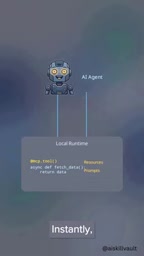
The most intuitive selling point of this SDK is that integration cost is reduced to an absolute minimum. As demonstrated in the video, the process is just two steps: run pip install mcp in the terminal to install dependencies, then add the @mcp.tool decorator to a function.
A standard async function, once decorated, immediately becomes a tool callable by an Agent, executed by the Agent on command when needed. This means developers don't need to define a separate JSON Schema-style tool description, nor maintain a separate routing layer—the function signature itself is the tool contract.
For teams that already have a large number of Python scripts, this is almost the shortest path to plugging existing assets directly into an Agent.
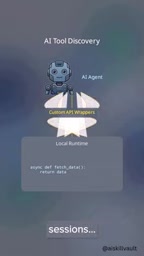
Tool schema is the key context for understanding the value of the @mcp.tool decorator. In traditional function calling workflows, developers must hand-write a JSON Schema specifying the function name, purpose description, each parameter's type, whether it's required, valid ranges, and so on, so the model can decide when to call it and how to pass arguments. This schema is both verbose and prone to drifting out of sync with the implementation code—changing a parameter but forgetting to update the schema is a common source of production incidents. The MCP Python SDK's approach is to leverage Python's type hints and function signatures to automatically reflect and generate the corresponding schema at decoration time, including parameter names, types, and natural-language descriptions extracted from the docstring. This way the function implementation itself becomes the single source of truth for the tool contract. It's worth noting that a model's accuracy in calling tools depends heavily on description quality, so whether the docstring is written clearly and whether parameter names are meaningful will still directly affect the Agent's actual performance.
Transport Layer: Two Channels, stdio and SSE
The MCP Python SDK supports both standard input/output streams (stdio) and real-time SSE connections for communication, covering both typical local and remote scenarios.
Local scripts communicate with the Agent process via stdio, requiring no open ports—ideal for automation scripts on a dev machine. When cross-network access is needed, SSE is used, allowing remote Agents to connect to the same tool service. The SDK encapsulates these session details internally, so developers deal with functions rather than connection management.
One detail worth highlighting is how it exposes local resources: resources, prompt templates, and tools go through the same protocol outlet, so an Agent can both read data and execute actions within a single session, rather than interfacing separately with a filesystem API and a function calling interface.
JSON-RPC 2.0 is the actual carrier protocol for MCP's message layer—whether over stdio or SSE, the client and server exchange method calls and responses conforming to the JSON-RPC specification. This also explains why both transports can share the same tool definitions: the transport layer is only responsible for delivering bytes to the other end, and the semantics are entirely determined by the upper-layer protocol. In stdio mode, the MCP Server is typically launched as a subprocess by the client, with both sides communicating through stdin/stdout pipes—naturally inheriting the parent process's permissions and environment variables, with no network configuration needed. SSE (Server-Sent Events) is a unidirectional streaming HTTP technology where the server can continuously push events to the client; MCP combines it with POST requests to achieve bidirectional interaction, making it suitable for deployment on a server for multiple clients to connect. Notably, over the past year the community has also been pushing a new transport spec based on Streamable HTTP to replace the pure SSE approach, in order to improve connection reliability and horizontal scalability—so when choosing, pay attention to which one the current SDK version actually supports.
Security Boundaries and Use Cases
Giving Agents execution permissions "safely" is the prerequisite emphasized repeatedly in this introduction. MCP's model is explicit exposure—only capabilities that are decorated and registered will appear in the Agent's tool list, and undeclared functions will not be implicitly called.
But this does not mean zero risk. Once a tool is exposed, the Agent's invocation decisions depend on model judgment, and in production environments you still need to add permission checks, parameter whitelists, and audit logs on the outer layer. Viewing MCP as an integration standard rather than a security solution is a more accurate positioning.
In terms of applicability, internal ops scripts, data processing pipelines, and enterprise capabilities that need to be reused by multiple Agents are all reasonable landing points for this SDK.
An Open-Source Direction Worth Watching
The significance of the MCP Python SDK is not that it saves developers a few dozen lines of code, but that it pulls "how AI calls external capabilities" back from per-vendor custom implementations to the protocol layer. For tool providers, this means implement once, reuse everywhere; for Agent developers, this means the tool ecosystem can be composed like dependency packages.
The SDK is still evolving, and the official positioning is a reference implementation—before production deployment, it's advisable to assess version stability and the maturity of the community ecosystem.
Related articles

From Photons to Production: An Open-Source Computer Vision Engineering Reading Path
Reddit user open-sources a computer vision engineering reading path with 16 chapters from image formation to production deployment, emphasizing primary sources, dependency order, and reproducible benchmarks to help engineers understand why models fail and build reliable vision systems.

Prompt Failures? The Truth About Why AI Agents Struggle in Production—and How to Fix It
A Reddit developer built Agents with Copilot and Gemini but faced unstable behavior. This article analyzes three gaps in prompt engineering for Agent scenarios and offers three practical paths to reliable Agent deployment, including structured prompts, workflow-first approaches, and building an evaluation loop.

Tesla Robotaxi to Open Private Vehicle Access Next Year: Promise or Pipe Dream?
At its Q3 earnings call, Tesla said owners can add their cars to the Robotaxi fleet next year. We analyze the technical basis, Musk's missed deadlines, business logic, and competition.