Anthropic's Official MCP Tutorial: A Complete Guide from Basics to Remote Deployment

Anthropic's MCP protocol standardizes how LLM applications integrate with external tools and data
MCP (Model Context Protocol) is an open protocol released by Anthropic in November 2024, based on the JSON-RPC 2.0 specification and client-server architecture, standardizing how LLM applications access external tools and data resources. It is model-agnostic, supports both local and remote deployment, and enables standardized interaction between AI applications and the external world through three core capabilities: Tools, Resources, and Prompt Templates—solving the pain point of developers repeatedly reinventing the wheel.
What is MCP?
Model Context Protocol (MCP) is an open protocol released by Anthropic in November 2024, designed to standardize how large language model applications access context (tools and data resources). Based on a client-server architecture, MCP defines how MCP clients in LLM applications communicate with MCP servers that expose tools, data resources, and prompt templates.
From a technical implementation perspective, MCP is essentially a communication protocol based on the JSON-RPC 2.0 specification, supporting two transport methods: stdio (standard input/output, suitable for local inter-process communication) and HTTP+SSE (Server-Sent Events, suitable for remote services). This design allows MCP servers to run either as local subprocesses or be deployed as independent remote services, balancing flexibility with scalability. Prior to this, the AI application space had long lacked a standardized tool integration specification—each framework (such as LangChain, AutoGPT, etc.) had its own tool integration approach, and MCP was created precisely to fill this gap.
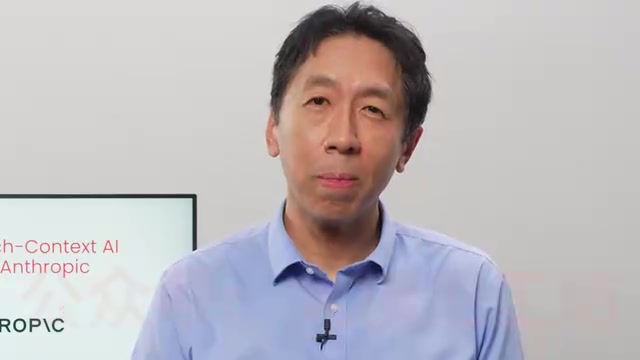
Since its release, the MCP ecosystem has grown rapidly, with numerous MCP services developed by both the open-source community and Anthropic's official team. You may not have noticed, but MCP is model-agnostic, designed to easily integrate with various AI applications—not limited to Claude.
The Origins and Design Philosophy of MCP
This course is taught by Eli Schopik, Head of Technical Education at Anthropic. According to him, MCP originated from an internal project at Anthropic—the team wanted to extend Claude Desktop's capabilities by enabling it to interact with the local file system and other external systems. They discovered that the protocol they developed was extremely useful across many AI applications with similar needs.
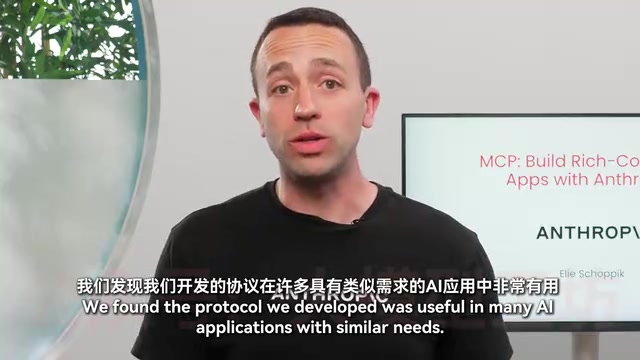
To benefit more developers, Anthropic published the MCP specification and opened its development to the open-source community. This decision reflects MCP's core design philosophy: instead of having every developer reinvent the wheel, enable tool and data reuse through a standardized protocol.
This open strategy is quite similar to other historically successful technology standardization cases—just as USB unified hardware connections and HTTP unified web communication, MCP aims to become the "universal interface" for AI applications to interact with the external world. Anthropic's choice to open-source it rather than keeping it proprietary also reflects a strategic judgment that prioritizes ecosystem building over short-term commercial interests.
Practical MCP Use Case: Research Assistant Agent
The course presents a highly representative scenario: imagine you're building a research assistant Agent that can:
- Interact with GitHub repositories to retrieve code and issue information
- Read notes and reference materials from Google Drive documents
- Create summaries and store them to the local file system

To appreciate the value of this scenario, you first need to understand how AI Agents work. AI Agents are a class of LLM applications that can autonomously plan, iteratively invoke tools, and complete multi-step complex tasks. Their core capability relies on LLM Function Calling—when generating a response, the model can decide to call an external tool, wait for the result, and then continue reasoning based on that result. This "perceive-decide-act" loop enables Agents to handle tasks far more complex than a single conversation. However, Function Calling itself only defines the interaction format between models and tools—it doesn't specify how tools are discovered, described, and managed, which is exactly the problem MCP solves.
The traditional approach involves writing custom LLM tool-calling code for each external system, which is expensive to maintain and difficult to reuse. With MCP, you simply connect your Agent to GitHub, Google Drive, and file system MCP servers—these servers provide tool definitions (API call specifications) and handle tool execution. Developers don't need to worry about underlying integration details, dramatically reducing development complexity.
Core Course Content in Detail
This official Anthropic MCP course covers the complete path from concepts to practice:
MCP Client-Server Architecture
A deep dive into MCP's communication mechanisms, helping developers understand the interaction patterns between clients (embedded in LLM applications) and servers (providing tools and resources). This is the foundation for mastering MCP development.
In the MCP architecture, the MCP Host (such as Claude Desktop or custom AI applications) houses the MCP client, which establishes connections with one or more MCP servers through the protocol. After connection establishment, the client first performs "Capability Negotiation," querying what tools, resources, and prompt templates the server provides, then injects this information into the LLM's context. When the LLM decides to call a tool, the client forwards the request to the corresponding MCP server for execution and returns the result to the model. This layered design means the LLM itself doesn't need to be aware of underlying integration details, achieving decoupling between the model and its tools.
Building an MCP-Compatible Chatbot
Starting from an existing chatbot application, the course guides you through progressively transforming it into an MCP-compatible application. This includes building and testing an MCP server, then connecting the chatbot to that server—the most essential hands-on component of the course.
Three Core Capabilities of MCP Servers
MCP servers provide three types of capabilities to client applications:
- Tools: Executable function calls, such as querying databases or calling APIs. Tools are the most central capability in MCP—each tool has a strict JSON Schema description including its name, functional description, and parameter specifications. The LLM decides when and how to call tools based on these descriptions.
- Prompt Templates: Predefined prompt structures that standardize interaction patterns. Prompt templates allow servers to provide optimized, task-specific prompt fragments to clients, helping developers reuse best practices across different applications.
- Resources: Data access interfaces providing structured contextual information. Unlike tools' "active execution," resources are more like read-only data sources—such as file contents, database records, or API responses—available for the LLM to reference during reasoning.
These three capability types cover the main patterns of AI application interaction with the external world: executing operations (Tools), retrieving data (Resources), and standardizing interactions (Prompt Templates), forming a complete capability matrix.
Connecting to Third-Party MCP Servers
Connecting the chatbot to trusted third-party MCP servers to extend its capability boundaries. This demonstrates the true power of the MCP ecosystem—achieving plug-and-play tool integration through a standard protocol.
Currently, the MCP ecosystem has seen the emergence of dozens of official and community MCP servers covering databases (PostgreSQL, SQLite), development tools (GitHub, GitLab), productivity suites (Google Drive, Notion, Slack), browser automation (Puppeteer, Playwright), and more. Developers can browse and use these ready-made integrations in the official MCP servers repository, truly achieving "out-of-the-box" functionality.
Remote Deployment of MCP Servers
The course concludes with how to deploy MCP servers to remote environments, which is crucial for production-grade AI applications. Remote deployment allows MCP servers to be shared across multiple clients, truly achieving service-oriented architecture.
Remotely deployed MCP servers typically use the HTTP+SSE transport method and need to additionally consider authentication and authorization (such as OAuth 2.0), transport security (HTTPS/TLS), and multi-tenant isolation among other production environment concerns. The MCP specification also provides clear guidance on these security requirements, ensuring remote servers don't introduce security risks when exposed to multiple clients.
Why Should Developers Learn MCP?
MCP addresses a long-standing pain point in AI application development: the complexity of connecting applications to external resources.
For AI application developers, MCP standardizes connecting to various tools and data resources, eliminating the need to write custom code for every integration. Learn once, apply everywhere.
For tool and data providers, MCP enables the services they build to be consumed by a large number of developers in a unified way, dramatically lowering the barriers to distribution and integration.
This bidirectional value is the fundamental reason for MCP's rapid ecosystem growth. From a broader perspective, the rise of MCP also reflects a paradigm shift in AI application development from "model-centric" to "system-centric"—simply improving model capabilities is no longer sufficient to solve real-world problems. How to enable models to efficiently and securely interact with real-world data and services is becoming the core challenge of AI engineering. As more MCP servers are developed by the community, the capability boundaries of AI applications will continue to expand while development costs continue to decrease.
Summary
This official Anthropic MCP course provides a systematic learning path from protocol principles to practical deployment. For developers building AI Agents or LLM applications, mastering MCP means being able to quickly tap into a rich tool ecosystem, significantly improving development efficiency. Developers with Agent development needs or those wanting to understand standardized integration solutions for AI applications should pay close attention to this course.
Key Takeaways
- MCP is an open protocol released by Anthropic, based on the JSON-RPC 2.0 specification, standardizing how LLM applications access tools and data resources through a client-server architecture
- MCP is model-agnostic, originating from an internal Anthropic project to extend Claude Desktop's capabilities, later open-sourced to the community
- With MCP, developers don't need to write custom tool code for each external system—they can directly connect to existing MCP servers for GitHub, Google Drive, and other integrations
- MCP servers provide three core capabilities: Tools (executable functions with JSON Schema descriptions), Prompt Templates, and Resources (read-only data sources)
- The course covers a complete practical path from architecture principles and server construction to third-party connections and remote deployment (including authentication and security)
Related articles
 Tutorials
ChatGPT Plus Subscription Guide: Are GPT-5.5, image-2, and Codex Worth the Upgrade?
A detailed look at ChatGPT Plus features — GPT-5.5, image-2, and Codex — with a Plus vs Pro comparison and a complete step-by-step subscription guide for users outside the US.
 Tutorials
Harness AI Engineering in Practice: Using Claude Code to Master Enterprise-Level E-Commerce Development
Deep dive into Harness AI Engineering: master enterprise e-commerce development with Claude Code using the Rules, Skills, Wiki, and Changes framework.
 Tutorials
Cursor + Codex Dual-IDE Collaboration: A Practical Methodology for Open-Source Project Customization
A complete methodology for open-source project customization based on real-world experience, detailing the Cursor+Codex dual-IDE workflow, seven-stage process, MVP validation, and AI source code reading techniques.