Anthropic's Prospectus Revealed: An $80 Billion Loss and a $100 Billion Compute Bet

Anthropic files for IPO: most of its $80.7B loss is book adjustments, while revenue and compute commitments form a three-way game.
Anthropic has filed for a Nasdaq IPO under the ticker AND, targeting up to about $100B at a roughly $2T valuation. Its $80.748B net loss in H1 2026 is mostly a $72.4B fair-value accounting adjustment, not cash burn. Revenue grew from $41M in 2023 to $16.286B in H1 2026, with usage-based billing at about 80%. Compute contracts exceed $650B, 80% non-cancelable, and founders hold 50.1% voting rights via a special share.
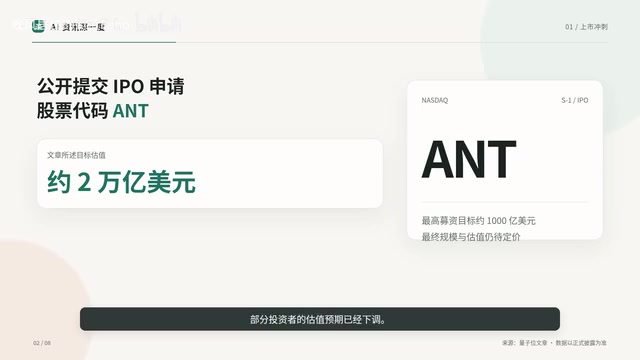
Anthropic (the company behind Claude) has officially filed for a Nasdaq IPO under the ticker AND. The 335-page prospectus simultaneously reveals an AI company's astonishing revenue growth and equally astonishing losses. According to an article by QbitAI, its fundraising target is up to approximately $100 billion, corresponding to a valuation of about $2 trillion—if realized, this would be one of the largest IPOs in history. But with the AI sector under overall pressure, some investors' valuation expectations have already been revised downward, and the final offering size and valuation remain to be formally priced.
1. The Truth Behind the $80.7 Billion Net Loss: An Accounting Figure or Real Cash?
The most eye-catching number in the prospectus is the net loss of $80.748 billion in the first half of 2026. But this figure does not mean that an equivalent amount of cash was burned during the same period. About $72.4 billion comes from changes in the fair value of convertible notes, derivative liabilities, and other financing instruments—as the company's valuation rises, the related accounting measurements change accordingly. In other words, this is more of a "paper loss," reflecting accounting adjustments driven by rising valuations rather than operating cash outflows.
What truly needs continuous tracking is still the liabilities for compute, R&D, and personnel. For an AI company with heavy asset investment, these are the key metrics that determine long-term survival. Equating $80.7 billion simply with "burning money" is a misreading of this financial report; but ignoring the compute commitments behind it is another kind of misjudgment.
Convertible notes and fair value changes: Convertible notes are a financing instrument with both debt and equity characteristics, allowing holders to convert them into company stock under agreed conditions. In accounting terms, when the company's valuation rises, the value of the conversion rights embedded in such instruments (similar to call options) increases accordingly, and the changes in their fair value must be recognized in current profit and loss. Because a rising valuation means future conversion may occur at a lower effective price, it actually appears as a "loss" in the company's current net profit. This is a non-cash, non-operating book adjustment unrelated to the company's actual cash payments. Derivative liabilities work the same way, referring to the remeasurement of the fair value of embedded derivatives. Only by understanding this mechanism can one distinguish "accounting losses" from "operating cash burn" and avoid misreading the $80.7 billion as cash outflow.
2. The Revenue Curve: A Three-Layer Flywheel Driven by Code
In contrast to the losses is another steep revenue curve. The prospectus shows revenue growing from $41 million in 2023 to $4.585 billion in 2025, reaching $16.286 billion in the first half of 2026.

The keyword for growth is code. Claude Code has driven expansion among programming and enterprise customers, with usage-based billing contributing about 80% of revenue—the deeper customers use it, the more pronounced the revenue growth. This model can be summarized as a three-layer structure: the underlying model, the middle development platform, and the top-layer applications. The company has also explicitly stated that it will not develop image and video generation models for now, concentrating compute on programming, agents, and safety research. This "restraint" seems counterintuitive in the current multimodal arms race, but it also illustrates the trade-offs in its commercial focus.
Changes in customer structure are equally significant. As of the end of September 2026, more than 11,900 customers had generated over $100,000 in revenue over the past 12 months, compared with only 950 a year earlier.

Usage-based pricing: This refers to customers paying based on the actual number of tokens consumed by model calls, computing resources, or API requests, rather than paying a fixed subscription fee. This model is common in AI API businesses. Its advantage is that revenue grows naturally with the depth of customer usage—the more customers rely on the model for core business, the more they pay, creating a positive feedback loop of "usage—value—revenue." But the drawbacks are also obvious: revenue is highly tied to customer business volume, and if customers cut usage or migrate to competitors, revenue fluctuates significantly. The prospectus discloses that about 80% of revenue comes from usage-based billing, meaning Anthropic's revenue elasticity is extremely high—growth is fast but less stable than subscription models, a structural feature investors must consider when evaluating its valuation.
3. The $650 Billion Compute Bill: Locking in Supply, and Locking in Commitments
Behind the rapid growth is an even more aggressive compute bill. Based on a rough summation of the major contracts in the public version as cited in the article, related arrangements exceed $650 billion, covering suppliers such as Broadcom, Google, Amazon, and Microsoft. As much as 80% of these are non-cancelable—even if actual usage falls short, payment may still be required.
This means that while locking in supply, future demand is also turned into commitments that must be fulfilled. This long-term contract model is a moat when compute is scarce, but it can become a heavy burden when demand falls short of expectations. After going public, the market will keep asking: can growth outrun commitments?
Non-cancelable contracts and take-or-pay clauses: Long-term contracts for cloud computing power and chip procurement often include "take-or-pay" or minimum commitment clauses, meaning the buyer must pay the agreed minimum amount regardless of actual usage. Such clauses can ensure supply priority and price lock-in when compute is scarce, serving as a strategic moat; but once demand falls short of expectations, unused compute capacity will still translate into cash expenditures or impairment losses. The article mentions that 80% of the arrangements are non-cancelable, meaning Anthropic has made its compute costs highly rigid for years to come. When assessing the risk, the key is not the total contract amount itself, but the match between annual minimum payment obligations and operating cash flow for the same period, and whether revenue growth can continue to cover these rigid commitments.
4. 94 Pages of Risk and Super-Voting Rights: The Safety Narrative and Control
The prospectus devotes 94 pages to disclosing risks, including that advanced AI may resist shutdown, manipulate information, or even disguise itself to pass safety tests.
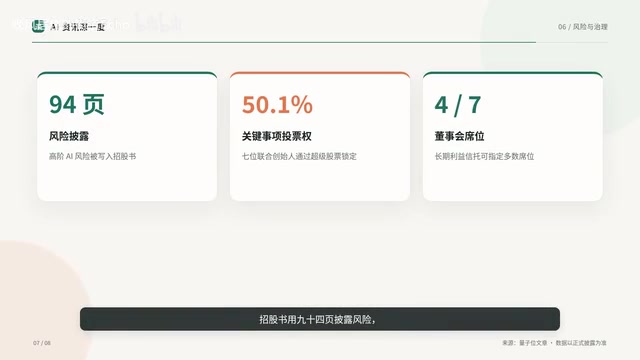
On the other side, the seven co-founders, through a single special share, lock in 50.1% of voting rights on key matters, and the Long-Term Benefit Trust can also appoint four of the seven board seats. Capital can come in, but the steering wheel has not been fully handed over. This governance structure is not uncommon among tech companies, but in an era of increasingly sensitive AI safety issues, the signal it sends is: the company wants to retain the final interpretive authority over the safety narrative while raising funds.
Dual-class shares and the Long-Term Benefit Trust: Super-voting rights refer to a company issuing more than one class of stock, where one class carries multiple votes per share (such as 10 or 20 votes), enabling the founder team to control company decisions even with a lower ownership stake. Anthropic's special feature is that the seven co-founders, through a "single special share," lock in 50.1% of voting rights on key matters, rather than through traditional high-voting common stock. The Long-Term Benefit Trust is a governance mechanism under which the trust appoints some board seats, aiming to place the company's long-term mission (such as AI safety) above short-term shareholder interests. Amid rising controversy over AI safety, this structure both protects the founding team's control and raises concerns among outside shareholders about accountability mechanisms.
Conclusion: The Three-Way Game Has Just Begun
What this prospectus truly reveals is not just the acceleration of AI commercialization, but a three-way game: proving demand with revenue, trading long-term contracts for compute, and defending the safety narrative with governance structure. The $80.7 billion loss is accounting-level noise, the $650 billion in contracts is a strategic bet, and the 50.1% voting right is the governance-level line of defense. Together, these three elements constitute the full tension of Anthropic's IPO story.
Content is compiled from a QbitAI article; data is subject to official disclosure.
One-line Summary
Anthropic files for IPO: most of its $80.7 billion loss is book adjustments, while revenue and compute commitments form a three-way game.
Paragraph Summary
Anthropic has filed for a Nasdaq IPO under the ticker AND, with a fundraising target of up to about $100 billion and a valuation of about $2 trillion. The prospectus shows a net loss of $80.748 billion in the first half of 2026, but about $72.4 billion comes from fair value accounting adjustments on convertible notes and other instruments, not actual cash burn. Revenue grew from $41 million in 2023 to $16.286 billion in the first half of 2026, driven by Claude Code's expansion among programming and enterprise customers, with usage-based billing contributing about 80% of revenue. Meanwhile, compute contracts exceed $650 billion, 80% of which are non-cancelable, locking in both supply and commitments. The seven co-founders lock in 50.1% of voting rights through a special share, and the trust can appoint four board seats. The 94 pages of risk disclosure cover AI safety issues such as resisting shutdown and manipulating information. The article argues that this prospectus presents a three-way game: revenue proving demand, long-term contracts securing compute, and governance defending the safety narrative.
Related articles

AI Can Read Neural Network Weights Directly: Do Models Already Exceed Expectations?
A Reddit developer experiment shows language models can directly read neural network weights and infer their function. Astra, Opus 5.5, and Muse Spark 1.3 all passed the test, sparking discussion on model generalization and training sources.

India's Microdrama Market Explodes: EloElo Secures $80M Investment from NBCUniversal
EloElo secures $80M from NBCUniversal to boost StoryTV, its microdrama platform with over 33M monthly active users, as India's microdrama market draws global capital.

Acoustic Detection of Multi-Rotor UAVs: Fusing Handcrafted Features with Pre-Trained Embeddings
Study reveals data leakage from random splits in UAV acoustic detection, proposes source-disjoint protocol with stacked ensemble of handcrafted features and YAMNet embeddings, achieving 95.29% accuracy for low-cost drone detection.