Anthropic's Trillion-Dollar IPO: Explosive Revenue Growth Amid Looming Risks

Anthropic plans a trillion-dollar IPO, with explosive revenue growth masking compute bills and competitive risks.
Anthropic plans to list on Nasdaq under ticker ANT, issuing 825 million shares at $70–78, for a total deal size of about $90 billion, though its valuation has fallen from $2 trillion to $1.2–1.4 trillion. Quarterly revenue grew from $380 million to $16.8 billion in about 18 months, with an annualized run rate of about $81 billion, mainly from enterprise customers and coding use cases. Compute costs fell from 160% of revenue to under half, and Q3 2026 saw adjusted profitability. But its moat relies on model quality, trust, and habit—with lower switching costs than NVIDIA's ecosystem—and its 43.8% enterprise paid share is only slightly above OpenAI's. Cloud providers are both landlords and competitors, nearly $900 billion in long-term compute commitments, and top-five customers contributing about a quarter of revenue form the three major risks. Founders control 50.1% of voting power via special shares, while public shareholders hold slightly less than half.
Anthropic's Trillion-Dollar IPO: Explosive Revenue Growth Amid Looming Risks
A company barely known five years ago is about to list on Nasdaq at a valuation exceeding one trillion dollars. Anthropic, the AI company behind the Claude models, devotes 93 pages of its prospectus to warning investors about various risks—its language is so blunt that it's rare in public company filings. Is this the birth of the next tech giant, or a dangerous moment when the AI bubble has been priced to perfection?
According to a deep-dive analysis by the YouTube channel "Margins and Moats," Anthropic plans to list on Nasdaq under the ticker ANT, issuing 825 million shares at a price range of $70 to $78. Combined with roughly $26 billion in investment from partners including Google, NVIDIA, AMD, and Microsoft, the total deal size could reach approximately $90 billion, making it the second-largest IPO in history, behind only SpaceX's listing earlier this year.
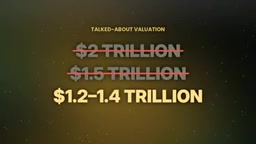
But valuation expectations have fallen from the $2 trillion discussed weeks ago to roughly $1.2 to $1.4 trillion. What happened? The answer lies in the details of revenue growth, cost structure, and the competitive landscape.
From Nonprofit Lab to Revenue Rocket
In 2021, seven former OpenAI employees founded Anthropic as a public benefit corporation, balancing a safety mission with commercial profit within the framework permitted by law. For the first few years, the company ran losses—reporting a net loss of $42 billion in 2025, though about $34 billion of that was accounting accruals rather than actual cash outflows, with true operating losses at roughly $8 billion.
The turning point came on the revenue side. In early 2025, Anthropic's quarterly revenue was about $380 million; by the end of 2025, that figure climbed to $2 billion; it reached $4.7 billion in Q1 2026, then $11.6 billion, and in the three months through September it hit $16.8 billion. That's more than 40x growth in about 18 months. As of the end of October, the company's annualized revenue run rate was approximately $81 billion.
The revenue engine comes primarily from enterprise customers. More than 11,900 customers each paid Anthropic at least $100,000 over the past year, and all of the Fortune 10 are customers. Coding is the core driver—developers use Claude to write, fix, and ship software, then extend it to agents that work across applications. About 80% of revenue is usage-based rather than fixed subscription fees.

Public Benefit Corporation (PBC) is a corporate form under Delaware law that requires a company to state one or more public benefit purposes in its charter and to weigh both shareholder financial interests and public benefit goals in its decisions. Unlike traditional nonprofits, a PBC can freely raise capital, issue stock, and pursue profit, but must periodically publish benefit reports describing progress toward its stated mission. Anthropic adopted this structure to enshrine its "AI safety" mission in its charter while bringing in massive capital from Google, Amazon, and others, so that it isn't entirely driven by short-term profit demands. However, the PBC's binding force is weaker than external regulation: directors still ultimately measure themselves by shareholder value, and the public benefit mission is more of a soft constraint at the governance level.
Margin Improvement: Every Dollar of Revenue Gets Cheaper
Running AI is expensive—chips, power, data centers. According to the prospectus analysis, in 2025 Anthropic's compute and infrastructure costs exceeded its entire revenue, amounting to about 160% of revenue. By Q2 2026, that ratio had fallen to less than half of revenue. In Q3, the company said it achieved adjusted profitability—the word "adjusted" carries a lot of interpretive leeway, but the direction is clear: revenue is growing far faster than the cost of service.

Annualized Revenue Run Rate (ARR) is a metric that multiplies revenue from a given period (usually a quarter or a month) by the corresponding factor to annualize it. For example, multiplying single-quarter revenue by 4, or single-month revenue by 12. It reflects the current pace of the business rather than realized annual revenue, so it can overstate scale for fast-growing companies and distort for seasonal businesses. Anthropic's reported run rate of about $81 billion is annualized from $16.8 billion in the last quarter, and investors should treat it as an extrapolation of current pace, not a promise.
How Deep Is the Moat?
Switching AI models is far easier than one might think. Enterprises often need only minor software changes to point requests at another model. This is far weaker than NVIDIA's CUDA ecosystem—the result of two decades of accumulated developer habits. Anthropic's defenses rest mainly on three pillars: model quality (if it writes code well, enterprises will pay), trust (large companies value reliability and safety, which is Anthropic's brand foundation), and habit (once thousands of employees depend on it daily, switching tools becomes a real project).
According to Ramp data tracking enterprise spending, in September 2026, 43.8% of U.S. businesses on its platform paid for Anthropic, slightly above OpenAI's 40.6%. But that lead is only single digits and could flip at any time.

CUDA (Compute Unified Device Architecture) is a parallel computing platform and programming model introduced by NVIDIA in 2006, allowing developers to directly invoke GPUs for general-purpose computing using languages like C/C++. After nearly two decades of accumulation, CUDA has built a vast library, toolchain, and developer community, and many AI frameworks and scientific computing applications are deeply optimized for CUDA. Migrating to other hardware platforms means rewriting low-level code and re-tuning performance, at extremely high cost. This is the core of what the original article calls "NVIDIA's moat": not the chip itself, but developer habits and ecosystem lock-in. By contrast, calling a different large model requires only changing the API endpoint or prompt, a much lower switching cost.
Three Cracks: Landlords, Bills, and Concentration
The risks are equally clear. First, the compute landlords are also competitors—Anthropic runs on compute rented from giants like Amazon and Google, and nearly half of revenue flows through cloud marketplaces operated by Amazon, Google, and Microsoft, which are both major investors and are all developing their own AI.
Second, long-term compute commitments. According to Reuters, Anthropic has signed long-term computing contracts totaling nearly $900 billion. That spending is locked in and won't disappear even if growth slows. Meanwhile, most revenue is usage-based—if customers cut usage, revenue could fall faster than costs.
Third, customer concentration. In the first nine months of 2026, the top five customers contributed about a quarter of revenue, and many large customers have no long-term contracts and can reduce spending at any time. That's one reason for the valuation pullback: in October, revenue growth slowed from more than doubling quarter-over-quarter to 45%—still very high, but investors had priced in higher expectations. AI stocks corrected sharply over the same period, fueling doubts about whether massive spending can deliver returns.
Adjusted Profitability is a profit metric a company derives beyond GAAP profit by excluding non-cash or one-time items such as stock-based compensation, depreciation and amortization, and restructuring charges. It's often used to show "whether the core business makes money," but the scope of adjustments is defined by the company itself and can obscure real costs. For example, depreciation from large-scale compute procurement and stock compensation to employees, if excluded, can significantly improve the profitability picture. Investors should compare the gap between GAAP net income and adjusted profit to judge whether the adjustments are reasonable and sustainable.
Control: What You're Buying, and What You're Not
Public shareholders collectively hold slightly less than half of the voting power. Founders hold special shares with 50.1% of voting power, and another special share held by an independent "Long-Term Benefit Trust" has the right to elect four of seven directors. In short, you can own a piece of the company but cannot control it. This structure was designed so that the mission cannot be easily overturned by shareholders chasing short-term profit.
The Key Variable in Trillion-Dollar Pricing
Margins are improving, revenue is growing, and it's growing faster than the cost of service. The moat is still being dug—quality and trust are powerful weapons, but switching costs are lower than in the NVIDIA era. At the all-important trillion-dollar price, Anthropic must grow rapidly for years while carrying hundreds of billions of dollars in compute bills. If growth continues, today's price may look cheap in hindsight; if growth stalls, the bills won't disappear.
As the analysis video says, this is not financial advice but a window into the quality of the AI business model: when revenue growth slows from more than doubling to 45%, the market immediately reprices—and what a trillion-dollar valuation implies is absolute faith in sustained high growth.
One-line Summary
Anthropic plans a trillion-dollar IPO, with explosive revenue growth masking compute bills and competitive risks.
Paragraph Summary
Anthropic plans to list on Nasdaq under ticker ANT, issuing 825 million shares at $70 to $78, for a total deal size of about $90 billion, though its valuation has fallen from the $2 trillion discussed to $1.2–1.4 trillion. Its quarterly revenue grew from $380 million to $16.8 billion in about 18 months, with an annualized run rate of about $81 billion, mainly from enterprise customers and coding use cases. Compute and infrastructure costs fell from 160% of revenue to less than half, and the company achieved adjusted profitability in Q3 2026. But its moat relies on model quality, trust, and habit, with switching costs lower than NVIDIA's ecosystem, and its 43.8% enterprise paid share is only slightly above OpenAI's. Cloud providers are both landlords and competitors, nearly $900 billion in long-term compute commitments, and the top five customers contributing about a quarter of revenue form the three major risks. Founders control 50.1% of voting power through special shares, while public shareholders collectively hold slightly less than half.
Related articles

Daybreak Red Deployment Guide: A Reference Architecture for Supervised Security Investigation
A breakdown of the Daybreak Red reference architecture: security control design, deployment configuration process, and runtime monitoring for supervised security investigation.

Gemini 4 Neon Tops the Models Engineering Index
Gemini 4 Neon tops the Models Engineering Index, sparking Hacker News debate over ranking credibility and evaluation methods. Here's what it means for developers.

Apple's Self-Developed AI Agent: An Agent That Can Operate Your Mac Is Coming
Apple is reportedly developing an AI agent that can operate a Mac, targeting Meta Muse, Claude, OpenAI Dots, and others. This article analyzes Apple's system-level advantages, the competitive landscape, and likely rollout paths in the agent race.