Anthropic's Valuation Surging Toward $2 Trillion: Why Ordinary People Are Shut Out of AI's Biggest Windfall

Anthropic's potential $2T valuation highlights how ordinary investors are locked out of AI's biggest wealth creation.
As Anthropic's valuation rockets toward trillion-dollar territory, a growing frustration emerges: ordinary investors who recognized the trend early are structurally excluded from participating. This article examines Anthropic's technical moat, the private market barriers shutting out retail investors, how this differs from the mobile internet era, and practical strategies for people to still benefit from the AI revolution.
A Single Remark That Sparked Deeper Reflection
Recently, an AI industry professional posted this lament on social media: "If you've been following Anthropic for this long and never had the chance to invest, that $2 trillion number really stings."
What seems like a personal emotional outburst actually strikes at a cruel reality in today's AI investment ecosystem: Ordinary investors and early observers can often see the trend clearly, yet have no way to participate in the most lucrative stage of value distribution.
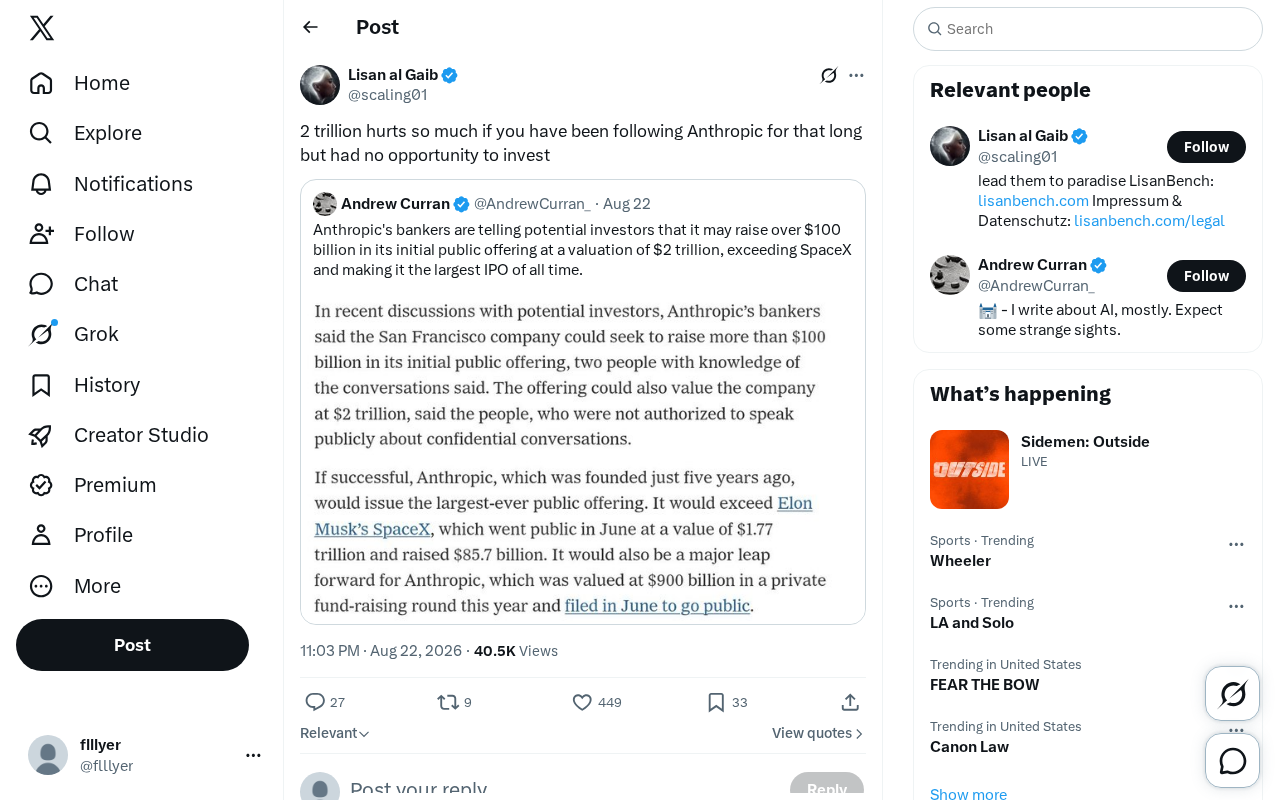
As the most closely watched frontier AI company outside of OpenAI, Anthropic has become an undeniable force in the global AI race through the continuous iteration of its Claude model series. The discussions sparked by its soaring valuation actually reflect structural problems across the entire AI capital market.
Why Anthropic Can Support a Trillion-Dollar Valuation
Technical Moat and Product Reputation
Anthropic was founded in 2021 by former OpenAI core members Dario Amodei and Daniela Amodei, who previously served as OpenAI's VP of Research and VP of Safety & Policy, respectively. The company's core technical philosophy revolves around "Constitutional AI" — an innovative approach that guides model behavior through preset principles, enabling AI systems to maintain safe and beneficial outputs with less human feedback. This methodological differentiation creates a clear divergence from OpenAI's technical approach and establishes Anthropic's unique competitive positioning.
The Claude model series has built a strong reputation in long-context processing, code generation, reasoning capabilities, and safety alignment. In the enterprise market especially, Claude has earned the trust of numerous developers and enterprise customers through its relatively robust performance and commitment to AI safety principles.
For observers who have tracked this company over time, Claude's evolution from early versions to its current mature form represents a clearly visible growth trajectory. This experience of "watching it grow step by step" is precisely the emotional source of that lament — the trend judgment was correct, but the channel for realizing that value is closed to ordinary people.
Continuous Capital Backing
Anthropic has attracted a substantial roster of strategic investors, including tech giants like Amazon and Google. Notably, these investments are not purely financial plays but are deeply tied to cloud computing businesses. Amazon has invested a total of $4 billion in Anthropic, while Google's investment reaches the $2 billion level. Anthropic's model training and inference deployment primarily runs on Amazon AWS, generating massive compute consumption revenue for AWS. This "invest-to-lock-in" model is particularly prevalent in the AI era — tech giants bind frontier model companies to their cloud platforms through strategic investments, creating a new form of industrial ecosystem control.
Multiple funding rounds have driven its valuation upward rapidly, from the single-digit billions toward discussions of trillion-dollar territory. This pace of valuation growth is almost unimaginable in traditional industries and epitomizes the capital frenzy of the AI era.
The "Informed Outsider" Dilemma
Understanding the Trend but Unable to Buy a Ticket
Funding for today's top AI companies is almost entirely concentrated in the private market, with extremely high participation thresholds. The private market (Primary Market) refers to the market where companies raise capital by issuing equity to qualified investors before going public — fundamentally different from public secondary markets (like NYSE or NASDAQ). In the United States, the SEC requires "accredited investors" to meet criteria such as annual income exceeding $200,000 or net worth exceeding $1 million. While this regulatory design was originally intended to protect ordinary investors from high-risk investment losses, it objectively excludes them from the value distribution of early high-growth companies.
Venture capital firms, sovereign wealth funds, and tech giants are the main players at this feast. Meanwhile, the independent researchers, developers, and ordinary investors who first recognized Anthropic's value and continuously followed its technical progress are completely shut out.
This gap between "information advantage but no capital access" represents an investment dilemma unique to the AI era:
- Top AI projects don't go public: Core AI companies remain in the private stage for extended periods, leaving retail investors with no way to participate
- Extremely high investment thresholds: Minimum investments often start at millions of dollars, excluding the vast majority of people
- Front-loaded value distribution: By the time a company actually goes public, the largest appreciation has already been divided up during the private stage
Comparison with the Mobile Internet Era
During the mobile internet era, although similar issues existed, ordinary investors could at least share in the growth dividends of companies like Apple, Google, and Tencent through public markets. Take Apple as an example: when the iPhone launched in 2007, its market cap was approximately $100 billion, and over the following decade-plus it grew to $3 trillion — ordinary investors could still achieve 30x returns through public markets. Google's market cap was about $23 billion at its 2004 IPO, and even those who bought after listing achieved over 80x returns as long-term holders.
In this AI wave, however, the most imaginative native companies are mostly still private, meaning ordinary people may be missing the steepest segment of the entire value creation cycle. When Anthropic grows from a $1 billion valuation to potentially the trillion-dollar level, that 1,000x appreciation occurs almost entirely in the private stage, and public market investors may only share in the final, relatively flat portion of growth.
A Rational Look at Trillion-Dollar Valuations
Bubble or Long-Term Trend?
When a company's valuation is being discussed at the trillion-dollar level, sober scrutiny becomes especially necessary. What supports such a valuation is the market's extremely optimistic expectation for Artificial General Intelligence (AGI), rather than current actual revenue.
Artificial General Intelligence refers to an AI system with cognitive abilities equal to or exceeding humans, capable of autonomous learning and reasoning across any intellectual task. There is currently no unified consensus in academia or industry on AGI's definition, ranging from "able to pass the Turing test" to "able to replace all human intellectual labor." AGI has become the core of the valuation narrative because, once achieved, its economic value would far exceed any single industry — it is essentially a "universal labor force." But how far we are from true AGI remains deeply contested in the technical community, with serious researchers supporting predictions ranging from "within 5 years" to "50+ years."
From a valuation methodology perspective, traditional corporate valuation typically relies on price-to-earnings ratio (P/E), price-to-sales ratio (P/S), or discounted cash flow (DCF). But frontier AI company valuations rely more on "endgame thinking" — investors assume that once AGI or near-AGI systems are achieved, the total addressable market (TAM) will cover a significant portion of global GDP. In Anthropic's case, even with current annualized revenue at roughly the $1 billion level, a trillion-dollar valuation implies a price-to-sales ratio of hundreds or even a thousand times — virtually inexplicable under traditional frameworks, only tenable under the extreme assumption of "winner-take-all + infinitely large market."
Two possibilities exist here:
- Trend bull case: AI will restructure all industries, and frontier model companies will become the next generation of infrastructure providers; current valuations are merely a discount of long-term value
- Cautious case: Valuation growth far outpaces commercialization progress, presenting clear risks of expectation overshoot and bubble
For observers who missed the investment opportunity, the key warning is — the emotion of "regret" should not translate into the impulse to blindly chase in at elevated prices. High valuations themselves also imply high risk.
Practical Takeaways Beyond Emotion
What this lament truly deserves reflection on isn't "missing out on $2 trillion," but rather the deeper question it reveals: In a field like AI that is technology-driven and capital-intensive, how can cognitive advantage be converted into actual returns?
For most people, rather than regretting the inability to directly invest in a star company, it's better to consider:
- How to leverage AI tools to create value in your own work and career
- How to indirectly share in AI dividends through accessible public market instruments (such as investing in chip companies and cloud providers that supply infrastructure to AI companies, or holding AI-themed ETFs)
- How to build personal competitive advantages that match the AI era
Conclusion
The lament triggered by Anthropic's rising valuation is a vivid footnote to the AI era's capital frenzy. It reminds us that understanding a trend and profiting from it are two entirely different things.
The value growth of frontier AI companies is largely locked behind the high walls of private capital. For ordinary people, what's truly within their control may not be the missed investment opportunity, but rather how to find their own way to participate in this technological revolution — whether as developers, entrepreneurs, or rational value investors.
Key Takeaways
Related articles

Build an AI Super Employee System at Zero Cost: A Full Breakdown of Automated Agent Workflows
A deep breakdown of the AI super employee system demoed on Bilibili: agent orchestration, digital human voiceovers, map and enterprise lead generation, 24/7 customer service, and legal modules. We analyze the business logic and compliance risks behind zero-cost signup to help entrepreneurs judge the real ROI of this AI digital employee system.

The Essential Difference Between Chatbots and AI Agents: Crossing from Conversation to Execution
What's the difference between a chatbot and an AI agent? Based on the MCP series on the Learn Tech channel, this article uses examples like booking flights and summarizing notes to explain: a chatbot only gives answers, while an agent actually completes tasks through a think-act-observe loop. It breaks down the four core components—model, tools, memory, and goal—as well as MCP's role as a bridge, and discusses agents' applicable boundaries and permission risks.

Free GitHub Repo: 342 Hours of AI Courses, from Math to MCP Servers
A free GitHub repo offers 342 hours of AI courses: 523 lessons across 20 phases, from math fundamentals to agent building and MCP servers. Nearly 100,000 learners have started.