Anthropic SDK v1.13.0 Released: Managed Agents Gain Multi-Agent Configuration

Anthropic SDK v1.13.0 strengthens Managed Agents with workflows, multi-agent config, and thread filtering for enterprise Agent apps.
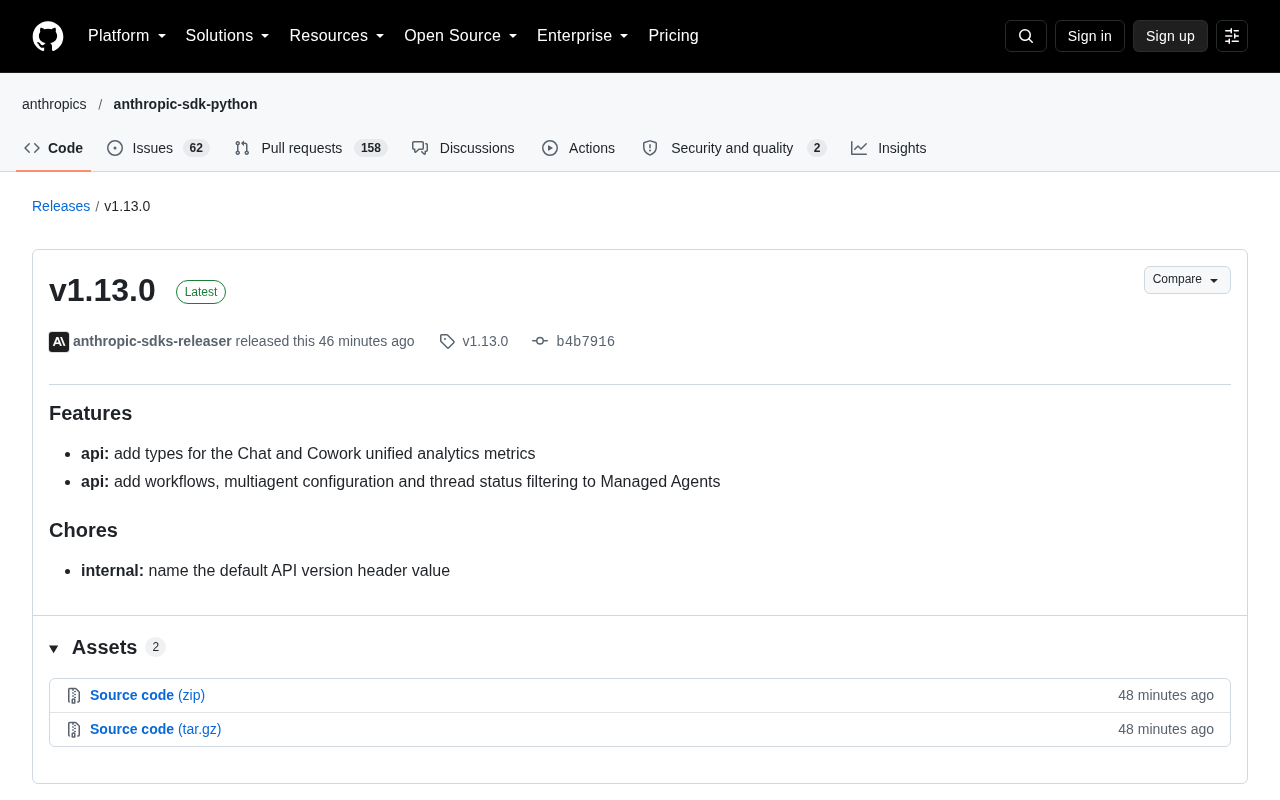
Anthropic SDK v1.13.0 expands Managed Agents with three new capabilities — workflows, multiagent configuration, and thread status filtering — enabling developers to orchestrate multi-agent collaboration and manage conversation threads with less custom infrastructure. The update also adds TypeScript type definitions for Chat and Cowork unified analytics metrics, improving the observability development experience. An internal naming normalization for the default API version header rounds out the release.
Anthropic's official SDK has released version v1.13.0, pushed by anthropic-sdks-releaser. While the version bump is modest, the new features are squarely focused on expanding Managed Agents capabilities and filling out unified analytics metric types — signaling Anthropic's continued investment in enterprise-grade agent orchestration.
What's New in This Release
According to the release notes, v1.13.0 includes two categories of changes: feature updates and internal chores.
On the features front, the most notable additions are enhancements to Managed Agents. The new version introduces three capabilities: workflows, multiagent configuration, and thread status filtering. This means developers can now orchestrate multiple agents working in concert with greater precision through the SDK, and filter and manage conversation threads by status — both of which are critical infrastructure for building complex Agent applications.
The update also adds types for the Chat and Cowork unified analytics metrics. For developers using strongly typed languages like TypeScript, complete type definitions translate directly to a better development experience and fewer runtime errors.
Why Managed Agents Matter
The shift from single model calls to multi-agent collaboration is one of the clearest trends in AI application development today. By bringing workflows and multiagent configuration into the Managed Agents framework, Anthropic is effectively reducing the cost for developers to build their own orchestration layers from scratch.
The introduction of workflows means developers can define ordered sequences of task steps and have agents execute them according to preset logic — without writing extensive state management code at the application layer. Multiagent configuration goes further by supporting task division and collaboration across multiple agents, making it well-suited for handling complex tasks that need to be decomposed.
Thread status filtering may seem like a minor feature, but in real production environments, the ability to filter conversation threads by status is enormously useful for monitoring, debugging, and operations — especially when managing large numbers of concurrent sessions.
Managed Agents is Anthropic's server-side managed orchestration solution. Rather than maintaining agent runtime state, retry logic, and conversation context themselves, developers delegate this infrastructure to the platform. This contrasts with "self-hosted" approaches where developers write their own loops, call models directly, and manage state on their own servers. The managed approach lowers cold-start costs and naturally fits cloud-native elastic scaling scenarios, at the cost of some control over low-level execution details. Comparable products in the industry include OpenAI's Assistants API and Google's Agent Builder — Anthropic's Managed Agents is its entry in this space.
What Complete Analytics Types Mean
Adding types for Chat and Cowork unified analytics metrics signals that Anthropic is building out an observability layer. After deploying AI applications, enterprise users typically need visibility into call volume, usage patterns, cost distribution, and similar metrics. A unified analytics metrics interface backed by complete type definitions lets this data be consumed and analyzed programmatically.
On the internal maintenance side, this release normalizes the naming for the default API version header value. This kind of change is nearly invisible to end users but contributes to the long-term maintainability of the SDK codebase.
Observability in AI applications typically spans three dimensions: Logs (recording raw inputs and outputs for each call), Metrics (such as token usage, latency, error rates, and costs), and Traces (reconstructing call chains across multi-step workflows). For multi-agent applications, a single user request can trigger dozens of model calls — without a unified analytics interface, cost attribution and performance bottleneck identification become extremely difficult. Filling in TypeScript type definitions for Chat and Cowork unified analytics metrics means developers can get field suggestions and type validation at compile time, rather than relying on runtime errors to catch data structure mismatches. This is especially valuable when building automated monitoring dashboards or alerting systems.
Recommendations for Developers
If your project uses the Anthropic SDK and involves agent orchestration, v1.13.0 is worth upgrading to — particularly if you need multi-agent collaboration or workflow management. For users doing simple text generation calls, the impact of this update is limited and an upgrade can be timed at your convenience.
One note of caution: the release notes themselves are fairly brief, and specific API usage patterns and parameter definitions still require consulting the official documentation. It's recommended to validate compatibility in a test environment before upgrading, and confirm that the new types and configuration options don't conflict with existing code.
Overall, v1.13.0 continues Anthropic's steady investment in agent infrastructure. Managed Agents capabilities are maturing incrementally, giving developers a more solid foundation for building production-grade multi-agent applications.
Related articles

Huberman's Rational Supplement Guide: A Five-Layer Health Framework and Scientific Decision-Making
Stanford neurobiology professor Huberman proposes a rational supplement framework: behavior and nutrition are the foundation, basic combination supplements serve as insurance, and sleep/hormonal/cognitive directions should stick to single-ingredient experiments. Omega-3 is the top single-ingredient choice, and melatonin is not recommended.

The Unsung Painter Behind Gilded Age Manhattan Interior Design
HN discussion highlights the painter behind Gilded Age Manhattan interiors: he created murals and decorative paintings but was long overlooked as his work was seen as architectural appendage.

Can AI Agents Be Socially Engineered? Understanding Prompt Injection and Tool Permission Risks
Through Invariant Lab's GitHub Issue injection and Brave's AI browser attack, this article analyzes how Prompt Injection induces AI Agents to perform unauthorized actions, and offers protection advice across three layers: least privilege, tool validation, and operation auditing.