Anthropic SDK v1.16.0 Released: Analytics and Admin API Upgrades

Anthropic SDK v1.16.0 strengthens Analytics, Admin API, SSE compatibility, and enterprise operations.
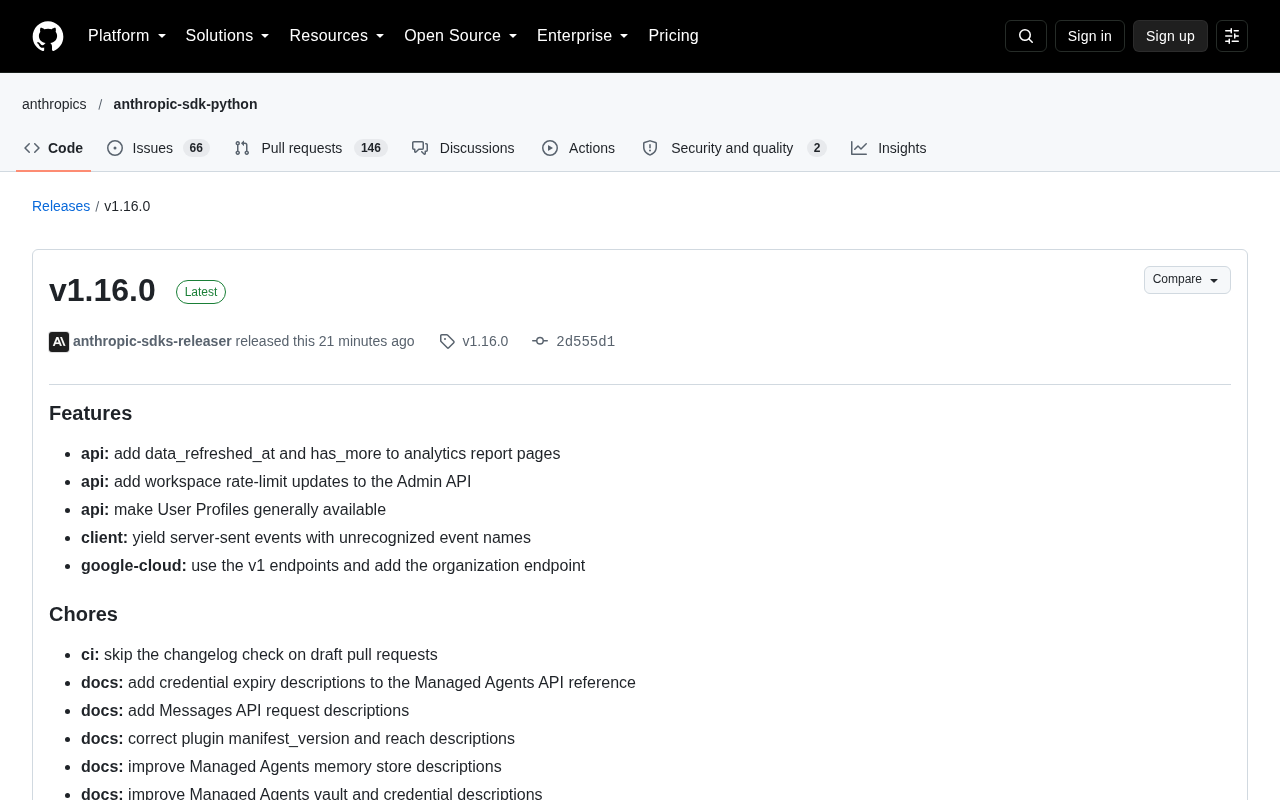
Anthropic SDK v1.16.0 is an iteration focused on feature enhancements and engineering refinement. Analytics API adds data_refreshed_at and has_more fields for data freshness transparency and reliable pagination; Admin API now supports updating workspace-level rate limits via API for IaC and automated operations; User Profiles is now GA with a stabilizing contract; the client yields SSE events with unrecognized event names for better forward compatibility; and Google Cloud integration migrates to v1 endpoints with a new organization endpoint. Documentation and CI improvements round out the release.
Anthropic SDK has released version 1.16.0, an update focused on practical API capability extensions and developer experience refinements. According to the official changelog, this release spans the Analytics API, Admin API, User Profiles, client-side event handling, and Google Cloud integration—making it an iteration centered on feature enhancements.
Analytics API: New Data Refresh Timestamp and Pagination Indicator
This update adds two new fields to Analytics report pages: data_refreshed_at and has_more. The former lets callers know exactly when report data was last refreshed, while the latter provides a basis for determining whether more results exist in pagination.
For teams relying on report data for monitoring or BI analysis, data_refreshed_at solves the problem of invisible data freshness. Previously, developers could only infer whether data had been updated through polling or additional requests; now they can read the timestamp directly from the response and pair it with has_more to implement more robust pagination logic. These two fields indicate that Anthropic is beginning to address more complex production-grade use cases in the Analytics scenario.
Admin API: Workspace Rate-Limit Configuration Now Updatable
The Admin API now supports workspace rate-limit updates. This means administrators can adjust workspace-level rate limits directly through the API rather than relying on manual operations in the console.
For enterprises where multiple teams and projects share a single organization account, dynamic rate-limit adjustments are a high-frequency operational need. By exposing this through the API, rate-limit configurations can be incorporated into Infrastructure as Code (IaC) workflows, integrated with CI/CD or configuration management systems, and reducing the risk of configuration drift caused by manual intervention.
Workspace is a resource isolation layer in the Anthropic platform, typically under an Organization, used to separate different teams, projects, or environments (such as development, testing, and production). Rate limits generally constrain request counts or token counts within a time window, and workspace-level rate limits allow further subdivision within an organization's overall quota. Once rate-limit configuration is exposed via API, administrators can manage these policies in a versioned, auditable manner and use IaC tools like Terraform for declarative configuration management and rollback, avoiding configuration drift caused by manual console operations.
User Profiles Now Generally Available
User Profiles has moved from preview to generally available (GA). This feature allows developers to establish persistent profile data associations for users, maintaining consistent context information across multiple sessions.
GA means the interface contract is stabilizing and can be safely relied upon in production. For applications building personalized Agents or requiring cross-session memory, the GA status of User Profiles lowers the decision cost of adopting the new capability.
GA (Generally Available) is a stage in the software release lifecycle, typically following Preview/Beta, indicating that a feature has passed stability validation, commits to backward compatibility of its interface contract, can be safely used in production, and is officially supported. In contrast, Preview-stage features may undergo breaking changes or be discontinued at any time. User Profiles entering GA means its data structures (such as how user identifiers are associated with profile fields) and API endpoints are stabilizing, allowing developers to incorporate it into long-term architecture design without worrying about frequent interface changes.
Client: Support for SSE Events with Unrecognized Event Names
A key client-side change is that it now yields server-sent events (SSE) whose event names are unrecognized.
The practical significance of this change lies in forward compatibility. When the server introduces new event types, older clients no longer discard these events but instead pass them through to the caller for handling. For applications that need to quickly follow up once server capabilities go live, this reduces the coupling that would otherwise require synchronously upgrading the SDK to receive new events. Developers can determine and handle unknown events at the application layer, while the SDK layer maintains maximum transparency.
SSE (Server-Sent Events) is an HTTP-based server push technology where the server continuously sends an event stream to the client through a text/event-stream response. Each event consists of fields such as event: (event name) and data: (payload). At the SDK level, clients typically dispatch to corresponding handling logic by event name, and unrecognized event names are often simply ignored. Passing through unrecognized events means the SDK hands the raw event object to the caller, leaving the application layer to decide how to handle it. This design is common in scenarios requiring forward compatibility: the server rolls out new event types first, and clients can receive and process them without waiting for an SDK release—at the cost of the caller needing to maintain fallback logic.
Google Cloud Integration: Migrated to v1 Endpoints and New Organization Endpoint
Google Cloud-related integration now uses v1 endpoints and adds support for an organization endpoint. Unified endpoint versions typically mean more stable interface behavior and clearer lifecycle management. The new organization endpoint completes organization-level cloud integration capabilities, making it easier for enterprises to configure and manage uniformly at the organization level.
Documentation and CI Improvements
This release also includes several documentation updates: the Managed Agents API reference now includes credential expiration notes, the Messages API adds request descriptions, descriptions for the plugin manifest_version and reach have been corrected, and documentation for Managed Agents' memory store, vault, and credential has been improved. On the CI side, changelog checks are now skipped for draft PRs, reducing process friction for contributors during the draft stage.
Although these changes do not directly alter API behavior, they provide practical help for onboarding and day-to-day troubleshooting—especially the refinement of Managed Agents documentation, which reflects that the capability is being used by more developers.
Conclusion
v1.16.0 does not introduce disruptive new capabilities, but several changes point in the same direction: making the SDK better suited for refined production operations. The Analytics data-freshness field, API-driven rate-limit configuration in the Admin API, and forward-compatible SSE handling all fill in engineering details for enterprise-grade use. For teams already using the Anthropic SDK in production, it is worth paying attention to data_refreshed_at and the handling logic for unknown SSE events, as these two changes may directly affect the expected behavior of existing code.
Related articles

Random Pruning of the DPO Computation Graph: 1.4x Training Speedup and Lower Peak Memory
DPO training too slow and memory-hungry? This paper proposes a random pruning framework for the DPO computation graph, sampling independently across position, sequence, and branch dimensions; branch pruning achieves a 1.426x step-time speedup and cuts training time by about 30%, with in-depth attribution of memory and time gains.

Why Does JEPA Underperform MLM in Longitudinal EHR Representation Learning?
New study compares JEPA and MLM for longitudinal EHR representation learning on MIMIC-IV: three JEPA variants train stably without collapse but underperform MLM; target size, not heterogeneity, drives prediction error.

Transfer Learning + Visible Light Communication: A New Approach to Energy-Efficient Indoor Positioning
A study proposes a transfer learning-based visible light communication indoor positioning method, achieving 47% accuracy improvement on the BOSCH factory dataset, 67.5% model efficiency under high noise, and introducing the ME composite metric for energy-efficient positioning in energy-constrained industrial IoT scenarios.