Anthropic Spends $740K on Lobbying, Targeting White House AI Policy
Anthropic Spends $740K on Lobbying, Ta…
Anthropic paid $740K to a lobbying firm run by Rubio's former chief of staff that also lobbies the NSC, raising concerns about AI companies' political influence.
According to Hacker News discussions, AI company Anthropic paid $740,000 to a lobbying firm run by Senator Marco Rubio's former chief of staff, and the firm is also lobbying the U.S. National Security Council (NSC), where Rubio sits. The article notes that the combination of the amount, timing, and lobbying target makes this expenditure hard to view as mere business consulting. Since the NSC serves directly under the President and is the core coordinating body for foreign and security policy, issues such as AI model capability boundaries, export controls, and military use regulations may all be discussed there. Anthropic's approach to the NSC through a lobbying firm means its influence extends beyond congressional legislation. The article argues that this case reflects leading AI companies moving from the technology lab to the policy arena, with lobbying expenditures and personnel connections becoming new dimensions for assessing AI companies' influence, and public understanding of these relationships is an important clue to the direction of AI regulation.
According to discussions on Hacker News, AI company Anthropic paid $740,000 to a lobbying firm run by Senator Marco Rubio's former chief of staff, and that same firm is also lobbying the U.S. National Security Council (NSC), where Rubio sits. The deal has thrust the relationship between AI companies and political lobbying networks into the spotlight.
An Unusual Lobbying Expenditure
Anthropic paid $740,000 to this lobbying firm with close political ties for AI policy lobbying. Given the identity of Rubio's former chief of staff and the firm's lobbying activities directed at the NSC, this expenditure is hard to view as mere business consulting.
It is not uncommon for AI companies to hire lobbying firms with political backgrounds, but the combination of the amount, the timing, and the lobbying target makes this particular transaction especially noteworthy.
Why the National Security Council
The NSC serves directly under the President and is the core coordinating body for foreign and security policy. Issues such as the capability boundaries of AI models, export controls, and regulations on military use may all be discussed there.
Anthropic's approach to the NSC through a lobbying firm shows that its interests extend beyond congressional legislation to include the direction of security policy at the executive level. For an AI company positioning itself as "safety-first," there is a tension between this kind of political investment and its public image.
The U.S. National Security Council (NSC) was established by the National Security Act of 1947 and comprises core cabinet members including the President, Vice President, Secretary of State, and Secretary of Defense. It is chaired in daily operations by the President's National Security Advisor and serves as the central body within the White House for coordinating foreign, military, and intelligence policy. Unlike the congressional legislative process, NSC decisions are typically implemented through presidential executive orders and national security memoranda without requiring public votes, making outside visibility into its internal discussions extremely low. This is why lobbying the NSC and lobbying Capitol Hill are two different strategies: the former seeks to influence the executive branch's interpretation and enforcement standards in the early stages of policy formation, while the latter focuses on the text of legislation itself. For AI companies, matters such as model export licenses and military procurement standards are often at the discretion of the executive branch, which explains why companies are willing to pay high fees for access to the NSC.
AI Companies' Political Engagement Is Deepening
Anthropic's case is not an isolated one. As AI regulation issues heat up, leading AI companies are moving from the technology lab to the policy arena. Lobbying expenditures, personnel connections, and policy positions are becoming new dimensions for assessing the influence of AI companies.
For the industry, this means that beyond technological competition, the contest for policy resources is equally critical. For the public, understanding these lobbying relationships is an important clue to understanding the direction of AI regulation.
The Lobbying Disclosure Act (1995) requires individuals and organizations engaged in lobbying activities in the United States to periodically submit disclosure reports to Congress, listing clients, lobbying issue areas, and quarterly expenditure amounts. Therefore, Anthropic's $740,000 expenditure may itself come from public disclosure filings rather than leaked information. However, the law only requires disclosure of broad issue categories (such as "technology policy") and does not require specifying particular meeting counterparts or policy demands, making it difficult for outsiders to reconstruct the actual content of lobbying activities. In addition, the so-called "former chief of staff" revolving-door phenomenon is common in American politics; the law typically imposes cooling-off period restrictions, but the duration and scope vary by position. Understanding this disclosure framework helps determine what public information can reveal and what it obscures.
References
This article is based on discussions and report titles from Hacker News. The original title was 'Anthropic Paid Rubio's Ex-Chief of Staff's Firm $740k.it Lobbied His NSC'.
Related articles
Gemini 4 Hydrogen Hands-On: Google's Fastest and Cheapest AI Model
Hands-on with Gemini 4 Hydrogen: the fastest, cheapest model in the Gemini 4 family. We break down the Carbon/Argon/Hydrogen split, API pricing traps, free-tier limits, and the cost trade-offs of four thinking levels—with a real bug-debugging demo.
Gemini 4 Hydrogen vs Sonnet Comparison Test: Uses Only 1% of Weekly Quota, Performance on Par
Hands-on test: Gemini 4 Hydrogen vs Sonnet on the same CRUD task—Hydrogen used only 1% weekly quota with comparable performance and better UI details, while Anthropic's model used 7%. Developer says daily tasks don't require expensive models.
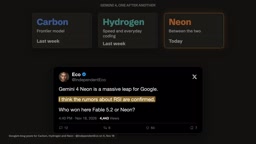
Gemini 4 Neon Released: Beats Opus 5.5 on Multiple Benchmarks, Google Returns to the Top Tier
Google DeepMind releases Gemini 4 Neon: 61 on the Artificial Analysis intelligence index (3rd) and 1st on the coding index, beating Opus 5.5 on multiple benchmarks. $3/$15 per million tokens; available in the Gemini API and AI Studio.