Anthropic Surges 17% on Nasdaq Debut, Market Cap Briefly Tops $2 Trillion; Nvidia's Doubled Earnings Fail to Lift Falling Stock
AI industry contrasts: Anthropic surges on debut, Nvidia earnings strong but stock falls, Gemini controls computers, Microsoft reshapes human-AI relations.
The article reviews major AI industry developments. Anthropic listed on Nasdaq with an opening market cap briefly above $2 trillion, closing up 17%, while protests occurred in San Francisco. Nvidia's Q3 revenue doubled to $115.8 billion, but its stock fell nearly 40% from its October high, with Jensen Huang's departure turmoil seen as the main variable. Google added computer control to Mac Gemini, demoing a sketch turned into a Blender 3D model, marking a shift from conversation to software operation. Meta's AI pendant MuseCharm is rumored at $300, and Nadella explained Microsoft's buyouts as helping employees become AI managers. Additionally, banks like Citibank require users to bear AI agent account risks, and Kuaishou released Kling Image 4.0 with native 8K support.
The AI industry saw dramatic contrasts overnight: on one side, Anthropic surged on its Nasdaq debut, with its market cap briefly surpassing $2 trillion; on the other, Nvidia delivered earnings that more than doubled revenue, yet its stock kept sliding. Meanwhile, Google's Gemini gained the ability to control a computer, rumors surfaced about Meta's AI hardware, and Microsoft redefined the relationship between people and AI.
Anthropic's IPO: Capital Frenzy and Protests Outside
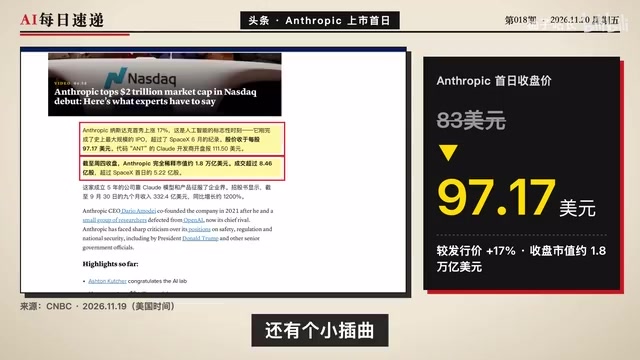
Anthropic officially listed on Nasdaq, with siblings Darryl and Daniela ringing the opening bell in person. The opening price was $111.5, more than 30% above the $83 IPO price, giving it a market cap briefly exceeding $2 trillion—surpassing Meta and Tesla. However, the stock declined steadily after the open, eventually closing at $97.17, a first-day gain of 17%, with a closing market cap of about $1.8 trillion. Trading volume reached 846 million shares, exceeding SpaceX's 522 million on its first day.
The capital market's enthusiasm did not mask controversy. On the same day, more than 100 people gathered outside Anthropic's office in San Francisco to protest, with slogans aimed squarely at "ban AI that can build AI," reflecting deep concerns about AI's capacity for self-evolution.
One detail: Anthropic itself was not immune to security incidents—its account was once hacked, which echoes the "read-only" design of its financial tool and further shows that the security boundaries of AI companies remain a work in progress.
Nasdaq Listing and IPO Pricing Mechanism: Nasdaq is one of the world's major stock exchanges, known for technology stocks. When a company lists, it sets an IPO price, assessed by underwriters based on institutional investor demand; the opening price is determined by market bidding on the first trading day, so it may be significantly above or below the IPO price. The article's phrase "more than 30% above the $83 IPO price" refers to the opening price's premium over the IPO price. The first-day closing price and trading volume reflect market enthusiasm, but subsequent stock performance is still affected by multiple factors such as fundamentals and governance structure.
Nvidia: Strong Earnings, Stock Under Pressure
Nvidia's third-quarter revenue reached $115.8 billion, more than doubling year-over-year, and the interim CEO publicly stated, "We can handle it." But the stock hovered around $150, down nearly 40% from its October high.
The divergence between earnings and stock price centers on the chain of turmoil triggered by Jensen Huang's departure. What the market worries about is not current performance but strategic continuity after a leadership change. This case reminds us that in the AI chip sector, the impact of personnel and governance structure on valuation can sometimes be no less than the earnings numbers themselves.
Common Reasons for Earnings-Stock Divergence: In an efficient market, stock prices usually reflect investors' expectations for the future in advance, not just current performance. When earnings are released, if results are good but fall short of the market's most optimistic expectations, or if there are uncertainties such as governance or personnel issues, the stock may fall instead of rise. The "Jensen Huang departure turmoil" mentioned in the article refers to concerns about strategic continuity brought by leadership changes—non-financial factors that are often amplified in tech stock valuations.
Google Gemini: From Conversation to Computer Control
Google added the ability for the Mac version of Gemini to directly control the computer. After a user assigns a task, Gemini clicks, scrolls, and types on its own in a background window while the user's mouse remains fully usable. In an official demo, it turned a quick hand-drawn butterfly sketch into a 3D model in Blender.

This means AI assistants are shifting from "answering questions" to "operating software on people's behalf," delivering real efficiency gains for repetitive workflows such as design and modeling. However, letting AI take over keyboard and mouse also brings risks of permissions and misoperation, so boundaries still need to be clearly defined in deployment.
How AI Agents Control Computers: Letting AI directly control a computer usually relies on "computer use" capabilities, where the model visually recognizes screen content and simulates mouse clicks, keyboard input, and other operations. Unlike traditional API calls, it requires the model to understand interface elements and task flows. This capability can significantly boost efficiency but also introduces risks of permission abuse, misoperation, and data security, so deployment requires boundary mechanisms such as sandbox environments, operation confirmation, and least-privilege permissions.
Meta MuseCharm and Microsoft's Organizational Restructuring
According to The Information, Meta's AI pendant MuseCharm is priced at $300, resembles an electronic pet, and can be carried around for conversations. Meta did not deny it, saying only that more news would be announced soon; it remains unconfirmed. A keychain-sized device selling for $300 raises doubts about market acceptance—its value depends on whether AI interaction can truly stand independently of the phone.
On Microsoft's side, Nadella explained at the Dealbook summit why buyouts were offered to 60,000 employees in October: not to let AI replace people, but because in the future everyone will need to become "the person managing AI." He cited the Cowork team, which has only 11 developers yet built a "software factory" that produces products.

The signal is clear: organizational efficiency gains come from restructuring human-AI collaboration models, not simple layoffs. For practitioners, learning to orchestrate and review AI output is becoming a basic skill.
Banks Tighten AI Agent Permissions; Kling Image 4.0 Released
Citibank amended its terms: if users let third-party AI agents operate their bank accounts, they bear the consequences themselves—even if the AI is hacked. JPMorgan Chase, Bank of America, and PNC have similar policies. Anthropic's own financial tool is simply read-only and cannot touch users' money.
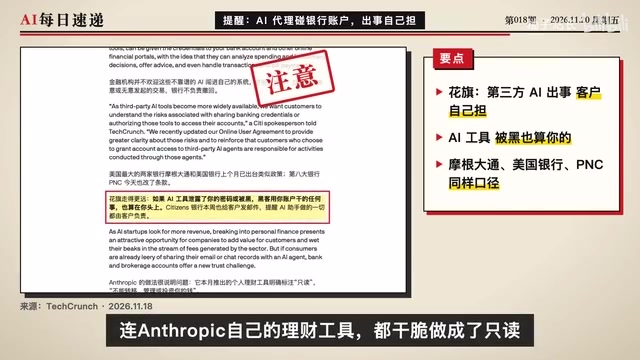
This is a reminder for everyone using AI to manage finances: don't hand your bank passwords to AI casually—least privilege is the bottom line.
Domestically, Kuaishou released Kling Image 4.0, supporting native 8K images, generating up to 10 style-consistent images from a single prompt, with each image able to contain 2,000 characters—a direct boon for advertising and e-commerce asset production.
Is Anthropic's 17% first-day gain expensive or cheap? Feel free to discuss in the comments.
AI Agents and Bank Terms Risks: An AI agent refers to an autonomous program that can perform tasks on behalf of users. When users authorize third-party AI agents to operate bank accounts, banks typically clarify risk responsibility in their terms. Banks such as Citibank require users to bear losses caused by AI agent operations themselves, even if the AI is hacked, reflecting financial institutions' cautious attitude toward AI agent permissions. For users, least privilege—granting AI only the minimum permissions necessary to complete a task—is the basic principle for reducing risk.
Related articles

VP ≠ VNP: A Major Breakthrough in Computational Complexity Theory
A study claiming to prove VP ≠ VNP over every field sparks heated discussion on Hacker News. This article analyzes the algebraic complexity background of VP and VNP, the proof approach, community controversy, and its potential impact on computational complexity theory.

Developer Naming Woes: The Technical Names That Drive Us Crazy
Why is technical naming so maddening? From Nginx and Vite to Qt and Sudo, a YouTube creator rants about the chaos of developer naming and pronunciation, revealing the tug-of-war between creators' intentions and community habits, and the cultural roots behind spelling traps like PyPI and GNOME.

Figma Workplace Scandal: Employee Sues CEO for Forcing Confrontation with Harasser
Figma and its CEO are sued by a current employee alleging sexual harassment and discrimination, and forcing the victim to confront her harasser. This article outlines the background, potential impact, and industry reflection.