Antigravity SDK Adds Local AI Model Support: Decoding Google's Deeper Strategy

Google's Antigravity SDK embraces local AI, signaling a shift from selling models to enhancing services.
Google added local AI model support to its Antigravity SDK, sparking deep community debate about the future of the AI industry. The core consensus: Google's business is services, not models — shifting inference costs to users is pure upside for Google. Combined with its existing open-source Gemma series, this move is seen as a strategic read of industry trends. The community further predicts that after an AI bubble burst, frontier model companies will struggle, while those using AI to enhance their own service ecosystems — like Google — will survive. Developers welcome local inference for privacy and cost benefits, but remain cautious about what Google's "freely handed-over keys" really mean.
Google's Antigravity SDK has announced support for local AI models. What appears to be a routine feature update has sparked a deep discussion in the developer community about the future direction of the AI industry. While most frontier model companies still guard their cloud inference walls closely, why is Google doing the opposite — proactively handing users the keys to run models locally?
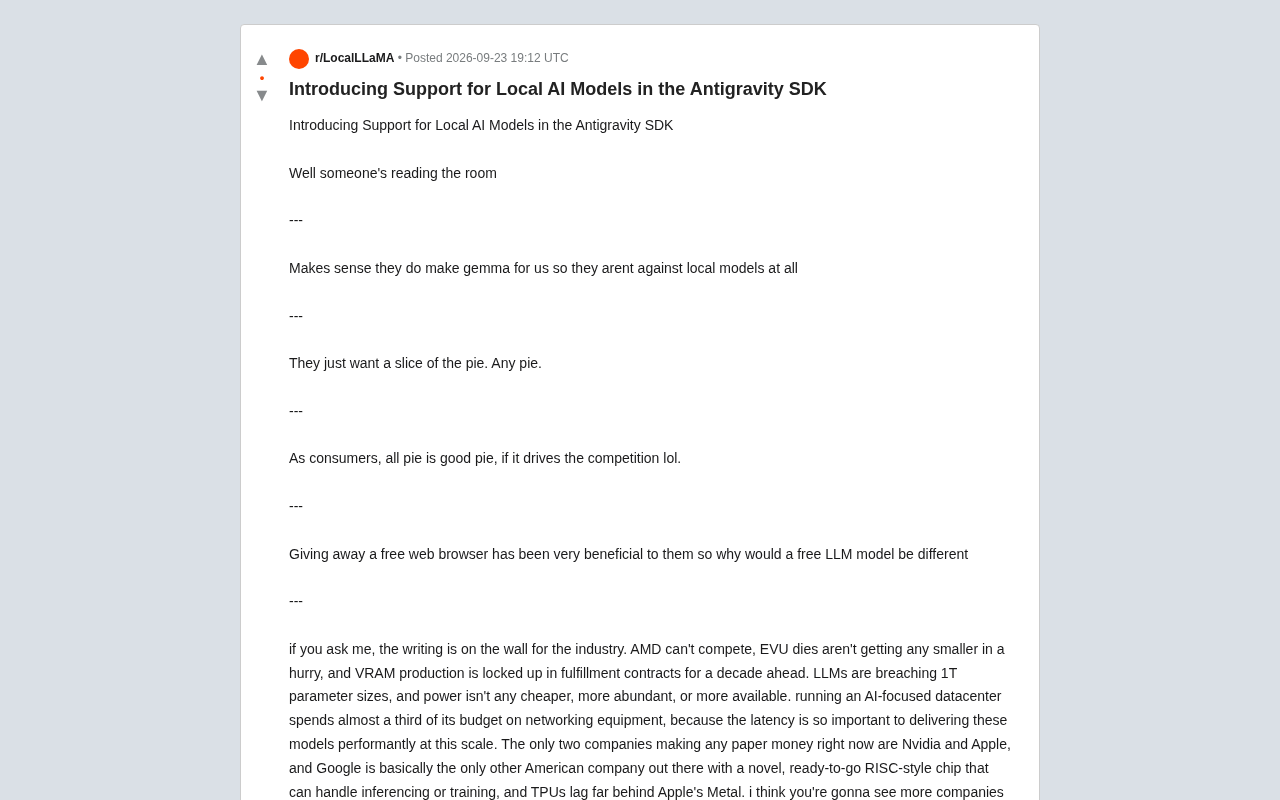
A Product Decision That "Read the Room"
The community's first reaction to the news was telling — "finally, someone read the room." Behind that phrase lies a widespread sentiment among developers: the demand for local AI has been growing steadily, yet it has long been ignored by frontier vendors.
Interestingly, Google supporting local models isn't entirely surprising. As one user pointed out, Google already releases the open-source Gemma model series — "they made Gemma for us, so they've never been opposed to local models." Gemma is available for free under a permissive open-source license. While it can't match the flagship Gemini in raw performance, it's widely regarded as a genuinely capable model. This dual-track strategy — a closed-source flagship alongside an open-source lightweight option — already laid the groundwork for embracing local inference.
From a business logic standpoint, Google giving away a web browser (Chrome) for free has proven to be an enormously beneficial strategic investment. How is giving away an LLM any different? Both share the same underlying logic: by lowering the barrier to entry, you keep users firmly locked within your service ecosystem.
Gemma is a series of lightweight open-source large language models released by Google in February 2024. Built on the same underlying research and technology as Gemini but optimized for local device execution, it comes in parameter sizes such as 2B and 7B. Its license permits commercial use, and developers can freely download, fine-tune, and deploy it. The Antigravity SDK (also known as Google AI Edge / On-device SDK) is Google's development toolkit for enabling local AI inference on Android, iOS, and the web — allowing models like Gemma to be bundled directly into apps so inference runs on-device without network calls to cloud servers. Together, they represent Google's systematic push into "on-device AI," not an isolated feature update.
Why Google Isn't Afraid of You Using Its Own Models
The most insightful perspective in the community came from an analysis of the fundamental nature of Google's business model — a point repeatedly emphasized across multiple discussion threads and treated as the core community consensus.
The central argument: Google is not just another "adversarial frontier model company." Its core business is services, not models. Allowing users to access Google's services via local models is pure upside for Google — it directly removes hosting and inference costs from Google's balance sheet. And almost everyone (except Wall Street) has painfully come to realize just how unsustainable the hosting costs of frontier models truly are.
One commenter offered a brilliant analogy: in this AI gold rush, Google isn't the person selling shovels — it's the one who owns the land where the gold is buried. Google's play is to hand you the car keys and even give you a map to find fuel — but that fuel ultimately still belongs to Google.
This also explains Google's protective attitude toward its crown jewel, Search: it won't scare away search users, but it also won't repeat the mistakes of Kodak or Blockbuster. True revolutionaries understand that the best inventions should be invisible — a Roomba doesn't look like Rosie the robot maid from The Jetsons; it's just a plastic disc on the floor. Google understands this deeply. It can quietly integrate Gemini into existing services like Search without forcing it into your workflow.
"No Frontier Business After the Bubble Bursts"
The discussion also expanded into a broader structural critique of the AI industry. One user laid out a sobering list of industrial realities:
- AMD is struggling to catch up in the AI chip race;
- Process node shrinkage faces near-term bottlenecks;
- VRAM production capacity is locked up in fulfillment contracts stretching a decade out;
- LLM parameter counts are breaking into the trillions, while power is neither cheap nor plentiful;
- Nearly a third of an AI data center's budget goes to networking equipment alone, given how latency-sensitive large-scale high-performance delivery is.
Based on these observations, the commenter argued the industry trend is already written on the wall: when the bubble bursts, LLMs won't disappear (just as the dot-com bubble didn't kill e-commerce), but the frontier model business as a standalone model will cease to exist. What will remain are companies that use models to enhance their own services, not companies whose business is selling model access. In this framing, more and more companies will pivot to making local inference work, because after the bubble, other paths won't be profitable.
It's worth noting that these specific claims about chip capacity and data center costs represent one commenter's personal views and have not been independently verified against external data sources. Readers should evaluate them with appropriate skepticism.
The "frontier model business" refers to companies whose core business model revolves around training and monetizing the largest, most capable foundation LLMs — think OpenAI, Anthropic, and similar players. These companies depend heavily on continuous large-scale compute investment and charging for cloud API access, making marginal inference costs difficult to compress. By contrast, companies that "use models to enhance their own services" (like Google with Search, or Adobe with creative tools) treat AI capabilities as a means of adding value to existing products rather than as a standalone product to sell. The dot-com bubble is frequently cited as a historical parallel: after the 2000 crash, pure-play "internet companies" collapsed en masse, while businesses that integrated the internet into real-world operations (Amazon, eBay) survived and thrived. This framework is essential context for understanding the article's core argument.
"The Cloud Is Just Someone Else's Computer"
The discussion also surfaced an old saying from the early 2010s: "the cloud is just someone else's computer." This slightly tongue-in-cheek phrase neatly captures the emotional root of the local AI movement — a desire for data sovereignty and autonomous control.
When inference can happen on a local device, users no longer have to hand every request to "someone else's computer." For developers, this means lower latency, more controllable costs, and the privacy benefit of data that never leaves the device.
Of course, the community's attitude toward Google is far from unconditional trust. One user was blunt: "This is genuinely the right direction for Google, and they're less evil than some tech companies, but I won't make the mistake of thinking they're trustworthy." This stance — direction endorsed, trust withheld — may be the healthiest posture toward any tech giant's displays of openness.
Final Thoughts
Antigravity SDK's support for local models is, on the surface, a developer tool feature update. At a deeper level, it reflects a value chain restructuring underway across the AI industry. As the economics of frontier models come under scrutiny and the hardware and demand for local inference continue to mature, companies like Google — those who own the "land" rather than just selling "shovels" — are positioning themselves for the next phase.
For developers and everyday users, whatever the giants' motivations may be, being able to run and control AI models locally is a direction worth welcoming — provided we always stay clear-eyed about the intentions behind "freely handed-over keys."
Related articles

Random Pruning of the DPO Computation Graph: 1.4x Training Speedup and Lower Peak Memory
DPO training too slow and memory-hungry? This paper proposes a random pruning framework for the DPO computation graph, sampling independently across position, sequence, and branch dimensions; branch pruning achieves a 1.426x step-time speedup and cuts training time by about 30%, with in-depth attribution of memory and time gains.

Why Does JEPA Underperform MLM in Longitudinal EHR Representation Learning?
New study compares JEPA and MLM for longitudinal EHR representation learning on MIMIC-IV: three JEPA variants train stably without collapse but underperform MLM; target size, not heterogeneity, drives prediction error.

Transfer Learning + Visible Light Communication: A New Approach to Energy-Efficient Indoor Positioning
A study proposes a transfer learning-based visible light communication indoor positioning method, achieving 47% accuracy improvement on the BOSCH factory dataset, 67.5% model efficiency under high noise, and introducing the ME composite metric for energy-efficient positioning in energy-constrained industrial IoT scenarios.