AnyInit: An Automatic Weight Initialization Tool for Custom Deep Learning Architectures

AnyInit automatically computes weight initialization for custom deep learning architectures, eliminating tedious manual derivation and training instability.
The article introduces AnyInit, an open-source tool by developer jmiravet that automates weight initialization for deep learning models. For standard architectures like ResNet and Transformer, built-in initialization suffices, but for custom layers, non-standard activations, or novel structures, manually deriving variance scaling coefficients such as Xavier and Kaiming is tedious and error-prone, often causing signal attenuation, explosion, and vanishing gradients. AnyInit analyzes the network structure to automatically determine per-layer initialization parameters, turning initialization from after-the-fact troubleshooting into before-the-fact assurance. The developer sought community feedback on non-standard methods and problematic custom layers. Released on GitHub and PyPI, it reflects the toolchain's shift toward adaptivity.
Why Manual Weight Initialization Is Always Such a Headache
In deep learning model development, weight initialization has always been an easily overlooked yet critically important step. For standard architectures (such as ResNet and Transformer), frameworks typically come with suitable built-in initialization schemes, so developers don't need to worry much. But once you start designing custom layers, unconventional activation functions, or novel network structures, things get complicated.
Improper initialization causes signals to attenuate or explode layer by layer during forward propagation, and gradients to vanish or diverge during backpropagation. Many times, the "culprit" behind a model failing to converge isn't the learning rate or the optimizer — it's the initialization method that was casually set to its default value.
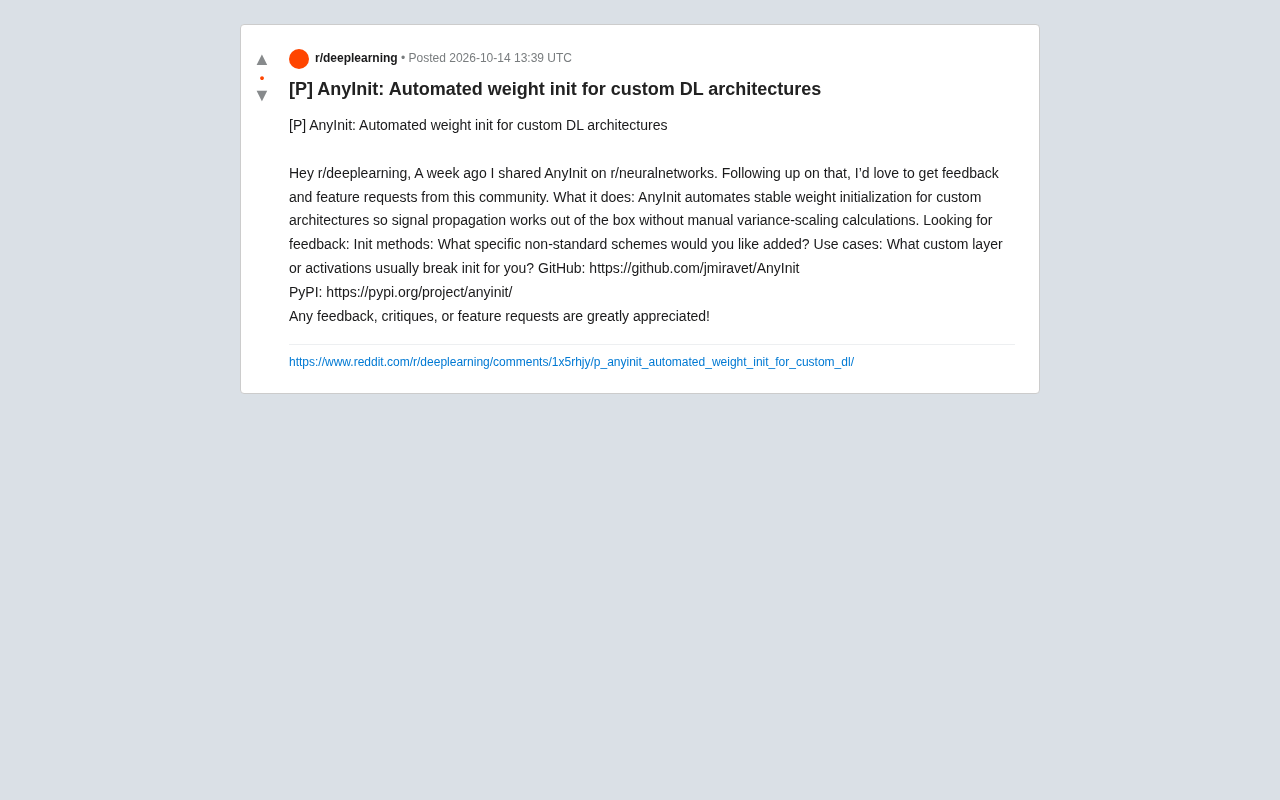
According to a share in the Reddit r/deeplearning community, developer jmiravet has released AnyInit — a tool designed to automate stable weight initialization, making signal propagation "work out of the box" in custom architectures without manual computation of variance scaling.
What Problem Does AnyInit Solve
Core Idea
AnyInit's core goal is to automatically compute a suitable weight initialization scheme for any custom architecture. In the traditional approach, developers need to manually derive variance scaling coefficients (such as the formulas for Xavier initialization or Kaiming initialization) based on each layer's input/output dimensions and activation function type — a process that is both tedious and error-prone.
AnyInit automates this process: it can analyze the network structure, automatically determine the initialization distribution parameters for each layer's weights, ensure that signals remain stable during forward propagation, and prevent gradients from vanishing or exploding during backpropagation.
Xavier initialization (also known as Glorot initialization) and Kaiming initialization are the two most classic types of variance scaling schemes; understanding them helps clarify AnyInit's positioning. Xavier initialization assumes that the activation function is approximately linear and symmetric about the origin (such as tanh and sigmoid). It makes the variance of each layer's weights proportional to the reciprocal of the sum of input and output dimensions, so that signal variance remains roughly constant in both forward and backward propagation. But when the activation function is asymmetric and zero in half its range, like ReLU, half the neurons are suppressed and the variance halves layer by layer, so Xavier no longer applies. Kaiming initialization (He initialization) corrects for this by making the variance proportional to twice the reciprocal of the input dimension, specifically designed for ReLU and its variants. The common premise of both is: the network structure is regular, and the activation function is known and fixed. Once the layer structure is custom or the activation function changes dynamically, these closed-form formulas need to be re-derived — which is precisely the root cause of the tedium of manual initialization.
Why It's Worth Paying Attention To
When deep learning researchers and engineers design new architectures, initialization is often the first thing to be "made do with." People habitually use default initialization and only revisit it after training goes wrong. AnyInit attempts to turn this "after-the-fact troubleshooting" into "before-the-fact assurance," reducing the debugging cost of custom architectures.
For researchers who frequently need to experiment with new layer structures and new activation functions, this kind of automation tool can significantly reduce trial-and-error time.
"Convergence failure" is a multi-cause problem in deep learning: too large or too small a learning rate, an inappropriate optimizer choice, missing batch normalization, unnormalized data, and improper weight initialization can all lead to loss failing to decrease over the long term or oscillating violently. Distinguishing these causes is not easy, because they often produce similar surface symptoms. What makes initialization special is that it happens before training; once set improperly, subsequent fine-tuning of the learning rate or switching optimizers can hardly fully recover the situation. Therefore, treating initialization as "before-the-fact assurance" rather than "after-the-fact troubleshooting" has higher cost-effectiveness in engineering. What AnyInit tries to cover is precisely the range of custom architectures that framework default schemes do not reach. It does not promise to outperform manual tuning in all cases, but it lowers the trial-and-error cost of deriving from scratch.
What the Developer Community Is Focused On
Which Initialization Methods Do People Want Supported
In the Reddit discussion, the developer proactively sought community input: which non-standard initialization schemes would people like AnyInit to add? This question touches on a key boundary of the current tool — standard methods are easy to cover, but the custom schemes constantly emerging at the research frontier are the real challenge.
For example, for complex-valued neural networks, special aggregation layers in graph neural networks, or models with dynamic computation graphs, their initialization needs often exceed the applicable range of classical formulas.
Which Custom Layers Are Most Prone to Problems
The developer also specifically asked: which custom layers or activation functions are most likely to cause initialization failure? This question has strong practical value. From community experience, the following scenarios are often "disaster zones":
- Non-standard activation functions: such as Swish, variants of GELU, or custom gating mechanisms, whose gradient characteristics differ considerably from the ReLU family, making classical initialization formulas no longer applicable.
- Variants of attention mechanisms: when the dimensions of Q, K, and V are asymmetric, or additional scaling factors are introduced, standard initialization may cause abnormal distributions of attention scores.
- Dynamic routing layers: such as the routing protocol in Capsule Networks and the gating network in Mixture of Experts, whose weight updates depend on runtime states, requiring special handling of initialization strategies.
The attenuation or explosion of signals during forward propagation is essentially a multiplicative effect of the ratios of each layer's output variance to input variance. If a certain layer amplifies the variance by about 1.1 times, after dozens of layers the signal will grow exponentially; if it shrinks it to 0.9 times, it will rapidly approach zero. Gradients during backpropagation are subject to a similar multiplicative effect, and are additionally multiplied by the activation function's derivative and the transpose of the weight matrix, making them even more sensitive to initialization. An ideal initialization should make this layer-wise variance ratio close to 1 — the so-called "variance conservation" or "dynamical isometry." Classical formulas obtain scaling coefficients precisely by analytically solving for this ratio, whereas AnyInit's approach is to automatically estimate this ratio for arbitrary layers through numerical or structural analysis and then back out the initialization parameters, thereby bypassing dependence on closed-form formulas.
Tool Ecosystem and How to Get It
AnyInit has been released simultaneously on GitHub and PyPI. Developers can install and use it directly via pip, or consult the source code to understand its implementation details.
- GitHub repository: https://github.com/jmiravet/AnyInit
- PyPI package: https://pypi.org/project/anyinit/
The tool's positioning is clear: it is not meant to replace frameworks' built-in initialization methods, but to provide an automated fallback in custom scenarios. This "filling the gap" approach is not common in the deep learning toolchain — most tools are either oriented toward general training workflows or focused on specific architectures.
What It Means for Developers of Custom Architectures
AnyInit's emergence reflects a trend: as deep learning research increasingly favors designing customized architectures, the toolchain also needs to move from "one-size-fits-all" toward "adaptive." Weight initialization, as the first checkpoint for training stability, deserves a more intelligent automated solution.
Of course, any automation tool needs to strike a balance between generality and precision. Whether AnyInit can cover enough edge cases, and whether its automatic computation outperforms manual tuning in all situations, still requires more validation through community practice. The developer's proactive approach of seeking feedback from the community is itself accumulating real-world use cases for the tool's iteration.
If you are designing a custom architecture and have ever been troubled by initialization issues, you might want to give AnyInit a try and give the developer feedback on your experience using it.
One-line Summary
AnyInit automatically computes weight initialization for custom deep learning architectures, solving the tedium of manual derivation and training instability.
Paragraph Summary
The article introduces the open-source tool AnyInit, released by developer jmiravet, which aims to automate the weight initialization process for deep learning models. For standard architectures like ResNet and Transformer, frameworks' built-in initialization is sufficient, but in custom layers, non-standard activation functions, or novel network structures, manually deriving variance scaling coefficients such as Xavier and Kaiming is both tedious and error-prone, and often leads to signal attenuation, explosion, and vanishing gradients. AnyInit automatically determines the initialization distribution parameters for each layer by analyzing the network structure, turning initialization from "after-the-fact troubleshooting" into "before-the-fact assurance." The developer solicited feedback in the Reddit community on non-standard initialization methods and custom layers prone to problems. The tool has been released on GitHub and PyPI, reflecting the trend of the toolchain evolving toward adaptivity.
Related articles

Random Pruning of the DPO Computation Graph: 1.4x Training Speedup and Lower Peak Memory
DPO training too slow and memory-hungry? This paper proposes a random pruning framework for the DPO computation graph, sampling independently across position, sequence, and branch dimensions; branch pruning achieves a 1.426x step-time speedup and cuts training time by about 30%, with in-depth attribution of memory and time gains.

Why Does JEPA Underperform MLM in Longitudinal EHR Representation Learning?
New study compares JEPA and MLM for longitudinal EHR representation learning on MIMIC-IV: three JEPA variants train stably without collapse but underperform MLM; target size, not heterogeneity, drives prediction error.

Transfer Learning + Visible Light Communication: A New Approach to Energy-Efficient Indoor Positioning
A study proposes a transfer learning-based visible light communication indoor positioning method, achieving 47% accuracy improvement on the BOSCH factory dataset, 67.5% model efficiency under high noise, and introducing the ME composite metric for energy-efficient positioning in energy-constrained industrial IoT scenarios.