AnyPS5: An Open-Source Tool for Automatically Porting PS5 Executables to Linux and Windows

AnyPS5 aims to automatically port PS5 executables to Linux and Windows, gaining 1,820 stars in one week.
AnyPS5 is an open-source C++ tool designed to automatically port PS5 executables to Linux and Windows, gaining ~1,820 stars in a single week (3,269 total) — reflecting strong community interest in console-PC compatibility. Its core technical challenges span three layers: parsing PS5's proprietary ELF variant and encryption, building a FreeBSD-to-Linux/Windows system call translation layer (similar to Wine), and mapping Sony's proprietary GNM graphics API to Vulkan. However, limited public information makes it difficult to assess the tool's actual coverage, stability, or performance, and like similar projects, it operates in a legally gray area under DMCA compliance.
An Open-Source Attempt to Run PS5 Programs on PC
Building a compatibility layer between game consoles and PCs has long been one of the open-source community's most persistent challenges. A GitHub project called AnyPS5 has recently drawn significant attention — it's a C++-based tool designed to enable the automated porting of PS5 executables to both Linux and Windows. The project has surged in popularity, gaining roughly 1,820 stars in a single week, with a cumulative star count of 3,269 and 277 forks — a clear signal of strong community interest in low-level compatibility solutions.
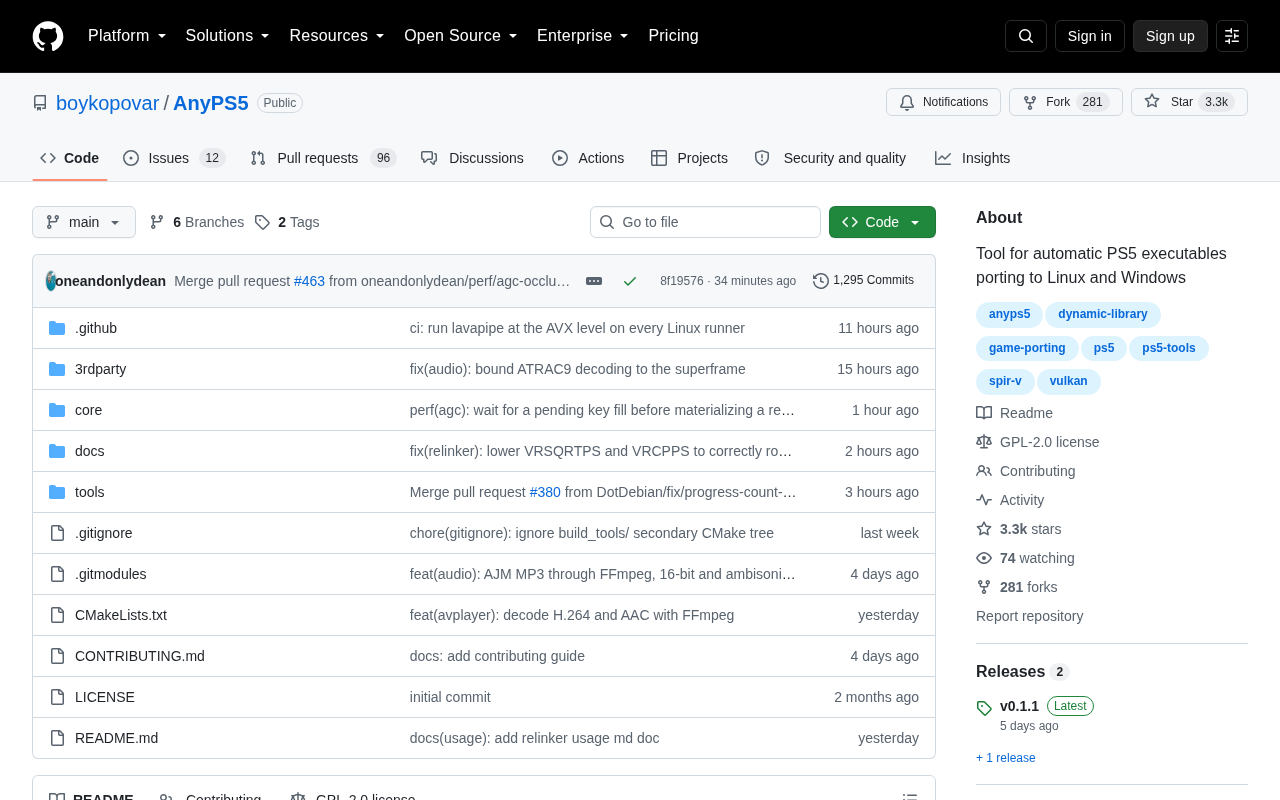
It's worth noting upfront: the available source material only covers the project's basic positioning and statistics, without detailed technical documentation or implementation specifics. This article draws on known information to provide a structured analysis of the technical background, use cases, and potential controversies surrounding this type of tool.
Technical Positioning: What Does "Executable Porting" Actually Mean?
"Executable porting" is far more complex than simply copying a file and double-clicking it. The PS5 runs a customized OS based on FreeBSD, and its binary format, system call interface, and graphics API differ significantly from standard Linux or Windows. Getting a program compiled for PS5 to run on a PC typically requires a tool to handle several layers of challenges:
Binary Format and Loading
PS5 executables use a specific ELF variant along with encryption and signing mechanisms. A porting tool must first be able to parse these file formats and reconstruct structures that the target platform's loader can recognize — often the most fundamental and tedious part of the entire process.
System Call and Runtime Translation
Running programs frequently invoke interfaces provided by the operating system. Since the PS5's foundation is FreeBSD, while the target platform may be Linux (Unix family, but with different interfaces) or Windows (entirely heterogeneous), the tool needs to establish a system call translation layer that maps requests from the source platform to equivalent implementations on the target — conceptually similar to what Wine does when running Windows programs on Linux.
Wine is the best reference point for understanding this kind of translation mechanism. Wine (Wine Is Not an Emulator), born in 1993, is essentially a compatibility layer that re-implements Windows API calls as POSIX-compatible calls — not a virtual machine or emulator. Valve's Proton, built on Wine, further integrates components like DXVK (a DirectX-to-Vulkan translation layer), enabling a large number of Windows games to run on Linux — and it's the core technology behind the Steam Deck. Porting PS5 games is a far greater challenge: the PS5's FreeBSD-based custom kernel has system call numbers and semantics that don't fully align with standard Linux, even though both belong to the Unix family. On top of that, PS5 programs rely heavily on Sony's proprietary runtime libraries (such as libSceKernel and libSceGnmDriver), meaning a porting tool must not only translate system calls but also produce open-source functional reimplementations of these proprietary libraries — a scope of work that far exceeds Wine's starting point.
Graphics and Hardware Abstraction
The PS5's graphics stack is deeply tied to its proprietary GPU and low-level API. Mapping this to desktop-standard Vulkan or DirectX is the critical factor that determines whether a program can actually "run" — and it's the most technically demanding piece of the puzzle.

The PS5 uses a graphics API called GNM (low-level) and GNMX (its higher-level wrapper) — Sony-proprietary graphics interfaces with no publicly available specification. This represents a fundamental departure from PC-standard Vulkan, DirectX 12, or OpenGL. Mapping GNM calls to Vulkan is generally considered the most viable path by the academic and reverse-engineering community, since Vulkan is also a low-level, explicit GPU control API with a resource management model that shares some similarities with GNM. In fact, the PS5's GNM API was designed around AMD's GCN/RDNA architecture — the same AMD custom GPU the PS5 uses — meaning some hardware-level calls bear a relationship to the underlying behavior of PC-side AMD graphics cards, which theoretically simplifies parts of the translation work. That said, shader compilation format differences, rendering state machine nuances, and the PS5's unique async compute and VRAM management mechanisms remain the primary technical barriers for the graphics porting layer.
Why Did Nearly Two Thousand People Star It in One Week?
AnyPS5's near-1,820 star gain in a single week reflects several real-world dynamics:
First, the inherent appeal of compatibility layer technology. From Wine and Proton to various console emulators, running programs across platforms has consistently captivated both enthusiasts and developers. Any tool that claims to automate porting will quickly attract traffic.
Second, the closed nature of the PS5 ecosystem. The console's walled garden makes it difficult for outside developers to access low-level internals, so when an open-source project claims to have found a way through, it naturally generates buzz.
Third, the amplifying effect of open-source collaboration. The 277 forks indicate that a significant number of developers have already tried cloning and experimenting with the code locally, and that level of engagement further boosts the project's visibility.
That said, high popularity doesn't equal high maturity. A sudden spike in stars is often accompanied by a large number of "wishlist" saves. The tool's actual usable scope, stability, and the range of programs it can handle still need to be evaluated against project documentation and real-world community testing.
The Legal and Compliance Boundaries That Can't Be Ignored
Any tool involving the porting of console programs inevitably runs into copyright and licensing questions. The tool itself is generally considered neutral technology, but its use cases may implicate copyrighted game content, console manufacturers' encryption and signing mechanisms, and laws like the DMCA in relevant jurisdictions.
For developers, studying low-level compatibility technology has legitimate educational and research value. But using such tools to run commercial content you don't own or haven't licensed could expose you to legal risk. Projects like this also routinely face takedown pressure on GitHub due to compliance complaints. Readers should clearly distinguish between "technical exploration" and "practical use."
DMCA Section 1201 is the core legal risk source for projects of this kind. That provision prohibits circumventing "effective technological protection measures" (TPMs), and console manufacturers' encryption and signing mechanisms are generally recognized as TPMs. This means that even if a porting tool contains no copyrighted game content whatsoever, the mere fact that it bypasses encryption or signing mechanisms could constitute a DMCA violation. Historically, multiple console emulators and jailbreak tools have received cease-and-desist letters or DMCA complaints from Sony, Nintendo, and others, with some projects forced off GitHub entirely. Notably, the DMCA has limited reach outside U.S. jurisdiction, but GitHub, as a U.S. company, must respond to qualifying DMCA complaints — meaning projects of this type hosted on GitHub always carry a takedown risk, regardless of the underlying legality of the code itself.
A Balanced View: Promise and Limitations Coexist
AnyPS5 represents another open-source attempt at console-to-PC compatibility, and its technical direction — automated binary porting — genuinely targets a long-standing pain point. The choice of C++ is also consistent with the typical approach for performance-sensitive, low-level system tools.
However, based on currently available information, it's premature to draw conclusions about maturity:
- What percentage of PS5 programs can it actually cover?
- What is the runtime performance and stability of ported programs?
- Does it require specific hardware or system environments?
The answers to these questions determine whether this is a practically usable tool or a project still in early proof-of-concept territory. For interested developers, the best course of action is to visit the project repository directly and review the latest documentation, Issues discussions, and Release notes for firsthand information.
Conclusion
AnyPS5 has amassed substantial community attention in a short time on the strength of its compelling pitch: automatically porting PS5 executables to Linux and Windows. The underlying challenges it tackles — binary parsing, system call translation, and graphics abstraction — are all hard-core problems in cross-platform compatibility engineering. At the same time, projects of this nature persistently occupy a gray area of copyright and compliance law. For technology enthusiasts, it offers an interesting window into console internals and cross-platform porting mechanisms — but a real assessment of its value ultimately has to come from the code itself and real-world test results.
Related articles

Random Pruning of the DPO Computation Graph: 1.4x Training Speedup and Lower Peak Memory
DPO training too slow and memory-hungry? This paper proposes a random pruning framework for the DPO computation graph, sampling independently across position, sequence, and branch dimensions; branch pruning achieves a 1.426x step-time speedup and cuts training time by about 30%, with in-depth attribution of memory and time gains.

Why Does JEPA Underperform MLM in Longitudinal EHR Representation Learning?
New study compares JEPA and MLM for longitudinal EHR representation learning on MIMIC-IV: three JEPA variants train stably without collapse but underperform MLM; target size, not heterogeneity, drives prediction error.

Transfer Learning + Visible Light Communication: A New Approach to Energy-Efficient Indoor Positioning
A study proposes a transfer learning-based visible light communication indoor positioning method, achieving 47% accuracy improvement on the BOSCH factory dataset, 67.5% model efficiency under high noise, and introducing the ME composite metric for energy-efficient positioning in energy-constrained industrial IoT scenarios.