AnythingLLM: A Deep Dive into the All-in-One Local AI Knowledge Base Tool
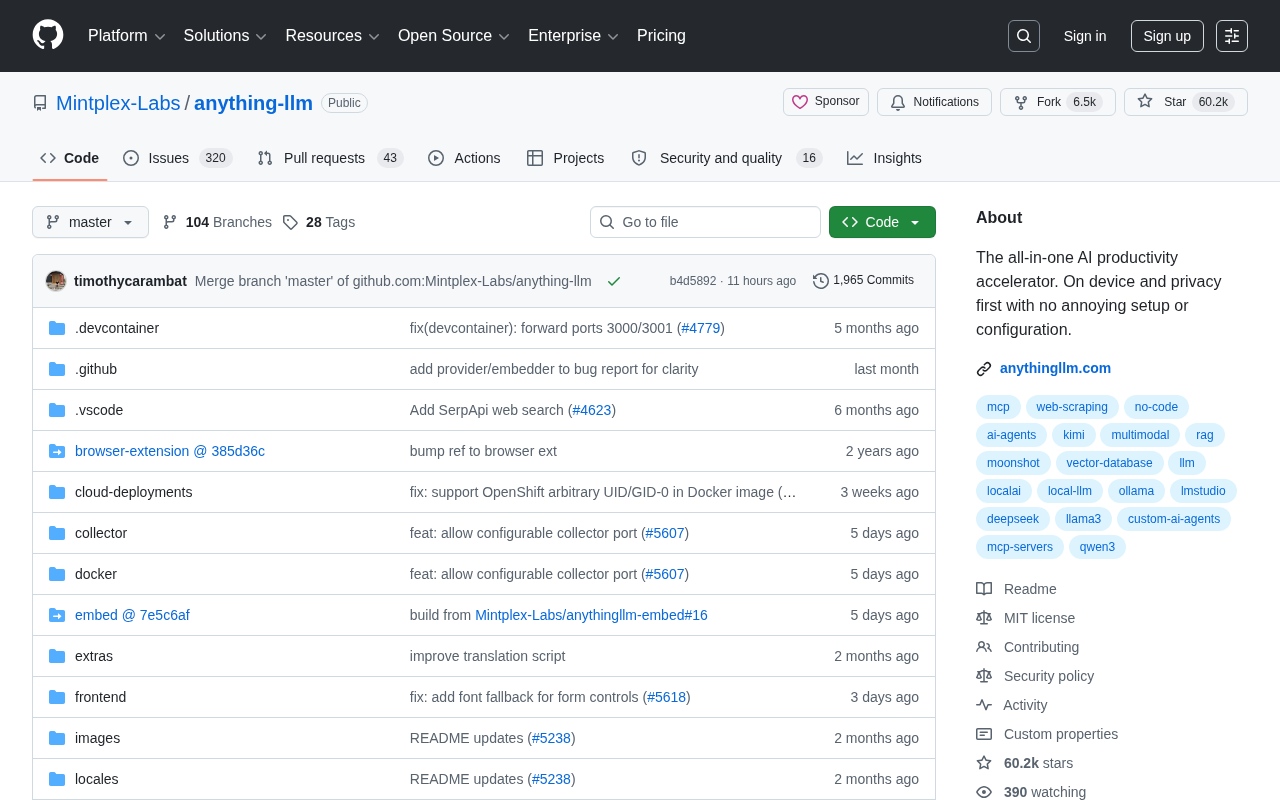
AnythingLLM is a privacy-first, zero-config open-source local AI productivity platform.
AnythingLLM is an open-source local AI platform developed by Mintplex Labs with nearly 60,000 GitHub stars. It emphasizes privacy-first design and zero configuration, supporting multi-model integration, RAG document chat, private knowledge bases, AI Agents, and multi-user collaboration. Built with JavaScript for cross-platform compatibility, it differentiates itself in the local AI space through its complete product form and low barrier to entry.
What Is AnythingLLM? A Quick Overview
AnythingLLM is an open-source AI productivity tool developed by Mintplex Labs, built around two core principles: "privacy first" and "zero configuration." The project has earned nearly 60,000 stars (59,495 stars) on GitHub with over 6,400 forks, making it one of the most popular local AI applications available today.
In simple terms, it's an "all-in-one" local AI platform — you can run large language models on your own computer to chat with documents, manage knowledge bases, use AI Agents, and more, all without sending your data to any third party.
Core Features: What Makes AnythingLLM Stand Out?
Privacy-First Local Deployment
In an era where data security is increasingly critical, AnythingLLM commits to an "on device" technical approach. All data processing and model inference happens on the user's local device, eliminating the need to upload sensitive information to the cloud.
For enterprise teams handling internal documents or individual users who don't want their conversations collected by third parties, this architecture fundamentally eliminates the risk of data leakage. Your data stays on your machine and never passes through external servers.
What "local inference" means here is that the LLM's computation runs entirely on the user's device CPU or GPU. Unlike calling the OpenAI API, local inference generates no network requests and works even without internet access. This is particularly important for industries with strict data compliance requirements — such as finance, healthcare, and government — where data never leaves the internal network from creation through processing to storage.
Truly Zero-Barrier User Experience
Many people want to experiment with local AI but get stuck at the environment configuration step. AnythingLLM's design philosophy is "no annoying setup or configuration" — download, install, and start using it immediately.
It offers desktop clients (supporting Windows, Mac, and Linux), with an installation process no different from any regular software. The built-in default configuration handles most use cases, while advanced users can customize settings as needed.
All-in-One AI Productivity Platform
As an integrated platform, AnythingLLM covers a wide range of practical AI capabilities:
- Flexible Multi-Model Integration: Compatible with OpenAI, Anthropic Claude, local Ollama models, and many other LLM backends, allowing you to switch freely based on task requirements
Ollama is a rapidly rising local LLM runtime framework that simplifies the complex model deployment process into Docker-like command-line operations — users can download and run open-source models like Llama, Mistral, and Qwen with a single command. Under the hood, Ollama uses llama.cpp's quantized inference engine, supporting hybrid CPU and GPU inference, enabling consumer hardware (such as laptops with 16GB of RAM) to smoothly run models with 7B-13B parameters. AnythingLLM's deep integration with Ollama means users don't need to manually configure model service ports and API formats — the platform automatically discovers locally running Ollama instances and connects to them.
- RAG Document Chat: Upload PDFs, Word documents, web pages, and other files, then ask questions directly about their content for precise answers
RAG (Retrieval-Augmented Generation) is one of the most essential technical paradigms in current LLM applications. The basic principle: when a user asks a question, the system first retrieves document fragments relevant to the query from an external knowledge base, then injects these fragments as context into the LLM's prompt, allowing the model to generate answers based on actual document content. This approach effectively solves the LLM "hallucination" problem (where models fabricate non-existent information) while enabling the model to answer questions about private domain knowledge not included in its training data. The RAG technical pipeline typically involves five stages: document chunking, vector embedding, vector database storage, semantic retrieval, and answer generation.
- Private Knowledge Base Construction: Organize enterprise documents, personal notes, and other materials into structured knowledge bases for instant retrieval
Private knowledge base construction relies on vector database technology. When users upload documents, the system splits text into semantically complete fragments (typically 200-1000 tokens), then converts each fragment into high-dimensional vectors (usually 768-1536 dimensions) through an Embedding model. These vectors are stored in specialized vector databases (such as ChromaDB, Pinecone, LanceDB, etc.). When a user asks a question, the query is similarly converted into a vector, and the system finds the most relevant document fragments using algorithms like cosine similarity or Euclidean distance. AnythingLLM has built-in vector database support, so users don't need to separately deploy and maintain this infrastructure.
- AI Agent Automation: Configure custom AI agents to handle complex tasks like searching, analyzing, and summarizing
AI Agent (intelligent agent) represents an advanced form of LLM applications, going beyond simple Q&A interactions to give AI the ability to autonomously plan and execute tasks. A typical Agent system contains four core modules: perception (receiving user instructions and environmental information), planning (decomposing complex tasks into executable steps), tool calling (invoking external tools like search engines, code executors, and APIs), and memory (maintaining conversation history and task state). In AnythingLLM, users can configure different tool sets for Agents — such as web search, file read/write, and database queries — enabling AI to autonomously complete multi-step complex workflows rather than merely answering single-turn questions.
- Multi-User Permission Management: Supports team collaboration with different access permissions for different members
Technical Architecture: Why JavaScript?
The project uses JavaScript as its primary development language, with an intuitive Web-based frontend interface and a modular backend design enabling flexible model integration and feature expansion.
Choosing JavaScript brings several practical benefits:
- Excellent cross-platform compatibility — runs smoothly on Windows, Mac, and Linux
- A large frontend developer community, lowering the barrier for community contributions and secondary development
- A rich ecosystem that makes various plugins and integration solutions easy to implement
Specifically, AnythingLLM's desktop client is built on the Electron framework — a mainstream approach for developing cross-platform desktop applications using web technologies (HTML, CSS, JavaScript), the same approach used by well-known applications like VS Code, Slack, and Discord. The backend runs on the Node.js runtime, communicating with the frontend via REST API and connecting to different LLM providers and vector databases through an adapter pattern. This loosely-coupled architecture design means adding support for a new model only requires writing the corresponding adapter module.
With 6,425 forks, a large number of developers are already building custom solutions on top of AnythingLLM, and the project ecosystem is expanding rapidly.
AnythingLLM vs Competitors: Which Should You Choose?
In the local AI application space, AnythingLLM's main competitors include PrivateGPT, LocalAI, and GPT4All. Each has its own focus, and AnythingLLM's differentiated advantages lie in three areas:
| Comparison | AnythingLLM | PrivateGPT | GPT4All |
|---|---|---|---|
| Product Completeness | Full productivity platform | Focused on document Q&A | Focused on model running |
| Learning Curve | Low, graphical interface | Medium | Low |
| Architecture Flexibility | Supports pure local + hybrid cloud | Mainly local | Mainly local |
| Team Collaboration | Multi-user support | Limited | Not supported |
Additional context on competitor positioning: PrivateGPT, developed by the Zylon team, focuses on document Q&A scenarios, is built with Python, and has a tech stack oriented toward backend developers. GPT4All, released by Nomic AI, excels at providing a minimalist model download and run experience, but offers relatively limited functionality — mainly a chat interface. LocalAI is more like a local replacement for the OpenAI API, providing an OpenAI-compatible API interface suited for developers who need to migrate existing cloud applications to local deployment. In comparison, AnythingLLM takes a "productization" route, integrating RAG, Agent, permission management, and other features into a complete out-of-the-box solution.
If you need more than just running a local model — if you want a comprehensive platform covering document management, knowledge bases, Agents, and more — AnythingLLM is currently the most mature choice.
Who Is It For?
- Enterprise Teams: Need to deploy AI Q&A systems within intranet environments to handle sensitive business documents
- Independent Developers: Want to quickly build AI application prototypes based on open-source projects
- Knowledge Workers: Need to manage large volumes of documents and want AI to improve retrieval and summarization efficiency
- Privacy-Conscious Users: Unwilling to hand personal data over to cloud services like ChatGPT
Final Thoughts
AnythingLLM represents a clear direction in AI tool development: bringing powerful AI capabilities to users' local machines while delivering a near-cloud-level experience without compromising data privacy.
Nearly 60,000 GitHub stars is no accident — it reflects genuine market demand for "controllable, private, and easy-to-use" AI tools. As open-source models like Llama and Qwen continue to improve in performance, and as consumer GPU computing power keeps growing, local AI platforms like AnythingLLM are evolving from geek toys into everyday productivity tools.
The pace of open-source model performance evolution is particularly noteworthy. Meta's Llama 3.1 405B has approached GPT-4 levels on multiple benchmarks, and Alibaba Cloud's Qwen2.5 series performs exceptionally well in Chinese-language scenarios. More importantly, through GGUF quantization technology (compressing models from FP16 precision to 4-bit), models that originally required hundreds of GB of VRAM can now run on consumer graphics cards (such as the RTX 4090 with 24GB VRAM) — with slight precision loss but dramatically improved practicality. This technology trend forms the hardware foundation that enables local AI platforms like AnythingLLM to truly reach mainstream adoption. When a 7B-parameter model can achieve usable response speeds on an ordinary laptop, local AI is no longer the exclusive domain of a few tech enthusiasts — it becomes a productivity tool accessible to every knowledge worker.
Key Takeaways
- AnythingLLM is a privacy-first local AI productivity platform with nearly 60,000 GitHub stars and an extremely active community
- The project emphasizes zero-configuration, out-of-the-box usability, significantly lowering the barrier to local AI adoption
- Supports multi-model backend integration, document chat (RAG), knowledge base management, AI Agents, and other full-stack AI features
- Built with JavaScript, offering excellent cross-platform compatibility and developer-friendly extensibility
- Differentiates itself in the local AI space through its complete product form and low usage barrier
Related articles
 Product Reviews
The Programmer's Desk Setup Guide: Building a Workspace That Feels Like Home
Discover how programmers build productive, comfortable workspaces. From multi-monitor setups to ergonomic design, explore the desk philosophy that drives focus and flow.
 Product Reviews
Qoder vs Cursor Real-World Comparison: Which $20/Month AI IDE Is Better?
Hands-on comparison of Qoder vs Cursor AI IDEs: Agent autonomy, human interaction count, and architecture decisions. Qoder needed only 2 interactions vs Cursor's 8.
 Product Reviews
Cursor Cloud Agent Demo: Eliminating Bottlenecks Across the Entire Software Development Lifecycle
Deep analysis of Cursor's Cloud Agent demo showing how cloud VMs, automated test artifacts, and a full-chain control plane systematically eliminate human bottlenecks across the software development lifecycle.