Apache Maka: An Auditable, Local-First AI Agent Workspace

Apache Maka is an auditable, local-first AI Agent workspace built on append-only log architecture.
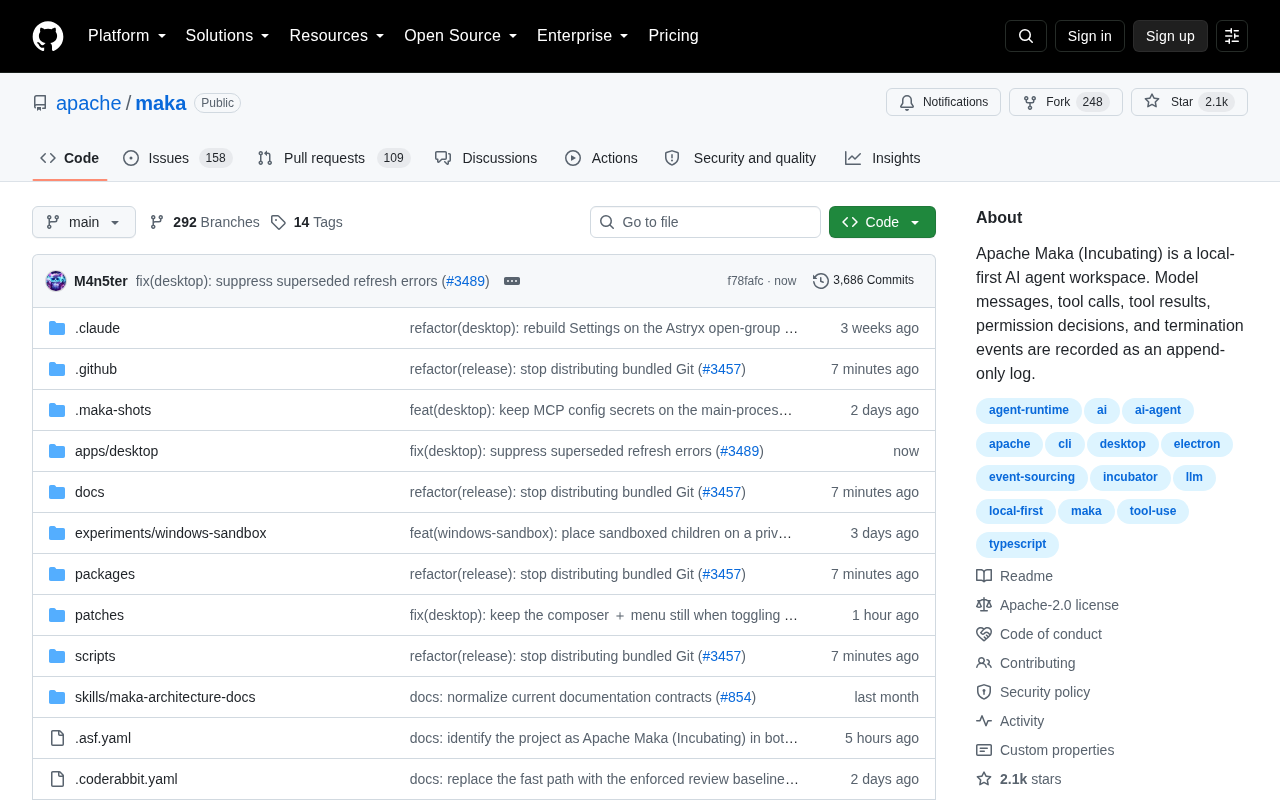
Apache Maka (Incubating) is a TypeScript-based open-source project that provides a local-first AI Agent workspace with full auditability. Its append-only log architecture records every model message, tool call, permission decision, and termination event, ensuring tamper-proof traceability. By keeping all data local, Maka addresses critical privacy and data sovereignty concerns, positioning itself as a trustworthy foundation for production AI Agent deployments.
What Is Apache Maka
Apache Maka (Incubating) is an open-source project that has recently gained rapid traction on GitHub. It positions itself as a local-first AI Agent workspace, built with TypeScript. The project has already garnered approximately 2,137 Stars and 248 Forks, with over 148 new Stars in a single recent day — a clear signal of the community's strong interest in localized AI Agent solutions.
As an incubating project under the Apache Software Foundation, Maka aims to address an increasingly prominent pain point in today's AI Agent ecosystem: the execution process of Agents is often an opaque black box. When a model invokes tools, returns results, or makes permission decisions, these critical events are extremely difficult to fully trace and audit. Maka's core design philosophy is to make all of this recordable, replayable, and trustworthy.
Core Design: Append-Only Log Architecture
Maka's most distinctive architectural choice is recording all critical events during Agent execution as an append-only log.
The append-only log is a classic data structure paradigm in distributed systems, first widely adopted in database WAL (Write-Ahead Logging) and message queue systems like Apache Kafka. Its core principle is that once data is written, it cannot be modified or deleted — new records can only be appended at the end. This design stems from an uncompromising pursuit of data integrity. In financial transaction systems, every transaction must be fully recorded and tamper-proof, which is the foundation of audit compliance. In blockchain technology, the append-only log concept was further developed into the idea of immutable ledgers. Bringing this paradigm into the AI Agent domain means that every decision and every tool call an Agent makes is permanently recorded like a transaction, providing a solid foundation for post-hoc analysis and accountability tracing.
The events Maka records include:
- Model messages: Every output generated by the AI model
- Tool calls: Which external tools the Agent decides to invoke and their parameters
- Tool results: Data returned after tool execution
- Permission decisions: Authorization judgments before the Agent performs sensitive operations
- Termination events: Records of task completion or interruption
Append-only logging means data is only added, never modified — every event is written sequentially, and historical records are tamper-proof. This design delivers several important benefits: complete auditability, behavior reproducibility, and ease of debugging. When an Agent exhibits unexpected behavior, developers can precisely trace back through every decision step, rather than facing an inexplicable result.
Why Append-Only Logs Are Critical for AI Agents
When deploying AI Agents in production environments, the biggest concern is often not insufficient capability, but uncontrollable and unexplainable behavior. An Agent that can access the file system, execute commands, and reach the network — without comprehensive operation logs — makes it nearly impossible to pinpoint responsibility and root causes when something goes wrong.
The observability problem of AI Agents is one of the core bottlenecks in productionizing LLM applications. Unlike traditional software, Agent behavior is non-deterministic — the same input may produce different tool call chains and final outputs. This makes conventional logging and monitoring approaches insufficient. Multiple solutions have emerged in the industry to tackle this problem: LangSmith provides LLM call chain tracing, and the OpenTelemetry community is exploring extending distributed tracing standards to AI workloads. However, most of these solutions rely on cloud services and focus on observation rather than auditing. True auditing requires not just visibility into what happened, but records with legally enforceable immutability — which is the deeper need that Maka's append-only log design aims to address.
Maka's log-first architecture essentially provides Agent systems with reliability guarantees comparable to the "transaction ledger" in financial systems.
Core Advantages of the Local-First Architecture
Maka emphasizes its "local-first" positioning, forming a sharp contrast with the many AI Agent products that rely heavily on cloud services.
Local-First is a software design philosophy systematically proposed by Ink & Switch lab in a seminal 2019 paper. It advocates that user data should first be stored on local devices, applications should function normally without network connectivity, and cloud synchronization should be an optional enhancement rather than a required dependency. This philosophy is a profound reflection on the past decade of the SaaS model — in cloud-first architectures, ownership of user data is effectively transferred to the service provider. When providers cease operations, change terms, or suffer data breaches, users are often left helpless. Local-First achieves both local storage and multi-device collaboration through technologies like CRDTs (Conflict-free Replicated Data Types), preserving data sovereignty without sacrificing collaboration capabilities.
In Maka, local-first specifically means:
- Data sovereignty: Sensitive data such as conversations, tool call records, and file access logs are all stored locally, with no need to upload to third-party servers
- Privacy protection: For scenarios involving enterprise internal data or personal privacy information, local execution significantly reduces the risk of data breaches
- Offline availability: Core workflows do not fully depend on network connectivity
- Control: Users have complete ownership over their Agent workspace
As enterprises and developers become increasingly sensitive about the data security of AI tools, a local-first architecture is becoming a significant differentiator. Maka has seized this trend, offering a viable option for users who cannot or choose not to entrust their data to the cloud.
Technology Choices and Ecosystem Positioning
Maka is developed in TypeScript, a choice that makes it naturally compatible with the modern frontend and Node.js ecosystem, and convenient for developers to build upon and extend.
TypeScript's advantages in AI Agent development go beyond simple type safety. First, Agent systems involve extensive asynchronous operations (model calls, tool execution, network requests), and TypeScript/Node.js's event-driven, non-blocking I/O model is naturally suited for this scenario. Second, an Agent's state machine is often extremely complex — involving multi-turn conversation context, tool call stacks, permission states, and other multidimensional states. TypeScript's Union Types and generics system can catch a large number of state transition errors at compile time. Additionally, the TypeScript ecosystem already has a rich set of AI-related libraries (such as Vercel AI SDK and LangChain.js), making integration straightforward. More importantly, TypeScript spans both frontend and backend, allowing the Agent runtime and visualization interface to share type definitions, reducing type inconsistency issues in full-stack development.
As an Apache incubating project, Maka follows the Apache Software Foundation's open-source governance model. The ASF Incubator is one of the world's most influential open-source project governance entry points. A project entering Apache incubation means it has passed initial technical and community review but has not yet met all the criteria for graduating as a Top-Level Project (TLP). During incubation, the project must establish a diversified community governance structure, complete intellectual property compliance reviews, build an active contributor base, and demonstrate it can operate independently of its original donors. Historically, industry-transforming projects like Hadoop, Spark, and Kafka all went through this incubation process. For enterprise users, an Apache project means the permissive and well-defined Apache License 2.0, community governance free from single-vendor control, and a proven model for long-term sustainability. These are also factors many teams value when making technology choices.
Differentiated Positioning in the AI Agent Landscape
The current AI Agent tool landscape is fiercely competitive, ranging from autonomous Agents like AutoGPT to various Agent frameworks. Maka's differentiation lies primarily in two areas: auditable execution logs and local-first privacy protection. It does not try to be the "most powerful Agent" — instead, it focuses on making Agent operation more transparent, trustworthy, and controllable. This pragmatic positioning directly addresses the most critical trust challenge in the transition from "toy" to "production tool."
Use Cases and Future Outlook
For developers and teams, Maka is currently in its incubation phase, and its features and APIs may still be evolving rapidly. However, the design philosophy it represents — making every step of an Agent into a traceable record — is very likely to become one of the standard paradigms for future AI Agent infrastructure.
If you're building applications that require audit compliance, prioritize data privacy, or need fine-grained debugging of Agent behavior, Maka is worth including in your technical evaluation. As a rapidly growing open-source project, early community involvement is also an excellent opportunity to understand the underlying architectural design of Agent systems.
Summary
Apache Maka answers the core challenge of AI Agent adoption with a clear philosophy: how to make Agents trustworthy. By recording all critical events through append-only logs, adhering to local-first data processing principles, and backed by the Apache Foundation's governance framework, Maka provides a clear path for building auditable, reproducible, privacy-focused AI Agent systems. At this pivotal moment when Agents are moving from proof of concept to production deployment, infrastructure projects like this deserve sustained attention.
Related articles

Chain of Thought Isn't Just for AI: How Humans Can Use CoT to Improve Thinking Quality
Chain of Thought isn't just a prompt trick for large models. Starting from a Hacker News discussion, this article analyzes why CoT works for human thinking too, breaks down actionable ways to transfer it, and highlights the key differences between human CoT and machine CoT.
Cloudflare Teams Up with OpenAI: Closi…
Cloudflare Teams Up with OpenAI: Closing the Loop from Vulnerability Discovery to Defense with AI
Cloudflare uses OpenAI Daybreak to investigate security vulnerabilities and generate reviewable remediation plans, while developers use Codex to boost coding efficiency and quality.

Orca Multi-Agent Orchestration in Practice: A Guide to Parallel Collaboration with Claude and Codex
Orca is Stable AI's free open-source agent workbench supporting 34 agents like Claude Code and Codex in parallel. Learn its Git worktree isolation, multi-model orchestration, and mobile management.